ICMR Report on Antimicrobial Resistance
Relevance: GS3- Awareness in the fields of bio-technology
(Source: DTE, 09/27/2023)
Click here for Daily Current Affairs
Why in the news?
Recently, Indian Council of Medical Research (ICMR) released its annual report(6th) for 2022, which says that various pathogens are rapidly becoming resistant and this could become major issues to human health.
Table of Contents
Key findings of the report
- According to the report, Escherichia coli(e-coli) was identified as the most commonly occurring pathogen.
- Other pathogens are Klebsiella pneumoniae, Pseudomonas aeruginosa, Acinetobacter baumannii and Staphylococcus aureus.
- The analysis showed a trend of declining susceptibility towards many antibiotics medicines.
- These low susceptibilities indicate that E coli has become highly resistant to these antibiotics and it can cause major health concerns.
- E coli and K pneumoniae from out-patients(patients who are visiting hospitals only during treatment) showed higher susceptibility compared to those from in-patients(patients who are admitted in hospitals) for all the tested drugs.
- P aeruginosa and A baumannii identified from ward and ICU were found to be multidrug-resistant.
- Apart from this many other pathogens such as S aureus, E faecalis, E faecium, Salmonella typhi etc are becoming resistant to multiple antibiotic drugs.
What is Antimicrobial resistance?
- Antimicrobials – including antibiotics, antivirals, antifungals and antiparasitics – are medicines used to prevent and treat infections in humans, animals and plants.
- Antimicrobial Resistance (AMR) occurs when bacteria, viruses, fungi and parasites change over time and no longer respond to medicines making infections harder to treat and increasing the risk of disease spread, severe illness and death.
- As a result of drug resistance, antibiotics and other antimicrobial medicines become ineffective and infections become increasingly difficult or impossible to treat.
- Major reasons of AMR are as follows,
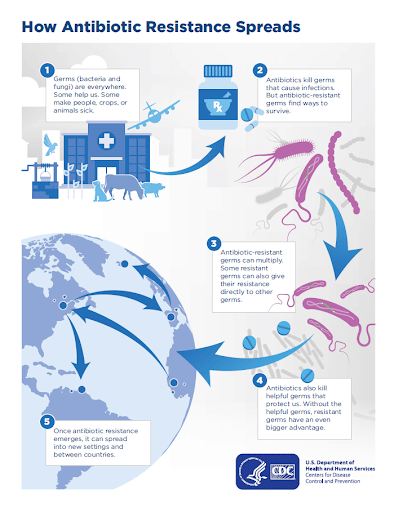
- Antimicrobials are being misused or overused in medicine and in agriculture.
- Contamination in pharmaceutical manufacturing sites is caused by untreated waste that releases large amounts of active antimicrobials into the environment.
- Greater access to over-the-counter antibiotic drugs in developing countries.
- Dumping of inadequately treated effluents from the pharmaceutical industry.
- Antibiotic use in livestock feed at low doses for growth promotion is industrialised countries.
Health impact due to AMR
- As a result of drug resistance, it has become increasingly difficult or impossible to treat some diseases.
- Treating resistant microbes require alternative or higher doses of medication so it becomes more expensive.
- Drug resistance is starting to complicate the fight against HIV and malaria.
- Organ transplantation, chemotherapy & surgeries would be compromised without effective antimicrobials.
- Medical procedures, such as surgery have become riskier.
- It can ultimately lead to the Antibiotic Apocalypse – A future without antibiotics, with bacteria becoming completely resistant to treatment & when common infections & minor injuries could once again kill.
Actions to Fight Antimicrobial Resistance
Global Level
- Third Global High-Level Ministerial Conference on Antimicrobial Resistance (November 24-25, 2022) held in Muscat where over 30 countries adopted the Muscat Ministerial Manifesto on AMR.
- The conference focused on three health targets:
- Reduce the total amount of antimicrobials used in the agri-food system at least by 30-50% by 2030;
- Eliminate use in animals and food production of antimicrobials that are medically important for human health;
- Ensure that by 2030 at least 60% of overall antibiotic consumption in humans is from the WHO Access group of antibiotics.Global Action Plan on Antimicrobial Resistance (GAP) was launched by WHO in 2015.
- World Antimicrobial Awareness Week is celebrated around the globe between 18 to 24 November.
- WHO launched the Global Antimicrobial Resistance and Use Surveillance System (GLASS) in 2015 to continue filling knowledge gaps and to inform strategies at all levels.
At India Level
- AMR Containment National Program was established in 2012. The AMR Surveillance Network has been strengthened as a result of this program by the establishment of labs at State Medical College.
- National AMR Action Plan: It was launched in April 2017 with the goal of involving various stakeholder ministries/departments. It is based on the One Health approach.
- The AMR Surveillance and Research Network (AMRSN) was established in 2013 to generate evidence and track trends and patterns of drug-resistant infections in the country.
- AMR Research and International Collaboration: To strengthen medical research in AMR, the Indian Council of Medical Research (ICMR) has taken initiatives to develop new drugs/medicines through international collaborations.
- In 2017, the ICMR and the Research Council of Norway (RCN) launched a joint call for antimicrobial resistance research.
- The ICMR has a joint Indo-German collaboration for AMR research with the Federal Ministry of Education and Research (BMBF) in Germany.
- Antibiotic Stewardship Program: The ICMR has launched an antibiotic stewardship program (AMSP) as a pilot project across India to combat antibiotic misuse and overuse in hospital wards and intensive care units.
- DCGI has banned the use of 40 Fixed-Dose Combinations (FDCs) that were found inappropriate.
(*Click this link to read prelims specific weekly current affairs articles)
FAQs
Question: What is AMR?
Answer:
Antimicrobial Resistance (AMR) occurs when bacteria, viruses, fungi and parasites change over time and no longer respond to medicines making infections harder to treat and increasing the risk of disease spread, severe illness and death.
MCQs
Question: Consider the following statements:
- Antibiotic resistance is one of the biggest threats to global health, food security, and development today.
- Antibiotic resistance occurs naturally.
- The misuse of antibiotics in humans and animals -i¥•making antibiotics less
Which of the following statements is/are correct?
(a) 1 & 2 Only
(b) 2 and 3 Only
(c) 1 & 3 Only
(d) All of the above
Answer: (d) See the Explanation
- Antibiotics are medicines used to prevent and treat bacterial infections.
- Antibiotic resistance occurs when bacteria change in response to the use of these medicines.
- The bacteria, not humans or animals, become antibiotic-resistant.
- These bacteria may infect humans and animals, and the infections they cause are harder to treat than those caused by non-resistant bacteria.
- Antibiotic resistance is one of the biggest threats to global health, food security, and development today. Hence, statement Y is correct.
- Antibiotic resistance can affect anyone, of any age, in any country.
- Antibiotic resistance occurs naturally, but misuse of antibiotics in humans and animals is accelerating the process.
- A growing list of infections such as pnia, tuberculosis, blood poisoning, gonorrhoea, and foodborne diseases are becoming hard, sometimes impossible, to treat as antibiotics become less effective. Hence, "stafeme” is correct.
- Antibiotic resistance leads to higher medical costs, prolonged hospital stays, and increased mortality.
- The world urgently needs to change the way it prescribes and uses antibiotics.
- Even if new medicines are developed, without behaviour change, antibiotic resistance will remain a major threat.
- Behaviour changes must also include actions to reduce the spread of infections through vaccination, hand washing, practising safer sex, and good food hygiene.
- Antibiotic resistance is rising to dangerously high levels in all parts of the world.
Download the PREPP App and attempt FREE IAS Exam Mock Tests and get complete study material!

Full Test - 04: UPSC CSE Prelims CSAT (Paper-II)
Full Test - 03: UPSC CSE Prelims CSAT (Paper-II)
UPSC CSE Prelims 2026 GS Paper 1 Question Paper (24-May-2026)
UPSC CSE Prelims 2026 CSAT Paper 2 Question Paper (24-May-2026)

17 February 2025 | The Hindu Must Read Articles | Current Affairs

16 February 2026 | The Hindu Must Read Articles | Current Affairs

13 February 2026 | The Hindu Must Read Articles | Current Affairs









Comments