Lancet report on cancer deaths among Indian women
Relevance: GS3- Awareness in the fields of biotechnology
(Source: DTE, 09/27/2023)
Click here for Daily Current Affairs
Why in the news?
- Recently the Lancet Commission report ‘Women, Power and Cancer’ was launched.
- According to the report around 6.9 million cancer deaths among women in India were preventable and 4.03 million were treatable.
Table of Contents
Key outcomes of the report
- According to the report 63% of premature deaths due to cancers in Indian women could have been prevented by reducing risk factors, screening, and diagnosis.
- Also 37% of deaths could have been prevented with timely and optimal treatment.
- As per the report men are at a higher risk of cancers than women but cancer incidence and mortality in women remains high.
- Globally, women account for 48% of the new cancer cases and 44% of cancer deaths.
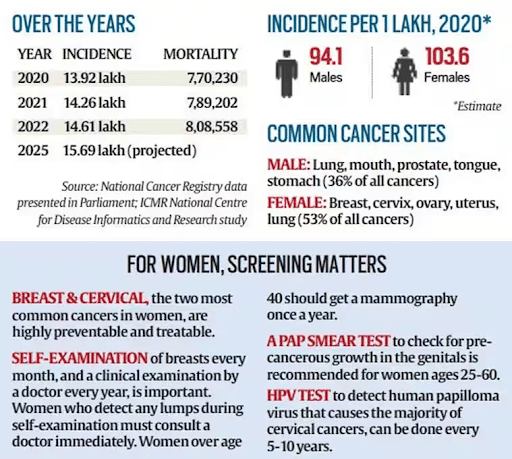
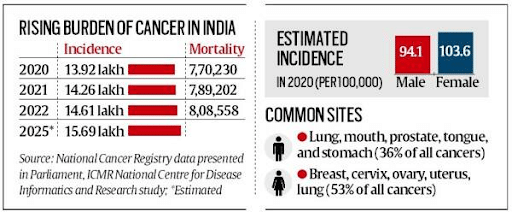
- Some other findings of the report are in the image below.
What are the reason for high cancer mortality rate in female
- Infection is the biggest risk factor for cancer in Indian women, contributing to 23 percent of deaths.
- Tobacco is the second important risk factor for cancer, contributing to six per cent of the cancer deaths, the report said.
- Absence of knowledge and timely care.
- Lack of availability of health care centres near to home lead more females to ignorance of issues.
- In many Indian families financial decisions are still being taken without consideration of women’s opinion, such societal methods hampres the access to healthcare facilities of females.
- Even after being diagnosed by cancer many females do not follow proper treatment due to financial burden.
- The report estimated that the value of unpaid cancer care-giving by women is about only 3.66% of India’s national health expenditure which is too less.
- Lack of awareness about health care and disease.
- Women hesitate to approach male doctors with these problems or even let a female doctor check the genital area, leading to delays in diagnosis and treatment.
- The patients are lost for follow-up, because they have to go to higher centres for biopsy and then treatment.
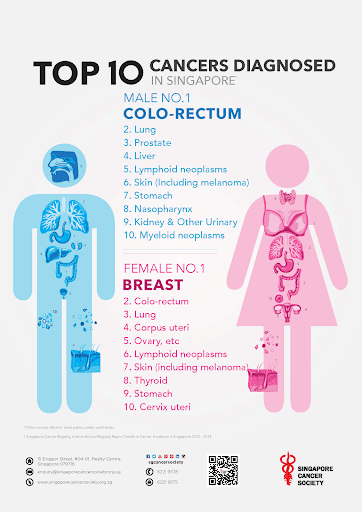
Types of Cancers commonly found in Female
|
Probable solution to decrease cancer mortality in female
Proper and timely screening
- Women who detect any lumps during self-examination must consult a doctor immediately.
- Women between the ages of 25 and 65 years should get a pap smear test to check for pre-cancerous growth on their cervix.
- An HPV test — a test to detect the human papilloma virus that causes a majority of cervical cancers — can also be done every five or ten years.
Government Initiatives
- The screening programme of the government at the level of primary health centres and sub-centres can also help in early diagnosis.
- treatment can be provided by the nursing staff at the primary health centres itself for cervical cancer.
Other Measures
- There is a need to regularly collect data on gender and social demographics for cancer health statistics.
- It is required to develop, strengthen, and enforce laws and policies that reduce exposures to known cancer risks.
- Equitable access to cancer research resources, leadership, and funding opportunities for women is also suggested.
(*Click this link to read prelims specific weekly current affairs articles)
FAQs
Question: What is Cervical Cancer?
Answer:
Cervical cancer is cancer that starts in the cells of the cervix. The cervix is the lower, narrow end of the uterus (womb). The cervix connects the uterus to the vagina (birth canal).
MCQs
Question: Cervical cancer in India is the most frequent cancer among women between of age.
(a) 35-55 years
(b) 25-55 years
(c) 15-44 years
(d) 30-60 years
Answer: (c) See the Explanation
- Cervical Cancer in India ranks aé'the second most frequent cancer among women between 15 and 44 years of age. lt occurs most often in women over age 30.
- Cancer in the cervix area is called cervical cancer.
- All women are at risk for this deadly disease.
- Cervical cancer is a type of cancer that occurs in the cells of the cervix.
- According to the World Health Organisation, (WHO),in 2018,an estimated 570000 women were diagnosed with cervical cancer.
- India's first indigenous qHPV vaccine, CERVAVAC, is developed by the Pune-headquartered Serum Institute of India.
- Serum Institute of India with coordination with the Department of Biotechnology, Government of India.
Download the PREPP App and attempt FREE IAS Exam Mock Tests and get complete study material!
*The article might have information for the previous academic years, please refer the official website of the exam.
How likely are you to recommend Prepp.in to a friend or a colleague?
Not so likely
Highly likely
UPSC CSE (IAS) 2027 Prelims Mock Test Series
Live Quizzes
Quizzes
Live Tests
Full Tests

Full Test - 04: UPSC CSE Prelims CSAT (Paper-II)
120 Minutes
80 Questions
200 Marks
English, Hindi
MEDIUM
Attempted by 19 aspirants in 12 hours
Full Test - 03: UPSC CSE Prelims CSAT (Paper-II)
120 Minutes
80 Questions
200 Marks
English, Hindi
MEDIUM
Attempted by 20 aspirants in 12 hours
Previous Year Papers
UPSC CSE Prelims 2026 GS Paper 1 Question Paper (24-May-2026)
120 Minutes
100 Questions
200 Marks
3,053 Attempted
English, Hindi
MEDIUM
Attempted by 12 aspirants in 12 hours
UPSC CSE Prelims 2026 CSAT Paper 2 Question Paper (24-May-2026)
120 Minutes
80 Questions
200 Marks
3,239 Attempted
English, Hindi
MEDIUM
Attempted by 13 aspirants in 12 hours
Videos

17 February 2025 | The Hindu Must Read Articles | Current Affairs
7,207 Views
•4
•7 months ago

16 February 2026 | The Hindu Must Read Articles | Current Affairs
6,963 Views
•4
•7 months ago

13 February 2026 | The Hindu Must Read Articles | Current Affairs
8,765 Views
•5
•7 months ago

12 February 2026 | The Hindu Must Read Articles | Current Affairs
5,789 Views
•4
•7 months ago






Also Check
IAS Exam Overview
IAS Exam Admit Card
IAS Exam Question Paper 2026
IAS Exam Mains Syllabus
IAS Exam Application Process
IAS Exam Eligibility
IAS Exam Result
IAS Exam Exam Pattern
IAS Exam CSAT Syllabus
IAS Exam Answer Key
IAS Exam Previous Year Paper
IAS Exam Current Affairs
IAS Exam Mains Question Paper
IAS Exam IAS Courses
IAS Exam UPSC Study Notes
IAS Exam Foundation Course 2024
IAS Exam Prelims Question Paper
IAS Exam Exam Center
IAS Exam Foundation Course 2025
IAS Exam Notification 2026
IAS Exam IAS Success Stories
IAS Exam Salary
IAS Exam Cutoff
IAS Exam Mock Tests
IAS Exam News


Comments