A Milestone In Hindu Marriage Reform In India
Relevance: GS2 - Government policies and interventions for development in various sectors and issues arising out of their design and implementation GS1 - Salient features of Indian Society, Diversity of India. Role of women and women’s organization, their problems and their remedies.
(Source: The Hindu, 09/29/2023)
Click here for Daily Current Affairs
Why in the news?
- This article discusses “Suyamarithai Seerthirutha Thirumanam” or Self-respect marriages which did away with the need for priests and rituals to complete wedding ceremonies.
- However, these marriages have faced numerous hurdles including judicial and executive interpretations thereby compromising the rights of those involved.
Table of Contents
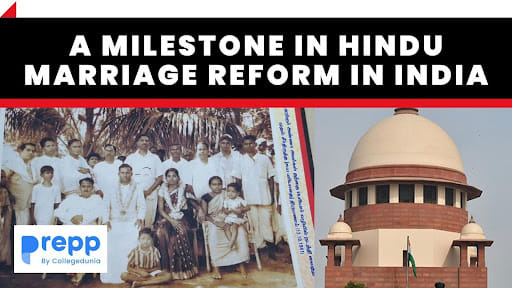
What are Suyamarithai Seerthirutha Thirumanam?
- Suyamarithai Seerthirutha Thirumanam or self-respect marriages refer to marriages that are solemnized in the presence of relatives, friends, or other persons.
- It aimed to simplify marriage ceremonies by eliminating the need for mandatory Brahmin priests, holy fire, and saptapadi (seven steps).
- The parties to the marriage declare each other to be husband or wife in the language of their choice and then garland each other or exchange rings or tie a thali or mangal sutra.
- These marriages have to be registered under the law.
Why was it introduced?
- According to the self-respect movement, traditional Hindu marriages, especially Brahmanical ones, reinforced the ideas of caste hierarchy and patriarchy.
- It advocated for dissoluble contracts between a man and a woman to enter into a conjugal relationship, irrespective of religious practices.
- The movement claimed that civil registration of all marriages and the provision of women's rights to dissolve marriages, remarry, and claim property rights was necessary to tackle existing social evils such as bigamy and sexual discrimination.
Historical background
- Chidambaram Chettiar vs. Deivanai Achi case(1953): The Madras High Court declared non-ritual Hindu marriages associated with the self-respect movement null and void citing the Manusmriti.
- As a result, children born from these unions were considered illegitimate.
- The Court also suggested that the Madras legislature take the initiative to legitimize self-respect marriages and protect the rights of Hindus who opted for these marriages.
- Rajathi v/s K. Selliah case (1958): A district court in Tiruchi denied the appellant Rajathi conjugal rights on the grounds that her marriage was invalid under the Hindu Marriage Act, 1955.
- The court criticized the self-respect movement for the plight of young women in such ‘illegal’ marriages.
- Hindu Code Bill: The report submitted in 1947 by the Hindu Law Committee headed by B.N. Rau only recognized and affirmed the legal status of Virasaiva, Brahmo Samaj, Arya Samaj, and Prarthana Samaj marriages.
- Therefore, the Hindu Marriage Act 1955 granted legal status only to these reformed marriages and not to self-respect marriages.
- Special Marriage Act: In 1954, Parliament passed the Special Marriage Act under which self-respect marriages were to be solemnized.
- This led to the Madras government withdrawing the Hindu Non-Conformist Marriage Registration Bill, 1954 introduced by it in 1953
- Madras Suyamariyathai Marriage Validation Bill: In 1959, the DMK introduced the ‘Madras Suyamariyathai Marriage Validation Bill’ to legalize self-respect marriages with retrospective effect but it was defeated.
- It was introduced again in 1965 to protect women in such marriages by giving them the legal right to seek divorce or redress in the case of bigamy but was not passed.
- In 1967, the Bill was introduced as Section 7 A, The Hindu Marriage (Tamil Nadu Amendment) Act 1967, and received the President’s assent in 1968 but was relevant only to the state of Tamil Nadu.
- It deals with the special provision on “self-respect and secular marriages” and validated all non-ritual Hindu marriages which can be referred to as “suyamariyathai” or “seerthiruththa marriage” or any other name.
What are the challenges faced by the Act?
Judicial interpretation
- The judiciary has interpreted self-respect marriages as illegal and discredited reformed marriages often of an inter-caste nature.
- These judgments were used by opponents to demean women in such marriages as concubines and children as illegitimate.
- Prevalent hegemonic ideals of Hindu marriage practices have been used to counter Dravidian ideas of alternative non-Brahminic marriage practices.
Contemporary challenges
- In 2017, the Union Ministry for Social Justice and Empowerment refused to recognize the Section 7 Act and rejected applications from Tamil Nadu when awarding inter-caste couples.
- It claimed that these marriages were not registered under the Hindu Marriage Act, 1955.
Court rulings
- “S. Nagalingam vs Sivagami” (2001): The Supreme Court recognized the petitioner’s marriage despite the lack of a saptapadi ceremony.
- It ruled that Section 7-A would apply and that self-respect marriages do not require any public solemnization or declaration.
- In August 2023, the Supreme Court of India reiterated the validity of Suyamarithai marriages in Tamil Nadu in a habeas corpus petition filed in the Ilavarasan v. Superintendent of Police case.
- The SC noted that the Madras High Court observations that Suyamarithai marriages were invalid violated the fundamental right to life under Article 21 as it inhibits two adult individuals from exercising their free will.
Self-respect Movement
To know more, click the link. |
(*Click this link to read prelims specific weekly current affairs articles)
FAQs
Question: What is saptapadi?
Answer:
Saptapadi or 'seven steps') is an important rite of Vedic origins in Hindu wedding ceremonies. It consists of the bride and groom taking seven steps jointly before the sacred fire. The Hindu Marriage Act, 1955 treats a marriage as complete once the Saptapadi ceremony is completed.
Question: What is the Special Marriage Act?
Answer:
It was originally enacted in 1872 by the British government to permit inter-faith marriages without either party renouncing their respective religion. It was later re-enacted by Parliament in 1954 with relevant provisions for divorce and other matters.
It applies to people of all faiths across India.
UPSC Mains Practice Question:
|
MCQs
Question: Consider the following pairs:
| Movement | Organization Leader |
|---|---|
|
Mahatma Gandhi |
|
Swami Sahajanad Saraswati |
|
E.V. Ramaswami Naicker |
Which of the pairs given above is/are correctly matched? (UPSC CSE 2019)
(a) 1 only
(b) 1 and 2 only
(c) 2 and 3 only
(d) 1, 2 and 3
Answer: (d) See the Explanation
- The All India Anti-Untouchability League was started by Mahatma Gandhi in 1923 while he was in jail. Hence statement 1 is correct.
- The All India Kisan Sabha was founded in Lucknow in 1936 with Swami Sahjanand Saraswati as the President and N.G. Ranga as the General Secretary. Hence statement 2 is correct.
- In the 1920s The Self-Respect Movement was initiated by E.V. Ramaswamy Naicker in South India. Hence statement 3 is correct.
Therefore, option (d) is the correct answer.
Download the PREPP App and attempt FREE IAS Exam Mock Tests and get complete study material!

Full Test - 04: UPSC CSE Prelims CSAT (Paper-II)
Full Test - 03: UPSC CSE Prelims CSAT (Paper-II)
UPSC CSE Prelims 2026 GS Paper 1 Question Paper (24-May-2026)
UPSC CSE Prelims 2026 CSAT Paper 2 Question Paper (24-May-2026)

17 February 2025 | The Hindu Must Read Articles | Current Affairs

16 February 2026 | The Hindu Must Read Articles | Current Affairs

13 February 2026 | The Hindu Must Read Articles | Current Affairs









Comments