Cement Industries: A major Emitter of GHG
Relevance: GS3- environmental pollution and degradation, environmental impact assessment
(Source: DTE, 09/27/2023)
Click here for Daily Current Affairs
Why in the news?
- According to the International Energy Agency (IEA), Cement manufacturing industries are the second largest industrial emitter of carbon dioxide.
- And as it is the cheapest material to build infrastructure, the emission from these industries is increasing rapidly along with the growth of the infrastructure sector.
- In this article we will take an insight into the - how CO2 is emitted from the cement industry, other sources of CO2 emission, solution to these cement industries, challenges.
Table of Contents
How has this industry become the major source of CO2 emission?
- During the production of cement limestone and clay are heated in a kiln at more than 1,400oC in a process called pyro-processing.
- Due to heating, calcium carbonate (CaCO3), the principal constituent of limestone, breaks up to release CO2. This process is known as calcination.
- The remaining calcium oxide (CaO), also known as quicklime.
- Calcium oxide combines with aluminium silicates present in clay to form calcium silicates.
- Calcium silicates combined with ingredients like gypsum to produce cement.
- Thus, production of 1 kg of cement releases almost an equal amount—up to 0.8 kg—of carbon dioxide (CO2).
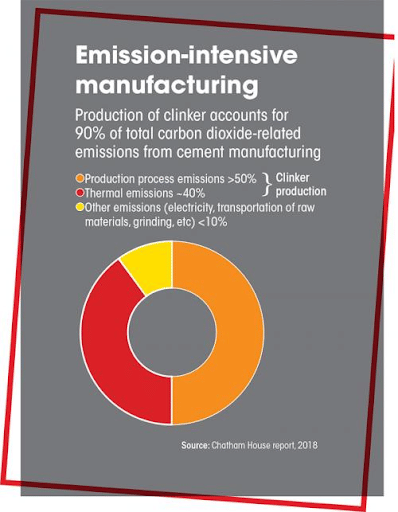
- As shown in the above image, More than 50 per cent of the CO2 emissions from cement-making result from calcination.
- Another part of CO2 is released from burning of coal and other fossil fuels during pyro-processing.
- Apart from this use of electricity to run such heavy processes itself emits the CO2.
Other sources of CO2 Emission
Effects of CO2 EmissionClimate Change
Health
Environment
|
What are the solutions to reduce CO2 emission from the cement industry?
- Decarbonizing the sector by using renewable energy where electricity is used.
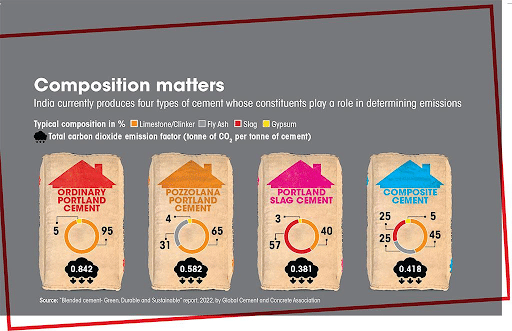
- Use of other types of cement which have low CO2 emission factors.
- Ordinary portal cement: which primarily uses limestone, has the highest emission intensity—a tonne of it produces 0.84 tonne of CO2.
- Pozzolana portland cement: in which a certain portion of fly ash from power plants replaces limestone. Emission intensity is - 0.58 tCO2
- Composite cement: which is a combination of limestone, fly ash, slag and gypsum. Emission intensity is - 0.41 tCO2
- Portland slag cement: in which some amount of slag from steel plants replaces limestone. Emission intensity is - 0.38 tCO2
![cement industry]()
- By putting a carbon tax on coal and allowing for the use of fly ash the use of coal can be curbed.
- Substituting overall fuel requirement with alternative fuels like refuse-derived fuel (RDF), industrial waste and biomass etc.
- A 2018 report by the World Business Council for Sustainable Development, an organisation of more than 200 international companies, says that for a cement plant with a capacity of 1 million tonnes per annum, production of composite cement requires 57 per cent less raw material, 52 per cent less thermal energy and 34 percent less electrical energy when compared with the production of ordinary portland cement.
- As this substitution is done with industrial waste materials like fly ash or slag, it is doubly beneficial.
- IEA says the global cement industry must cut its CO2 emission by 3 percent every year till 2030 to get on track to meet net-zero emissions by 2050.
Challenges in transition from old to new methods in the cements industries:
- High temperature demand during various processes in the industry is easily fulfilled by fossil fuels like coal.
- Substitution of raw material is not that easy due to lack of availability.
- Technological upgradation by changing the process is very much costly.
- Supply chain of the substitutes is not up to the mark to fulfil the demand which is growing rapidly.
- Use of electricity from renewable sources is still costly.
- Lack of proper policies and subsidies on using environment friendly fuels.
(*Click this link to read prelims specific weekly current affairs articles)
FAQs
Question: Why is CO2 referred to as a greenhouse gas?
Answer:
This is due to the greenhouse's glass walls trapping the Sun's heat. On Earth, the greenhouse effect functions in a similar way. Gases in the atmosphere, such as carbon dioxide, trap heat in the same way as a greenhouse's glass roof does. The gases that trap heat are known as greenhouse gases.
MCQs
Which of the following statements is/are correct regarding cement industries in India?
1. Limestone is the major raw material used in production of cement.
2. The production of cement releases greenhouse gas emissions both directly and indirectly.
Select the correct answer using the codes given below:
(a) Only 1
(b) Only 2
(c) Both
(d) None
Answer: (c) See the Explanation
Cement Industries in India
- India is the second largest manufacturer of cement in the world.Andhra Pradesh, Rajasthan, Karnataka, Madhya Pradesh, Gujarat and Kerala are largest cement producing states in India.
- Limestone is the major raw material used in production of cement.
- The production of cement releases greenhouse gas emissions both directly and indirectly: the heating of limestone releases CO2 directly, while the burning of fossil fuels to heat the kiln indirectly results in CO2 emissions.
- Cement plants account for 5 percent of global emissions of carbon dioxide, the main cause of global warming. Cement has no viable recycling potential.
Download the PREPP App and attempt FREE IAS Exam Mock Tests and get complete study material!

Full Test - 04: UPSC CSE Prelims CSAT (Paper-II)
Full Test - 03: UPSC CSE Prelims CSAT (Paper-II)
UPSC CSE Prelims 2026 GS Paper 1 Question Paper (24-May-2026)
UPSC CSE Prelims 2026 CSAT Paper 2 Question Paper (24-May-2026)

17 February 2025 | The Hindu Must Read Articles | Current Affairs

16 February 2026 | The Hindu Must Read Articles | Current Affairs

13 February 2026 | The Hindu Must Read Articles | Current Affairs









Comments