Caring For The Old: On The United Nations Population Fund’s India Ageing Report 2023
Relevance: GS1 - Population and Associated Issues; GS2 - Important International institutions
(Source: The Hindu, 09/29/2023)
Why in the news?
- Recently, the International Institute for Population Sciences (IIPS) and the United Nations Population Fund (UNFPA) released the India Ageing Report 2023 according to which India’s aged population will increase from 14.9 crore in 2022 to 34.7 crore by 2050.
- This means that around 308% of India’s population will be above the age of 60 by 2050, highlighting the need to finetune policy to meet their unique needs.
Table of Contents
What are the findings of the India Ageing Report?
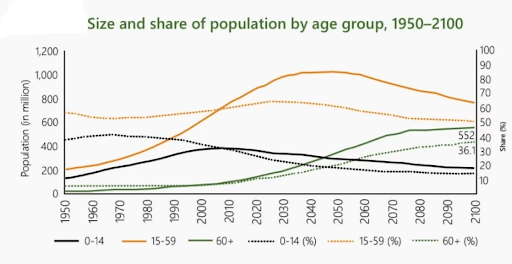
- Rapid growth of the elderly population: India's elderly population is growing at an unprecedented rate and is projected to account for over 20% of the total population by 2050.
- By 2046, the number of elderly individuals will exceed the population of children aged 0 to 15 years.
- The number of elderly in India is projected to exceed 36% by the end of the century.
- The life expectancy of the population has improved due to healthcare and scientific advancements and is expected to increase from 70.19 in 2019 to 81.96 in 2100.
- Decadal growth rate: The decadal growth of the elderly population in India is estimated to be 41%.
- Gender disparities: Women tend to have higher life expectancy at ages 60 and 80 compared to men, with variations across different states and union territories.
- State-level variation: In 2021, the southern states had a higher share of the elderly.
- States with higher fertility rates, such as Bihar and Uttar Pradesh, are also expected to witness an increase in the elderly population share in the same period but still remain below the national average.
- Changing sex ratios: By 2031, there will be 951 men for 1,078 women as compared to the ratio of 930 elderly women per 1,000 men in 1991.
- There has been a steady increase in the sex ratio since 1991 despite a stagnation of the sex ratio in the general population.
- Between 2011 and 2021, the ratio increased in India as a whole and across all regions, barring the Union Territories and western India.
- The sex ratio of the elderly in the northeast and the east has increased but still remained below 1,000 indicating that men still outnumber the women in these regions.
- In central India, the sex ratio improved from 973 in 2011 to 1,053 in 2021 implying that more women survived after 60 than men.
Key concerns highlighted by the Report
- Poverty among the elderly: More than 40% of India's elderly population belongs to the poorest wealth quintile, with nearly 18.7% living without any source of income.
- This ranges from 5% in Punjab to 47% in Chhattisgarh which means they have limited access to healthcare and quality of life.
- Additionally, a high proportion of the elderly in rural populations are economically disadvantaged and face challenges in access to physical and mental health, food and shelter, income security, and social care
- Increasing number of lonely elderly: Women tend to outlive men leading to concern about the rising number of widowed women among the elderly population.
- There has been an increase in the population of the elderly living alone in Kerala and West Bengal as children migrate for better opportunities.
- As the female labor force participation in India is low (24%), they will become more vulnerable in old age due to the lack of economic and social security.
- State-level variation: There are significant variations in life expectancy between states, especially between male and female life expectancy in certain states.
- This has emphasized the need for region-specific policies to address the unique challenges faced by elderly women across the country.
- E.g: In India, a man aged 60 years can live another 18.3 years, while a woman can live 19 years while women can live for up to 4 years more than men in Kerala and Himachal Pradesh.
- Dependency and caregiving: The growth of the elderly population has led to an increase in demand for caregiving services, particularly for elderly women in their later years.
- This underscores the strain on the existing healthcare and social support systems in the country and the need for efficient planning in the caregiving sector.
Recommendations
- Include elderly-related questions in data collection: The report recommends including questions related to older persons in upcoming data collection exercises such as the National Sample Survey, the National Family Health Survey, and the Census of India which will help gather more credible data on elderly issues.
- Increase awareness about schemes: The government should work on increasing awareness about existing schemes and programs designed for older persons. This would ensure that eligible individuals are aware of and can benefit from these initiatives.
- Regulate old age homes: Bring all Old Age Homes under regulatory purview to ensure the well-being and rights of elderly residents are protected.
- Promote in-situ aging: Encourage elderly people to age in their own homes as much as possible. This can be facilitated by creating short-term care facilities like creches or day-care facilities to support families in caring for their elderly members.
- Support elderly self-help groups: Encourage the creation and running of self-help groups among the elderly. These groups can provide social support, share resources, and promote well-being among older persons.
- Promote multigenerational households: Emphasize the importance of having elderly people live in multigenerational households. This arrangement can provide emotional and practical support to older family members.
Government Schemes and for the Elderly
- Maintenance and Welfare of Parents and Senior Citizens Act, 2007: The Senior Citizens Act was enacted in 2007 by the Indian Parliament to effectively provide maintenance and welfare to senior citizens.
- Adult children and heirs are legally obliged to provide for parents, including biological, adoptive, or step-parents, in the form of a monthly allowance.
- Maintenance Tribunals may direct children to pay a maximum of Rs 10,000 per month as maintenance amount to their parents.
- In cases where senior citizens have transferred their movable or immovable property on the condition that the transferee shall provide them basic amenities and take care of their physical needs, the transfer shall be considered done by fraud or coercion or under the influence if the transferee refuses to fulfill their commitments.
- Abandonment of a senior citizen in any place has been made a criminal offense.
- State governments must establish at least one old age home in every district and ensure adequate medical care for senior citizens.
- In 2019, The Maintenance and Welfare of Parents and Senior Citizens (Amendment) Bill, 2019 was introduced in Parliament which removes the maintenance ceiling and permits children and relatives to appeal the rulings of the Tribunal.
- India is a signatory party to the Vienna International Plan of Action on Ageing, 1982, and the United Nations Principles for Older Persons, 1991.
- Under Article 41 of the Indian Constitution (Directive principle of state policy), the state must secure the right to work, education, and public assistance in case of unemployment, old age, sickness, and disablement.
Other Policies
- National Policy on Older Persons (NPOP)
- National Social Assistance Programme (NSAP)
- Pradhan Mantri Vaya Vandana Yojana (PMVVY)
- Integrated Program for Older Persons (IPOP)
- Rashtriya Vayoshree Yojana
- SAMPANN Project
- SACRED Portal for Elderly
- Seniorcare Ageing Growth Engine(SAGE)
Conclusion
- The India Ageing Report 2023 reveals the demographic changes occurring in India and emphasizes the importance of public and private policies to create a supportive environment to address the unique challenges faced by the elderly population.
- Geriatric care must be fine-tuned to the unique healthcare needs of the aging population to ensure that they can live in dignity.
About UNFPA
Functions of UNFPAUNFPA funds assistance, research, and advocacy programs in three major areas:
|
FAQs
Question: What is the International Institute for Population Sciences (IIPS)?
Answer:
- The IIPS is a research and training center for population studies in Mumbai, India, and was established in 1956 by the Government of India, the United Nations, and Sir Dorabji Tata Trust.
- It is a regional center for the Asia and Pacific region and is an autonomous organization of the Union Ministry of Health & Family Welfare.
Question: What is the National Family Health Survey?
Answer: the NFHS or National Family Health Survey is a large-scale, multi-round survey conducted in a representative sample of households throughout India by the International Institute for Population Sciences as a nodal agency on behalf of the Union Ministry of Health and Family Welfare. It aims to provide essential data on health and family welfare and emerging health issues.
UPSC Mains Practice Question:
|
MCQs
Question: Consider the following statements.
- The UNFPA is directly responsible for the collection of primary statistics.
- It prepares the State of World Population Report and the India Aging Report.
Which of the above statements is/are correct?
- Only 1
- Only 2
- Both 1 and 2
- None of the above
Answer: (b) See the Explanation
Explanation:
- The United Nations Population Fund is an international development agency created in 1968 to support the execution of projects and programmes in the area of population and sexual and reproductive health.
- It is headquartered in New York and is not directly responsible for the collection of primary statistics. Hence statement 1 is incorrect.
- It prepares the State of World Population Report and releases the India Aging Report with the International Institute for Population Sciences. Hence statement 2 is correct.
Therefore, option (b) is the correct answer.
Question: Which one of the following States of India has passed legislation (in 1996) making the maintenance of one's parents mandatory? [1997]
- Kerala
- West Bengal
- Maharashtra
- Himachal Pradesh
Answer: (d) See the Explanation
Explanation:
- The Himachal Pradesh Maintenance of Parents and Dependents Bill, 1996 was passed to provide speedy relief to old parents unable to maintain themselves.
- It makes it mandatory for children to maintain their elderly parents
Therefore, option (d) is the correct answer.
Download the PREPP App and attempt FREE IAS Exam Mock Tests and get complete study material!

Full Test - 04: UPSC CSE Prelims CSAT (Paper-II)
Full Test - 03: UPSC CSE Prelims CSAT (Paper-II)
UPSC CSE Prelims 2026 GS Paper 1 Question Paper (24-May-2026)
UPSC CSE Prelims 2026 CSAT Paper 2 Question Paper (24-May-2026)

17 February 2025 | The Hindu Must Read Articles | Current Affairs

16 February 2026 | The Hindu Must Read Articles | Current Affairs

13 February 2026 | The Hindu Must Read Articles | Current Affairs









Comments