Nipah Virus Outbreak: What Are Monoclonal Antibodies?
Relevance: GS2 - Issues relating to the development and management of Social Sector/Services relating to Health; GS3 - Developments in Science and Technology
(Source: The Hindu, 09/29/2023)
Click here for Daily Current Affairs
Why in the news?
- Recently, India reached out to Australia to procure monoclonal antibody doses to combat the Nipah Virus outbreak in Kerala.
- The virus has killed two people so far and has infected at least five others in the Kozhikode district. The current Nipah outbreak is Kerala’s fourth since 2018.
- According to the World Health Organization (WHO), Nipah virus has a mortality rate of 40% to 75%
Table of Contents
What is a Monoclonal Antibody?
- Monoclonal antibodies are laboratory-made proteins that mimic the behaviour of antibodies produced by the immune system to protect against diseases and foreign substances.
- Antibodies are like immune system detectives that lock onto foreign invaders, often disease-causing molecules known as antigens, aiding in their removal from the body. Monoclonal antibodies are precisely engineered to seek out and target specific antigens.
- Niels K. Jerne, Georges J.F. Köhler and César Milstein were awarded the medicine Nobel Prize in 1984 for their work on the “the principle for production of monoclonal antibodies”
- Monoclonal antibodies play a pivotal role in numerous domains:
- Medical Treatment: They are employed for the treatment of a broad spectrum of diseases, spanning cancer, autoimmune disorders, infectious diseases, and various other health conditions.
- Scientific Research: Monoclonal antibodies are pivotal tools in scientific investigations, facilitating the study of biological processes, disease mechanisms, and the development of novel therapies.
- Diagnostic Applications: They are instrumental in the development of diagnostic tests, aiding in the accurate identification and monitoring of various medical conditions.
How do monoclonal antibodies work?
- Monoclonal antibodies are engineered to target specific disease-causing antigens, typically proteins.
- They work by binding to these antigens, preventing them from functioning as they normally would, such as in the case of SARS-CoV-2 spike protein.
- To produce monoclonal antibodies, genes encoding the antibody's binding region are isolated or synthesized and introduced into host cells using recombinant DNA technology.
- These host cells, often bacteria or mammalian cells, act as bioreactors to produce large quantities of monoclonal antibodies. These antibodies are then purified and prepared for use.
- For example, the m102.4 monoclonal antibody binds to the immunodominant receptor-binding glycoprotein of the Nipah virus, potentially neutralizing the virus.
What is m102.4?
- M102.4 is a potent, fully human monoclonal antibody that can neutralize Hendra and Nipah viruses both inside and outside living organisms.
- It has successfully passed phase-one clinical trials, determining the right treatment dose without significant side effects.
- Currently, it is used on a compassionate use basis when no other authorized treatment is available, and patients cannot participate in clinical trials.
- The m102.4 monoclonal antibody was first developed by Dr. Christopher Broder and his team at the Uniformed Services University of the Health Sciences (USU) in Bethesda, Maryland, with help from the U.S. National Institutes of Health (NIH).
Phase one clinical trial
- A phase one clinical trial for the monoclonal antibody m102.4, led by Geoffery Playford at Princess Alexandra Hospital in Brisbane, Australia, was conducted between March 2015 and June 2016. This trial involved 40 volunteers and aimed to assess the safety, tolerability, and immunogenicity of m102.4.
- It was a double-blind study, with participants and researchers unaware of who received m102.4 and who received a placebo.
- The trial divided participants into eight cohorts, with varying doses of m102.4 given to six people in each cohort, while two received placebos.
- The most common treatment-related side effect was a headache, reported by 12 out of 30 participants in the m102.4 group and three in the placebo group.
- No severe effects or deaths occurred, confirming the safety of m102.4.
- The results showed that both single and repeated doses of m102.4 were well-tolerated and did not elicit adverse immune responses.
- The monoclonal antibody m102.4 for Dr. Playford’s clinical trial was manufactured by the Australian Institute for Bioengineering and Nanotechnology (AIBN) at the University of Queensland.
What is the regulatory status?
- The antibody has been available in Queensland State since 2010 to treat Hendra virus infections, and has been shared by USU and the Henry M. Jackson Foundation for the Advancement of Military Medicine, according to the Queensland Health Department.
- As of 2020, it had been administered to 13 people on compassionate grounds in Queensland.
- Hendra virus is on the World Health Organisation’s list of priority diseases requiring urgent attention for research and development of therapeutics, as is the Nipah virus.
- Both Hendra and Nipah viruses are bat-borne Paramyxoviridae, a family of viruses that contain a single-strand RNA of negative-sense genome, similar to the ones that cause diseases like measles, influenza etc., and replicate within infected cells.
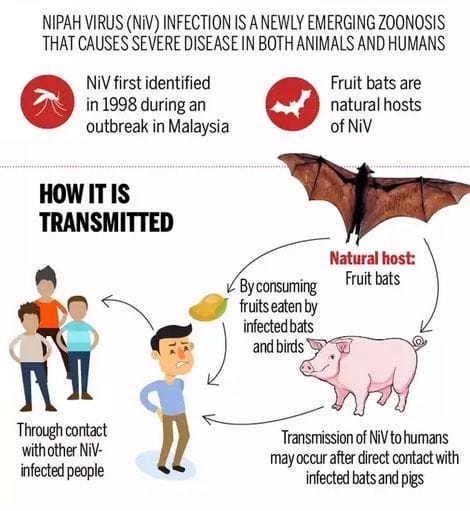
What is Nipah Virus?
Origin and Discovery of Nipah Virus
Transmission of the Virus
|
(*Click this link to read prelims specific weekly current affairs articles)
FAQs
Question: What is Nipah Virus?
Answer: Nipah is a zoonotic disease, which means it is transmitted to humans through infected animals or contaminated food. The virus belongs to a new genus termed Henipavirus (subfamily Paramyxovirinae).
Question: What is a Monoclonal Antibody?
Answer: Monoclonal antibodies are laboratory-made proteins that mimic the behaviour of antibodies produced by the immune system to protect against diseases and foreign substances.
Question: What is m102.4?
Answer: M102.4 is a potent, fully human monoclonal antibody that can neutralize Hendra and Nipah viruses both inside and outside living organisms.
MCQ
Question: Which of the following statements is/are correct? (UPSC 2013)
- Viruses lack enzymes necessary for the generation of energy.
- Viruses can be cultured in any synthetic medium.
- Viruses are transmitted from one organism to another by biological vectors only.
Select the correct answer using the codes given below:
(a) 1 only
(b) 2 and 3 only
(c) 1 and 3 only
(d) 1, 2 and 3
Answer: (a) See the Explanation
Explanation:
- Viruses are obligate intracellular parasites and lack the necessary enzymes for the generation of energy. They depend on the host cell's metabolic machinery to replicate.
- Viruses require living host cells to replicate and cannot be cultured in synthetic media alone. They can only replicate within the host organism.
- Viruses can be transmitted from one organism to another by both biological vectors (such as mosquitoes) and non-biological vectors (such as contaminated surfaces).
Therefore, option (a) is the correct answer.
Download the PREPP App and attempt FREE IAS Exam Mock Tests and get complete study material!

Full Test - 04: UPSC CSE Prelims CSAT (Paper-II)
Full Test - 03: UPSC CSE Prelims CSAT (Paper-II)
UPSC CSE Prelims 2026 GS Paper 1 Question Paper (24-May-2026)
UPSC CSE Prelims 2026 CSAT Paper 2 Question Paper (24-May-2026)

17 February 2025 | The Hindu Must Read Articles | Current Affairs

16 February 2026 | The Hindu Must Read Articles | Current Affairs

13 February 2026 | The Hindu Must Read Articles | Current Affairs









Comments