Simon Commission - Indian Polity Notes
Simon Commission, also known as the Indian Statutory Commission, was a group appointed in November 1927, to study constitutional reform in India. The purpose of the Simon Commission was to report on the workings of the Indian constitution established by the Government of India Act of 1919. Simon Commission was appointed under the supervision of Sir John Simon. The Simon Commission received severe criticism since it did not consist of any Indians. The commission was boycotted by the Indian National Congress and most other Indian political parties. The topic “Simon Commission” is an important part of the UPSC/IAS Exam Modern History of India syllabus which is discussed in this article in detail.
|
Table of Contents |
Historical Background
- The 1919 Act had provided for the appointment of a Commission to review the provisions of the Act in the light of its working and to extend, modify or restrict the degree of responsibility of the government of India.
- The Commission was to be appointed in 1929 as per the provisions of the Act.
- But for various political reasons, it was appointed in November 1927 with Sir John Simon as its Chairman.
Composition
The commission had seven members—four Conservatives, two Labourites, and one Liberal—and was co-chaired by Sir John Simon, a distinguished Liberal lawyer, and Clement Attlee, the future prime minister.
|
" Simon Commission ignited a fervent call for self-determination, shaping the nation's relentless pursuit of independence."
|
Recommendations of the Simon Commission
- The Diarchy system of administration in the provinces is to be abolished, and representative governments will be established in its place.
- It suggested that the separate electorates be kept in place until communal violence and tension subsided.
- It advocated for a Federation-style structure at the center, with a 'Council of Greater India' representing both British India and the princely states' interests.
- It proposed reserving seats for the poorest classes.
- The Governor was given discretionary powers in order to maintain communal hatred, rift, and internet security.
- It was suggested that the number of Legislative Council members be increased.
- The reforms also recommended that the Commission be incorporated into the Government of India Act of 1935.
- The Government of India should have complete control over the High Court so as to have complete control over it.
Simon Commission - Criticism & Facts related to Freedom Struggle
- The Commission's all-European composition was interpreted as an insult to Indian nationalism. As a result, the Indian National Congress decided to boycott the Commission at every stage and in every form.
- All seven members of the Commission were Englishmen who were members of the British Parliament.
- The British government gave the following arguments for excluding the Indians from the Commission:
- They pointed out that since the committee had to report its proceedings to the British Parliament so it was justified to appoint British members only.
- This argument did not hold much weight because there were two Indian Members of the British Parliament—Lord Sinha and Mr. Saklatwala.
- The British government declared that as there was no unanimity of Indian opinion on the problem of Constitutional development it was not possible to appoint an Indian as its member.
- It was pointed out that what they had asked for was a Round Table Conference of Indians and British and not an exclusive English Commission. Through the boycott, Congress tried to revive the Non-Cooperation spirit.
- However, Indian revolutionaries like Bhagat Singh and others opposed the Simon Commission on the ground that only Indians should have a say in framing the constitution of India.
- The Muslim League led by Muhammed Shafi as also Justice Party in Madras, Central Sikh Sangh, and All India Achut Federation did not oppose the Commission.
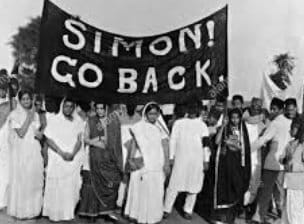
- On February 3, 1928, the Simon Commission arrived in Bombay and was greeted with the slogan "Go back, Simon."
- In Lahore, a procession led by Lala Lajpat Rai was attacked with a lathi, and Lalaji died as a result of his injuries. Jawaharlal Nehru and G.B. Pant were both charged with a lathi in Lucknow.
- A revolutionary group led by Bhagat Singh assassinated Assistant Police Superintendent Saunders to avenge Lala Lajpat Rai's death.
Conclusion
The Simon Commission submitted its report in 1930, recommending some constitutional changes, but it failed to address the demand for complete self-rule. The discontent and protests against the Simon Commission played a significant role in shaping the political climate in India and further fueling the demand for independence.In February 1928, Congress called an All Parties Conference, and on May 19, 1928, Motilal Nehru appointed a Committee to draft Constitution.
| Other Relevant Links | |
|---|---|
| The Company Rule (1773 – 1858) | The Crown Rule (1858-1947) |
| Historical Background of Indian Constitution | Making of The Constitution |
FAQs
Q1: What was the Simon Commission?
Answer: The Simon Commission was a British-appointed group in 1927 tasked with reviewing political conditions in India and suggesting reforms.
Q2: Why did Indians oppose the Simon Commission?
Answer: Indians opposed it because the commission lacked Indian members, which many saw as a disregard for Indian representation.
Q3: What was the impact of the Simon Commission on Indian politics?
Answer: It intensified the freedom movement, prompting the Nehru Report advocating self-governance.
Q4: Who led the protests against the Simon Commission?
Answer: The Indian National Congress and prominent leaders like Lala Lajpat Rai led widespread protests.
Q5: What were the recommendations of the Simon Commission?
Answer: The commission suggested limited constitutional reforms but maintained British control.
MCQs
- In what year was the Simon Commission appointed?
a) 1925
b) 1927
c) 1930
d) 1935
Answer: (b) See the Explanation
- What was the main reason for Indian opposition to the Simon Commission?
a) Lack of Indian representation
b) Delay in its formation
c) Financial burden
d) Inclusion of Indian princes
Answer: (a) See the Explanation
- Who led the protests against the Simon Commission in Punjab?
a) Mahatma Gandhi
b) Jawaharlal Nehru
c) Lala Lajpat Rai
d) Subhas Chandra Bose
Answer: (c) See the Explanation
- Which report was formulated as an alternative to the Simon Commission?
a) Cripps Report
b) Nehru Report
c) Jinnah Report
d) Mountbatten Report
Answer: (b) See the Explanation
- What was a key recommendation of the Simon Commission?
a) Complete independence
b) Provincial autonomy
c) Separate electorates
d) Abolition of the British Raj
Answer: (b) See the Explanation
GS Mains Questions and Model Answers
Q1: Analyze the significance of the Simon Commission in India’s freedom struggle.
Answer: The Simon Commission, formed without any Indian members, highlighted British indifference toward Indian demands for self-governance, sparking nationwide protests. This opposition united diverse political groups and strengthened the call for self-rule. The commission’s exclusion of Indian representation led to the Nehru Report in 1928, advocating dominion status. Thus, the Simon Commission indirectly fueled nationalist sentiment and accelerated demands for independence, making it a catalyst in India’s freedom movement.
Q2: Explain the consequences of the Simon Commission’s formation on Indian political unity.
Answer: The Simon Commission unified various Indian political factions, including moderates and extremists, against the British-imposed reforms. Prominent leaders organized large-scale protests, and the Indian National Congress rejected the commission’s authority. This united opposition led to the drafting of the Nehru Report, marking the first comprehensive demand for self-governance by Indian leaders. The commission’s formation thus strengthened Indian nationalism and set the stage for subsequent independence movements.
Q3: Discuss the importance of the Nehru Report as a response to the Simon Commission.
Answer: The Nehru Report of 1928 was a pioneering Indian effort toward a constitution, proposing dominion status within the British Empire and rejecting separate electorates. Drafted by Motilal Nehru, it served as a counter-proposal to the Simon Commission, illustrating Indian aspirations for self-governance. While the British did not accept it, the report marked a critical step in the Indian demand for autonomy, laying the groundwork for future constitutional developments.
Previous Year Questions on Simon Commission
1. UPSC Civil Services Mains 2019
Question: Evaluate the impact of the Simon Commission on the unity of the Indian nationalist movement.
Answer: The Simon Commission played a pivotal role in uniting Indian political factions across ideologies. Its exclusion of Indian members drew criticism from all sections of society, leading to protests spearheaded by the Indian National Congress. The Nehru Report, formulated in response, brought moderate and radical leaders together in a common demand for dominion status. The commission’s actions highlighted British reluctance to acknowledge Indian political aspirations, reinforcing the demand for self-governance and fostering a sense of unity among Indian nationalists that would endure through subsequent movements toward independence.
2. UPSC Civil Services Mains 2021
Question: "The Simon Commission of 1927 played a paradoxical role in advancing Indian unity and the demand for self-governance. Discuss."
Answer: The Simon Commission, exclusively British, inadvertently unified Indian leaders and the public against British imperialism due to its lack of Indian representation. This exclusion ignited nationwide protests, including non-violent demonstrations led by prominent leaders such as Lala Lajpat Rai, who tragically died from injuries sustained during a protest. The commission’s reception led to the Nehru Report of 1928, India’s first comprehensive constitutional outline, advocating dominion status. This opposition not only strengthened the nationalist movement but also underscored Indian demands for greater self-rule, eventually inspiring broader calls for complete independence.
*email: contactus@prepp.in
Download the PREPP App and attempt FREE IAS Exam Mock Tests and get complete study material!
UPSC IAS : CSAT - Mini Live Test

Live Test : UPSC CSE Prelims CSAT (Paper-II) (Oct 20 - 23)
Full Test - 04: UPSC CSE Prelims CSAT (Paper-II)
Full Test - 03: UPSC CSE Prelims CSAT (Paper-II)
UPSC CSE Prelims 2026 GS Paper 1 Question Paper (24-May-2026)
UPSC CSE Prelims 2026 CSAT Paper 2 Question Paper (24-May-2026)

17 February 2025 | The Hindu Must Read Articles | Current Affairs

16 February 2026 | The Hindu Must Read Articles | Current Affairs

13 February 2026 | The Hindu Must Read Articles | Current Affairs









Comments