Shedding More Light On The Debt Dilemma
Relevance: GS3 - Indian Economy and issues relating to planning, mobilization, of resources, growth, development and employment. Government Budgeting. GS2 - Government policies and interventions for development in various sectors and issues arising out of their design and implementation.
(Source: The Hindu, 07/27/2023)
Click here for Daily Current Affairs
Why in the news?
- Author, M Govinda Rao, a former member of the 14th Finance Commission, has discussed India’s fiscal and public debt, which have risen to a concerning level in this article.
Table of Contents
What are the challenges to the sustainability of India’s debt?
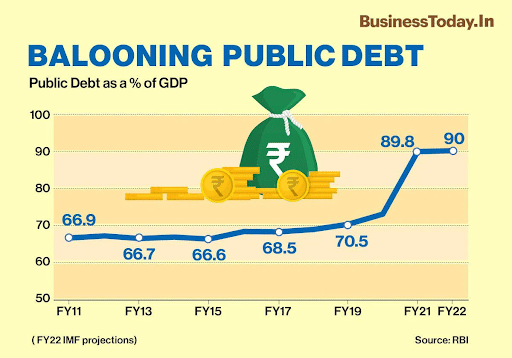
- Public Debt: India’s debt levels were high for an emerging country even before the Covid-19 pandemic.
- India’s fiscal deficit in 2020-21 increased to 13.3% and aggregate public debt increased to 89.6%.
- Although the fiscal deficit and public debt have recovered to 8.9% and 85.7% respectively, projections indicate that they may not return to pre-pandemic levels in the medium term.
- Electoral considerations: State Assembly elections scheduled for 2023 and the General Election in 2024 are likely to worsen the debt situation through increased electoral spending.
- The introduction of targeted interventions to reduce debt may not be possible due to political considerations.
- Financial repression: Overall debt declines when there is no primary deficit if the GDP growth rate is higher than the effective interest rate paid on government bonds.
- Financial repression which includes measures implemented by the government to keep interest rates low can lead to other distortions in the financial market.
- Deficits and debts: Interest payments account for over 5% of GDP and 25% of revenue receipts.
- This results in the crowding out of necessary investments in physical infrastructure, human development, and the green transition.
- It affects the ability of the government to respond to shocks, especially in states like Punjab, Kerala, Rajasthan, and West Bengal where the Debt to GSDP is 48.9%, 33%, 35.4%, and 37.6% respectively.
- Cost of borrowing: As the Indian debt market is mostly captive to banks and insurance companies, there is a scarcity of funds to lend to the manufacturing sector, thereby increasing the cost of borrowing.
- Commercial banks have to maintain 4.5% of their funds as Cash Reserve Ratio (CRR), 18% as Statutory Liquidity Ratio (SLR), while 40% of credit is reserved for priority sectors.
- Debt to GDP ratio: The Finance Commission recommended that the Union government reduce its deficit from 43.6% in 2015-16 to 36.3% and the states were directed to maintain their deficit at 22%.
- It also recommended a debt-to-GDP ratio of 58.2%. However, this is unfeasible in the medium term.
What are some steps to be taken for sustainability?
- Technology: Modern technology can be used to ensure the stabilization of the Goods and Services Tax (GST) regime.
- Improved income tax compliance will boost tax revenues by 1.5-2% in the medium term.
- Policy actions: The state should withdraw from activities that are better handled by the market.
- Focus on cash transfers for redistribution instead of subsidies which cause distortions.
- Hard budget constraints should be imposed by the Union government to enforce Fiscal Responsibility and Budget Management rules on the states and prevent excess borrowing.
Keywords
|
(*Click this link to read prelims specific weekly current affairs articles)
FAQs
Question: What is GST?
Answer:
The Goods and Services Tax or GST is a value-added tax that is levied on goods and services sold for domestic consumption. It is paid by consumers but is paid to the government by businesses. It is a destination-based tax and is applicable on the supply side.
Question: What is Financial Repression?
Answer:
Financial repression is defined as measures implemented by the government to channel funds from the private sector as a form of debt reduction.
Question: What is the FRBM Act, 2003?
Answer:
The Fiscal Responsibility and Budget Management Act, 2003 was enacted to establish a target for governments regarding financial discipline, transparency, and management of public funds. It aims to reduce the fiscal deficit. It is regulated by the Department of Economic Affairs, Ministry of Finance.
MCQs
Question: Consider the following statements:
- Primary deficit is the difference between the total expenditure and income of the government.
- GST is a revenue receipt.
Which of the above statements is/are correct?
(a) Only 1
(b) Only 2
(c) 1 and 2
(d) None
Answer: (b) See the Explanation
- The difference between the total expenditure and total income of the government is the fiscal deficit.
- Fiscal deficit minus the interest payments is the primary deficit. Hence statement 1 is incorrect.
- Receipts that neither create liability nor cause any reduction in the government’s assets are called revenue receipts. GST is a revenue receipt. Hence statement 2 is correct.
Therefore, option (b) is the correct answer.
Download the PREPP App and attempt FREE IAS Exam Mock Tests and get complete study material!

Full Test - 04: UPSC CSE Prelims CSAT (Paper-II)
Full Test - 03: UPSC CSE Prelims CSAT (Paper-II)
UPSC CSE Prelims 2026 GS Paper 1 Question Paper (24-May-2026)
UPSC CSE Prelims 2026 CSAT Paper 2 Question Paper (24-May-2026)

17 February 2025 | The Hindu Must Read Articles | Current Affairs

16 February 2026 | The Hindu Must Read Articles | Current Affairs

13 February 2026 | The Hindu Must Read Articles | Current Affairs









Comments