Parliamentary Privilege Breached, Says Congress Chief Kharge
Relevance: GS2 - Indian Constitution—historical underpinnings, evolution, features, amendments, significant provisions and basic structure; Prelims
(Source: The Hindu, 07/27/23)
Click here for Daily Current Affairs
Why in the news?
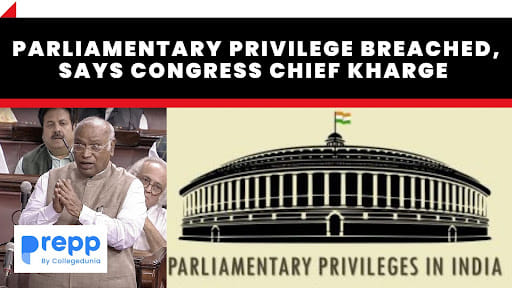
Recently, the Leader of Opposition in the Rajya Sabha, Mallikarjun Kharge said that his mics were turned off while he was speaking in Rajya Sabha and it amounts to a breach of privilege.
Table of Contents
What are Parliamentary Privileges?
- Parliamentary privilege refers to rights and immunities enjoyed by Parliament as an institution and MPs in their individual capacity, without which they cannot discharge their functions as entrusted upon them by the Constitution.
- It is the right which includes the freedom of speech and expression during the proceedings.
- Constitutional privileges:
- Article 105: Pertains to the powers, privileges, etc, of Parliament, its members and committees.
- Article 194: Protects the privileges and powers of the houses of legislature, their members and committees in the states.
What is the Breach of Privilege?
- If an individual or authority disregards or undermines a parliamentary privilege of a member or the House, it is called a ‘breach of privilege’.
- It occurs when one of the MPs' or Parliament's privileges is violated.
- Any activity that 'casts reflections' on MPs, parliament, or its committees, for example, could be considered a breach of privilege.
Process to raise Question of Privilege
- To raise a question of privilege in Parliament, a member of the House must seek permission from the Chairman or Speaker.
- If the presiding officer grants consent, the matter is either decided by the Council or referred to the Committee of Privileges for further examination.
- The Chairman can also independently investigate a breach of privilege and inform the House of the findings.
- Only one question of privilege can be raised during a sitting, and it should pertain to a specific recent incident.
Punishment for Breach of Privilege
- If someone violates the privileges or disrespects the authority of the House, the House itself has the power to decide the punishment.
- If the person is found guilty, they can be reprimanded, warned, or even sent to prison for a limited time during the House session.
- If a member of the House is found guilty, they may face suspension from the House or even expulsion.
- Example: One of the most significant cases of breach of privilege was seen in 1978 against Indira Gandhi.
- She was found guilty of contempt and breach of privilege by the privileges committee of the Lok Sabha, after a notice accused her of harassing government officials.
- She was expelled from Parliament and sent to jail. The resolution was, however, rescinded in 1981.
(*Click this link to read prelims specific weekly current affairs articles)
FAQs
Question: What is parliamentary privilege?
Answer:
Parliamentary privilege is the sum of certain. rights enjoyed by each House collectively and by members of each House individually, without which they could not discharge their functions, and which exceed those possessed by other bodies or individuals.
Question: What is the breach of privilege?
Answer:
A breach of privileges occurs when a person or authority disregards or attacks any of the Members' or the House's rights, immunities, or privileges individually or collectively.
Question: What is Article 105?
Answer:
Article 105 of the Constitution defines the powers, privileges, and other responsibilities of the Houses of Parliament, as well as the members and committees. There must be freedom of expression in Parliament, subject to the requirements of this constitution and the rules and standing orders governing Parliamentary procedure.
UPSC Mains Practice Question:
|
MCQ
Question: Which Article of the Constitution establishes the rights, privileges, and immunities of either House of the Indian Parliament?
(a) Article 76
(b) Article 80
(c) Article 105
(d) Article 106
Answer: (c) See the Explanation
Article 105 of the Constitution establishes the rights, privileges, and immunities of either House of the Indian Parliament as well as its members and committees respectively.
Therefore, option (c) is the correct answer.
Download the PREPP App and attempt FREE IAS Exam Mock Tests and get complete study material!

Full Test - 04: UPSC CSE Prelims CSAT (Paper-II)
Full Test - 03: UPSC CSE Prelims CSAT (Paper-II)
UPSC CSE Prelims 2026 GS Paper 1 Question Paper (24-May-2026)
UPSC CSE Prelims 2026 CSAT Paper 2 Question Paper (24-May-2026)

17 February 2025 | The Hindu Must Read Articles | Current Affairs

16 February 2026 | The Hindu Must Read Articles | Current Affairs

13 February 2026 | The Hindu Must Read Articles | Current Affairs









Comments