Moving Away From The ‘Take-Make-Dispose’ Model
Relevance: GS2 - Bilateral, regional and global groupings and agreements involving India and/or affecting India’s interests; GS3 - Environment Pollution and Degradation; Growth and Development
(Source: The Hindu, 07/26/2023)
Click here for Daily Current Affairs
Why in the news?
- Recently, India's G-20 presidency has brought to the forefront the importance of Resource Efficiency and Circular Economy.
- These strategies aim to reduce dependence on natural resources, minimize waste, and encourage sustainable design practices.
Table of Contents
Shift in the ‘Take-Make-Dispose’ Model’
- Resource efficiency and circular economy have emerged as pivotal drivers of sustainable development, drawing widespread attention on a global scale.
- Recognizing the urgency to shift from the traditional linear 'take-make-dispose' model to the more sustainable 'reduce-reuse-recycle' model, India has prioritized ‘Resource Efficiency and Circular Economy’ as one of the three core themes in the G-20 forum.
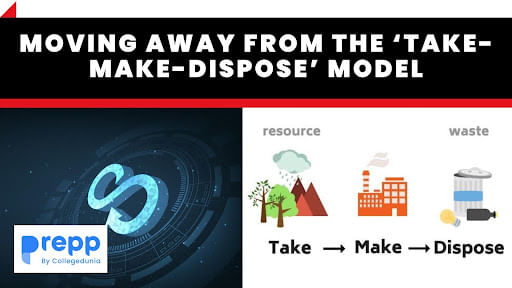
- Currently, our society often follows a "take-make-dispose" model, where we extract resources, use them to make products, and then throw them away after use.
- This approach is not sustainable in the long run and can lead to environmental problems.
India’s four priority areas for the Circular Economy
- Circularity in the steel sector: The steel industry's significant role in infrastructure development and its contribution to greenhouse gas emissions, transitioning to a circular steel sector is crucial. Hence, it is essential to find ways to recycle and reuse steel so that we can reduce the need for new raw materials and limit the environmental impact of steel production.
- Extended Producer Responsibility (EPR): It is a critical mechanism that plays a key role in driving circular economy principles across the entire value chain. EPR is about making manufacturers more responsible for the entire life cycle of their products.
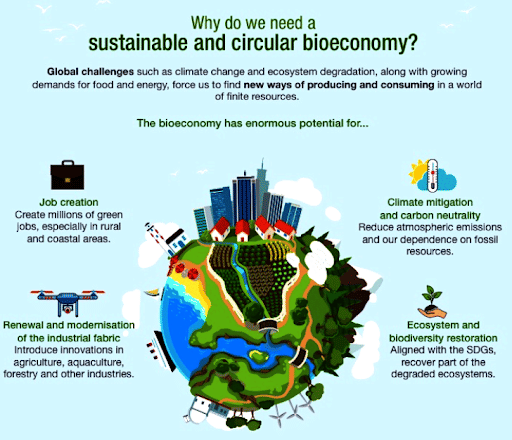
- Circular bioeconomy: This involves promoting the use of renewable resources, like plant-based materials, and finding ways to recycle and reuse bio-based products. India's efforts in adopting biofuels have been significant.
- Industry-led resource efficiency and Circular economy coalition: This coalition aims to enhance technological collaboration, build advanced capabilities, mobilize de-risked finance, and promote private sector engagement.
India Efforts towards Circular Bioeconomy
- The Pradhan Mantri JI-VAN Yojana supports second-generation ethanol projects, producing bioethanol from waste feedstock such as crop residues and municipal solid waste.
- The GOBAR Dhan scheme converts organic waste into compost, biogas, and biofuels to promote sustainable agriculture and reduce pollution.
- The Sustainable Alternative Towards Affordable Transportation (SATAT) Scheme promotes Compressed BioGas (CBG) as an alternative green transportation fuel, aiding the bioenergy sector and infrastructure development.
What is a Circular Economy?
|
Conclusion
- India's G-20 presidency is prioritizing resource efficiency and circular economy to promote global sustainability.
- The focus is on the 'reduce-reuse-recycle' model and circular economy strategies to lessen environmental impact and disconnect resource use from economic growth.
- By sharing knowledge, best practices, and innovative technologies, G-20 member countries can collaboratively tackle global challenges and work towards a sustainable and resilient future.
FAQs
Question: What is a Circular Economy?
Answer:
A Circular Economy refers to an approach where products are intentionally designed with durability and the ability to be reused and recycled. In this system, items are continuously repurposed, remanufactured, or recycled, ensuring that very little goes to waste, and instead, most materials are transformed into raw materials or utilized for energy generation.
Question: What is the take-make-dispose model?
Answer:
The take-make-dispose model, often known as the linear economy model, refers to the conventional and linear approach to resource consumption and output in our economic system. In this model, resources are extracted from nature, processed into products, used by consumers, and then discarded as waste after their use.
Question: What is the reduce-reuse-recycle approach?
Answer:
The reduce-reuse-recycle approach is a sustainable strategy to minimize environmental impact by promoting responsible resource use, extending product lifespan, and maximizing material recovery for new products.
MCQ
Question: As per the Solid Waste Management Rules, 2016 in India, which one of the following statements is correct? (UPSC 2019)
(a) Waste generator has to segregate waste into five categories.
(b) The Rules are applicable to notified urban local bodies, notified towns and all industrial townships only.
(c) The Rules provide for exact and elaborate criteria for the identification of sites for landfills and waste processing facilities.
(d) It is mandatory on the part of the waste generator that the waste generated in one district cannot be moved to another district.
Answer: (c) See the Explanation
- Under the Solid Waste Management Rules 2016, waste processing facilities will have to be set up by all local bodies having 1 million or more population within two years.
- Rules provide for exact and elaborate criteria for identification of landfill sites and waste processing facilities.
- It is not mandatory for the waste generator that the waste generated in one district cannot be moved to another district.
Therefore, option (c) is the correct answer.
Download the PREPP App and attempt FREE IAS Exam Mock Tests and get complete study material!

Full Test - 04: UPSC CSE Prelims CSAT (Paper-II)
Full Test - 03: UPSC CSE Prelims CSAT (Paper-II)
UPSC CSE Prelims 2026 GS Paper 1 Question Paper (24-May-2026)
UPSC CSE Prelims 2026 CSAT Paper 2 Question Paper (24-May-2026)

17 February 2025 | The Hindu Must Read Articles | Current Affairs

16 February 2026 | The Hindu Must Read Articles | Current Affairs

13 February 2026 | The Hindu Must Read Articles | Current Affairs









Comments