530 Districts Reported As Free Of Manual Scavenging: Centre
Relevance: GS 2 - Government policies and interventions for development in various sectors and issues arising out of their design and implementation; Mechanisms, laws, institutions, and Bodies are constituted for the protection and betterment of these vulnerable sections; Issues relating to the development and management of Social Sector/Services relating to Health.
(Source: The Hindu, 07/27/23)
Click here for Daily Current Affairs
Why in the news?
- Recently, according to data submitted by the Social Justice Ministry in Rajya Sabha approximately 530 districts across the country have declared themselves free of manual scavenging.
- However, States and Union Territories like Jammu and Kashmir, Manipur, Telangana, Andhra Pradesh, West Bengal, and Jharkhand still have a significant number of districts yet to declare themselves as manual scavenging free.
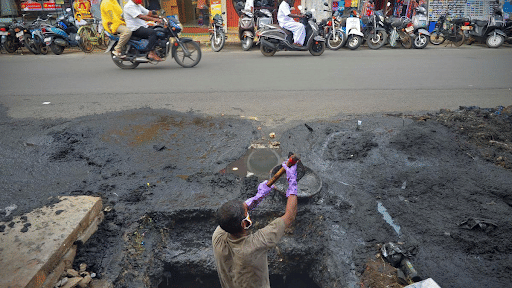
- Manual scavenging is the practice of removing human excreta by hand from sewers or septic tanks. India banned the practice under the Prohibition of Employment as Manual Scavengers and their Rehabilitation Act, 2013 (PEMSR).
- The Act bans the use of any individual for manually cleaning, carrying, disposing of or otherwise handling in any manner, human excreta till its disposal.
Table of Contents
What is the status of Manual Scavenging in India?
- 330 people had died while being engaged in cleaning sewers and septic tanks according to recent reports.
- Out of this compensation had been paid out to families of 306, and FIRs had been registered in 249 cases either under the Prohibition of Manual Scavenging Act or under the SC/ST Act.
- The status of manual scavenging varies significantly across different states and union territories in India.
- In States such as Bihar, Rajasthan, Tamil Nadu, and a few others, 100% of districts have declared themselves free of manual scavenging. However, in several other States and Union Territories, only around 15% to 20% of the districts have made such declarations.
Concerns
- Health: Manual contact with excreta exposes them to various diseases, skin infections, rotting of fingers and limbs, tuberculosis, hepatitis, leptospirosis , helicobacter and nausea.
- Lack of validation of complaints: Since 2016, the Ministry has reviewed over 6,000 complaints submitted through the Swachata mobile app, but none of them have been verified or validated as evidence of ongoing manual scavenging.
- Lower conviction rates: A Parliamentary Panel, earlier this year highlighted lower conviction rates. Only one conviction out of 616 FIRs was registered against contractors for unsafe sewer cleaning.
- According to data released by the government in Parliament in 2021, more than 90% of the manual scavengers identified in surveys conducted until 2018 belonged to Scheduled Caste communities.
- The surveys revealed that the highest number of manual scavengers were identified in Uttar Pradesh, Maharashtra, Uttarakhand, Assam, Karnataka, and Rajasthan.
Reason behind the prevalence of manual scavenging in India
- Lack of enforcement: The lack of enforcement of the Act and the exploitation of unskilled laborers. For example, civic bodies charge anywhere between Rs 20,000 and Rs 30,000 to clean septic tanks. However, unskilled labourers are much cheaper to hire and contractors illegally employ them at a daily wage of Rs 300-500.
- Untouchability and social isolation: Manual scavenging has always been linked to the practice of untouchability.
- The India Exclusion Report for 2019-20, released by the Centre for Equity Studies states how caste oppression is institutionalized in India’s sanitation jobs.
- Lack of investment in mechanized cleaning of sewage.
- Lack of integration between Swach bharat abhiyaan and manual scavenging
What needs to be done?
- The compensations should be revisited with stricter enforcement of on-ground implementation.
- Reassessment of the Contractual employment system: The unregularised contractual hiring makes sanitation workers more vulnerable and makes the eradication of manual scavenging more difficult.
- Investment in technology and safety: Use of robots to clean septic tanks without human intervention.
- For example, HomoSep', invented by scientists at the Indian Institute of Technology in Madras can be promoted in large scale.
Steps taken by the government to address Manual scavenging
- Article 17 of the Constitution of India abolishes the continuation of such practices.
- Identification: The Ministry has implemented a system where each district is required to declare itself as either free of manual scavenging or identify locations with insanitary latrines and associated manual scavengers.
- The district sanitation committees analyze relevant data pertaining to the presence of insanitary latrines within their jurisdiction.
- National Action for Mechanized Sanitation Ecosystem” (NAMASTE) Scheme: Ministry of Social Justice and Empowerment has formulated the NAMASTE scheme particularly to stop the deaths of Sewers and Septic Tank Workers (SSWs) and to promote mechanization of cleaning operations with a vision to reduce hazardous cleaning and ensure the safety of sanitation workers.
- Rehabilitation: Around 58,000 identified manual scavengers were being rehabilitated under government schemes for compensations, capital subsidies, and other benefits.
Conclusion
- It is the collective responsibility of our government and of the society in which we reside. Therefore, it is the duty of the executive to implement the laws passed by the legislature effectively and also the duty of society to abide by these laws.
(*Click this link to read prelims specific weekly current affairs articles)
FAQs
Question: What is Untouchability?
Answer:
Untouchability is the discrimination of individuals on the basis of caste and the nature of jobs done by them. Untouchability has been deeply rooted in the Indian caste system for ages. Abolition of untouchability (Article 17) was incorporated in Part III - Fundamental Rights of the Indian constitution. It places limitations on and outlaws the practice of untouchability, ensuring that it is removed in all forms. The practice of untouchability will not be accepted by a democratic government and will be punished.
Question: What is Manual Scavenging?
Answer:
Manual scavenging is the practice of removing human excreta by hand from sewers or septic tanks.
Question: What is Prohibition of Employment as Manual Scavengers and their Rehabilitation Act, 2013 (PEMSR)?
Answer:
India banned the practice under the Prohibition of Employment as Manual Scavengers and their Rehabilitation Act, 2013 (PEMSR). The Act bans the use of any individual for manually cleaning, carrying, disposing of or otherwise handling in any manner, human excreta till its disposal.
MCQ
Question: Which one of the following Articles of the Indian constitution prohibits untouchability?
(a) Article 17
(b) Article 19
(c) Article 20
(d) Article 14
Answer: (a) See the Explanation
- Untouchability is the discrimination of individuals on the basis of caste and the nature of jobs done by them. Untouchability has been deeply rooted in the Indian caste system for ages. Abolition of untouchability (Article 17) was incorporated in Part III - Fundamental Rights of the Indian constitution. It places limitations on and outlaws the practice of untouchability, ensuring that it is removed in all forms. The practice of untouchability will not be accepted by a democratic government and will be punished.
- Therefore, option (a) is the correct answer.
Download the PREPP App and attempt FREE IAS Exam Mock Tests and get complete study material!

Full Test - 04: UPSC CSE Prelims CSAT (Paper-II)
Full Test - 03: UPSC CSE Prelims CSAT (Paper-II)
UPSC CSE Prelims 2026 GS Paper 1 Question Paper (24-May-2026)
UPSC CSE Prelims 2026 CSAT Paper 2 Question Paper (24-May-2026)

17 February 2025 | The Hindu Must Read Articles | Current Affairs

16 February 2026 | The Hindu Must Read Articles | Current Affairs

13 February 2026 | The Hindu Must Read Articles | Current Affairs









Comments