Resilient, But Just: On The IMF’s Economic Outlook And Lopsided Growth
Relevance: GS2 - Effect of Policies & Politics of Countries on India's Interests; GS3 - Important International Institutions; Growth and Development
(Source: The Hindu, 07/27/2023)
Click here for Daily Current Affairs
Why in the news?
- Recently, IMF's World Economic Outlook highlighted the global economy's resilience but warned of challenges ahead. U.S. and China face slowdown, Eurozone reeling from gas prices surge, and inflation concerns persist.
- Urgent need for global debt resolution initiative stressed, emphasizing equitable growth for interconnected economies.
- The IMF projected a growth rate of 6.1% for India in 2023, which is a 0.2 percentage point upward revision compared with the April projection.
Table of Contents
What are the Challenges?
- Slowdown in Key Economies: In the U.S., pandemic-era cash transfers to support families during COVID-19 and the cost-of-living crisis have nearly depleted, causing economic headwinds.
- In China, the post-reopening rebound has faltered due to a contraction in the real estate sector, weakening consumption, and slumping overseas demand for exports.
- Euro Area Struggles: The euro area, another vital pillar of the global economy, faces challenges induced by the Ukraine-war triggered surge in gas prices.
- Vulnerabilities in Low-Income Economies: The termination of Russia's Black Sea grain deal has raised concerns over a potential 15% increase in grain prices, affecting low-income economies in Africa.
- Restrictive monetary policy: Inflation may stay elevated or rise further due to potential shocks like escalating Ukraine war and extreme weather events, leading to tighter monetary policies.
- Resolution of the US debt ceiling standoff and previous actions to stabilize the US and Swiss banking sectors have reduced immediate risks of financial turmoil.
- However, downside risks to the global economy persist, including the potential for financial sector turbulence to resume as central banks tightened their policies.
About International Monetary Fund (IMF)
|
Recommendations
- IMF's Advice on High and Persistent Core Inflation: Central banks advised to communicate commitment to lowering inflation by maintaining a tight approach with real interest rates above the neutral level until underlying inflation decreases.
- Fiscal Challenges Amidst Higher Government Debt : Many countries face fiscal deficits and increased government debt post-pandemic. Credible plans for fiscal consolidation crucial to regain budget flexibility and effective debt management in the medium term.
- Warning Against Uneven Growth and Vulnerable Nations: Global economic leaders urged to consider the risks of uneven growth, potentially dragging down the interconnected global economy if vulnerable nations are left behind.
(*Click this link to read prelims specific weekly current affairs articles)
FAQs
Question: What is the International Monetary Fund (IMF)?
Answer:
The IMF is a 190-member organisation with participation on the IMF's executive board proportional to its financial importance, such that the most powerful nations in the global economy have the most voting power.
Question: What is the Black Sea Grain Initiative?
Answer:
The Black Sea Grain Initiative is a grain export deal signed separately by Ukraine and Russia. The deal brokered by the United Nations and Turkey was signed in Istanbul, Turkey in July 2022.
MCQ
Question: "Rapid Financing Instrument" and "Rapid Credit Facility" are related to the provisions of lending by which one of the following? (UPSC 2022)
(a) Asian Development Bank
(b) International Monetary Fund
(c) United Nations Environment Programme Finance Initiative
(d) World Bank
Answer: (b) See the Explanation
- The Rapid Financing Instrument (RFI) offers swift financial aid to all member countries facing urgent balance of payments needs, replacing the IMF's emergency assistance policy. It ensures flexibility to cater to diverse member states' requirements.
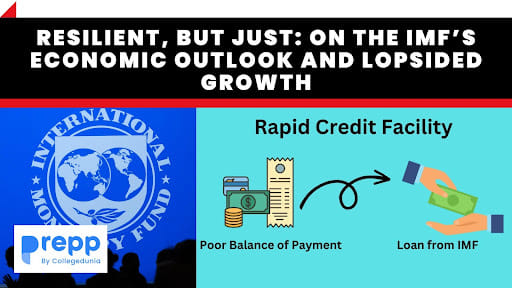
- The Rapid Credit Facility (RCF) provides immediate balance of payments support to low-income countries (LICs) without ex-post conditions, making it suitable for LICs during crises without requiring a full economic program. These reforms aim to enhance the IMF's financial support to better suit the unique needs of member states.
Therefore, option (b) is the correct answer.
Download the PREPP App and attempt FREE IAS Exam Mock Tests and get complete study material!

Full Test - 04: UPSC CSE Prelims CSAT (Paper-II)
Full Test - 03: UPSC CSE Prelims CSAT (Paper-II)
UPSC CSE Prelims 2026 GS Paper 1 Question Paper (24-May-2026)
UPSC CSE Prelims 2026 CSAT Paper 2 Question Paper (24-May-2026)

17 February 2025 | The Hindu Must Read Articles | Current Affairs

16 February 2026 | The Hindu Must Read Articles | Current Affairs

13 February 2026 | The Hindu Must Read Articles | Current Affairs









Comments