Bill Proposes Birth Record Digitisation
Relevance: GS 2 - Government policies and interventions for development in various sectors and issues arising out of their design and implementation; e-governance- applications, models, successes, limitations, and potential; citizens charters, transparency & accountability and institutional and other measures.
(Source: The Hindu, 07/27/23)
Click here for Daily Current Affairs
Why in the news?
- Recently, the government tabled the Registration of Births and Deaths (Amendment) Bill, 2023 in the Lok Sabha. The Bill amends 14 sections of the Registration of Births and Deaths Act, of 1969.
Table of Contents
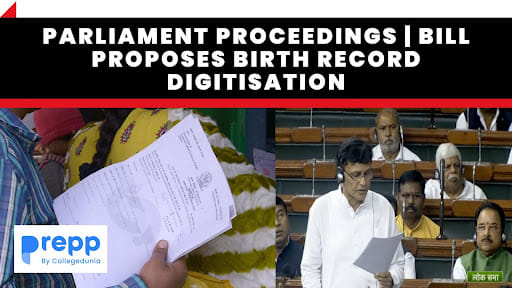
Provisions of Registration of Births and Deaths (RBD) Amendment Bill, 2023
- The bill is aimed at simplifying the procedures for registering births and deaths and the new rules apply to those born after the Bill becomes an Act of law.
- Civil Registration System (CRS) portal: It makes it obligatory for States to register births and deaths on the Centre’s Civil Registration System (CRS) portal, and to share the data with the Registrar General of India which functions under the Union Home Ministry.
- Use of Adhaar: The bill proposes collecting the Aadhaar numbers of parents and informants during birth registration if available. Currently, either parent can choose to voluntarily provide their Aadhaar number for their newborn's birth certificate generated through the CRS.
- Medical institutions: It will make it mandatory for all medical institutions to provide a certificate as to the cause of death to the Registrar and a copy of the same to the nearest relative.
- Registration: It proposes to facilitate the registration process for various categories of children like adopted, orphan, abandoned, surrendered, surrogate child, and child to a single parent or unwed mother.
- Special Sub-Registrars: The bill proposes the appointment of Special "Sub-Registrars" to expedite the registration of deaths and certificate issuance during disasters or epidemics.
Significance
- Efficiency and Transparency: The bill aims to establish national and state-level databases for registered births and deaths, leading to increased efficiency and transparency in public services and social benefits delivery.
- The centralized register will also update other important databases, such as the National Population Register (NPR), ration cards, and property registration records.
- The National Population Register (NPR) is a Register containing details of persons usually residing in a village or rural area or town or ward or demarcated area within a ward in a town or urban area. The objective of the NPR is to create a comprehensive database of usual residents in the country.
- Birth certificates as proof: The new legislation establishes the birth certificate as the definitive proof of a person's date and place of birth for individuals born on or after the commencement of the Registration of Births and Deaths (Amendment) Act, 2023.
- This certificate will be crucial for various processes, including school admissions, driver's license issuance, voter list preparation, marriage registration, government employment, Public Sector Undertakings, passport issuance, Aadhaar number issuance, and other official purposes.
- Digital registration: The Bill aims to introduce provisions for digital registration and electronic delivery of birth and death certificates, benefiting the general public.
(*Click this link to read prelims specific weekly current affairs articles)
FAQs
Question: What is the National Population Register (NPR)?
Answer:
The National Population Register (NPR) is a Register containing details of persons usually residing in a village or rural area or town or ward or demarcated area within a ward in a town or urban area. The objective of the NPR is to create a comprehensive database of usual residents in the country.
Question: What is the National Register of Citizens (NRC)?
Answer:
The NRC is an official record of those who are legal Indian citizens. It includes demographic information about all those individuals who qualify as citizens of India as per the Citizenship Act, 1955. The register was first prepared after the 1951 Census of India and since then it has not been updated until recently.So far, such a database has only been maintained for the state of Assam.
Question: Who is responsible for the decadal census in India?
Answer:
The responsibility of conducting the decadal census rests with the Office of the Registrar General and Census Commissioner of India, Ministry of Home Affairs, Government of India.
MCQ
Question: Which authority/ministry is responsible for the decadal census in India?
(a) Ministry of Statistics and Programme Implementation
(b) Ministry of Home Affairs
(c) Ministry of Social Justice and Empowerment
(d) Ministry of Women and Child Development
Answer: (d) See the Explanation
- The responsibility of conducting the decadal census rests with the Office of the Registrar General and Census Commissioner of India, Ministry of Home Affairs, Government of India.
- Therefore, option (d) is the correct answer.
Download the PREPP App and attempt FREE IAS Exam Mock Tests and get complete study material!

Full Test - 04: UPSC CSE Prelims CSAT (Paper-II)
Full Test - 03: UPSC CSE Prelims CSAT (Paper-II)
UPSC CSE Prelims 2026 GS Paper 1 Question Paper (24-May-2026)
UPSC CSE Prelims 2026 CSAT Paper 2 Question Paper (24-May-2026)

17 February 2025 | The Hindu Must Read Articles | Current Affairs

16 February 2026 | The Hindu Must Read Articles | Current Affairs

13 February 2026 | The Hindu Must Read Articles | Current Affairs









Comments