Punjab - Rise of Autonomous States during Mughal Empire - Modern India History Notes
Punjab was established as an autonomous Sikh empire in 1801 by Ranjit singh (1780–1839). The weakness of Mughal authority and Afghans invasions created confusion and anarchy in Punjab. Sikhs organised themselves into 12 misls or confederacies at this point.Ranjit Singh fully exploited the political situation to his advantage and by following the policy of “blood and iron”carved out a kingdom which included the provinces of Multan, Kashmir, and Peshawar.This article will explain to you about Punjab - Rise of Autonomous States during the Mughal Empire which will be helpful in Modern Indian History preparation for the UPSC Civil service exam.
|
Table of Contents |
Punjab - During the Mughals
- In 1675, Aurangzeb detained and murdered Tegh Bahadur, the ninth Sikh guru, for refusing to accept Islam.
- According to Sikh history, the guru fought for the rights of Kashmiri Pandits and shielded them from Mughal oppression.
- Guru Tegh Bahadur's successor, Guru Gobind Singh, publicly defied Aurangzeb. In defense of their faith and rights, he turned the Sikhs into a violent group.
- In 1708, Banda Bahadur, who eventually became the Sikhs' leader, was defeated and slain.
- Following the invasions of Nadir Shah and Ahmad Shah Abdali, the Sikhs asserted their dominance once more.
- They organised themselves into 12 misls or confederacies at this point, each controlling a different region of the country. Ranjit Singh is credited with founding a powerful Punjab monarchy.
- He was the son of Mahan Singh, the Sukarchakia Misl's chief.
- The territory spanning from the Sutlej to the Jhelum was brought under control by Ranjit Singh.
- In 1799, he captured Lahore, and in 1802, he seized Amritsar. Ranjit Singh recognized the British claim to the Cis-Sutlej provinces in the Treaty of Amritsar with the British.
- Ranjit Singh showed himself to be a capable administrator. With the support of Europeans, he substantially modernized his army.
- However, the English compelled him to sign the Tripartite Treaty with Shah Shuja and the English Company in 1838, in which he promised to allow British forces to travel through Punjab in order to install Shah Shuja on the throne of Kabul.
- In 1839, Ranjit Singh passed away. His successors were unable to hold the state together, and the British eventually took control.
Rise of Autonomous State - Punjab
- The failure of Mughal soldiers at Samana and Sadhaura kicked off Banda Singh Bahadur's revolt, which ended in the destruction of Sirhind.
- During the revolt, Banda Singh Bahadur made a point of destroying Mughal cities that had been harsh to Sikhs, and Wazir Khan was killed in retaliation for the deaths of Guru Gobind Singh's sons, Baba Zorawar Singh and Baba Fateh Singh, following the Sikh victory at Sirhind.
- He governed the region between the Sutlej and the Yamuna rivers, built a capital at Lohgarh in the Himalayas, and coined the titles Guru Nanak and Guru Gobind Singh.
- Following the Second Anglo-Maratha War of 1803–1805, when the Marathas lost this area to the British, Maharaj Visesa Sarang Khokhar of the Khokhar dynasty of the Maratha Empire.
- Some of the states in the region pledged their allegiance to British General Gerard Lake throughout the conflict.
- An 1809 agreement with Ranjit Singh, ruler of the Sikh Empire west of the Sutlej, brought these nations under formal British protection at the end of the Second Anglo-Maratha War.
- Ranjit Singh's death in the summer of 1839 threw the country into instability, and the succession disputes and brutal infighting among the court factions damaged the kingdom.
- By 1845, the British had sent 32,000 troops along the Sutlej border to protect its northernmost assets from Punjab succession disputes.
- The First Anglo-Sikh War began in late 1845 when British and Sikh forces clashed in Firozpur.
- In 1849, the East India Company seized Punjab. It was administratively autonomous, but being officially part of the Bengal Presidency.
- Punjab remained largely quiet throughout the Indian Rebellion of 1857.
- Punjab fell under direct British authority in 1858, according to Queen Victoria's Queen's Proclamation.
Sikh Empire
- Maharaja Ranjit Singh built the Sikh Empire (1801–1849) on the foundations of the Khalsa, bringing together a collection of independent Sikh misls to form a cohesive political power.
- From the Khyber Pass in the west to Kashmir in the north, Sindh in the south, and Tibet in the east, the empire stretched.
- The Punjab area was the empire's major geographical imprint.
- Internal strife and political incompetence severely damaged the empire after Ranjit Singh's death in 1839.
- The British Empire took advantage of this chance to start the Anglo-Sikh Wars.
- The army's demise was precipitated by a series of betrayals of Sikhs by major army officers.
- The army's main generals were Maharaja Gulab Singh and Raja Dhian Singh.
Maharaja Ranjit Singh
- Maharaja Ranjit Singh, also known as Sher-e-Punjab or "Lion of Punjab," was the first Maharaja of the Sikh Empire, which ruled the northwest Indian subcontinent in the early half of the nineteenth century.
- In Pakistani Punjab, he was born in 1780 to the chief of the Sukerchakia misl of the Sikh confederacies.
- In 1801 he unified 12 Sikh misls and conquered several small kingdoms to become the "Maharaja of Punjab."
- Many Afghan attacks were successfully repelled, and areas including Lahore, Peshawar, and Multan were conquered.
- Lahore became his capital when he captured it in 1799.
- His Sikh Empire stretched north of the Sutlej River and south of the Himalayas in the northwest. Lahore, Multan, Srinagar (Kashmir), Attock, Peshawar, Rawalpindi, Jammu, Sialkot, Amritsar, and Kangra were all part of his empire.
- With the British, he maintained cordial relations.
- Ranjit Singh's rule was marked by reforms, modernization, infrastructure investment, and overall prosperity. Sikhs, Hindus, Muslims, and Europeans served in his Khalsa army and government.
- His legacy encompasses a time of Sikh cultural and artistic rebirth, including the reconstruction of the Harmandir Sahib in Amritsar as well as other significant gurudwaras, including Takht Sri Patna Sahib in Bihar and Hazur Sahib Nanded in Maharashtra.
- In his army, he had troops of many ethnicities and beliefs.
- His army was very efficient in terms of fighting, logistics, and infrastructure.
- There was a fight for succession among his numerous relatives after his death in 1839. This signified the beginning of the Empire's demise.
- Ranjit Singh died in June 1839, and the process of his empire's downfall began with his death.
- Kharak Singh, his eldest legitimate son, succeeded him.
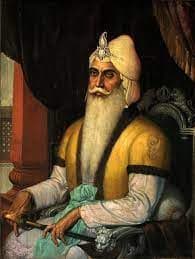
Maharaja Ranjith singh
Conclusion
The rise of Punjab as an independent state under Ranjit Singh symbolises a transformative era marked by military prowess and cultural resurgence. Ranjit Singh's visionary leadership fostered stability, economic prosperity, and unity among diverse communities. While the Sikh Empire's decline after his death led to British annexation in 1849, Ranjit Singh's legacy endures as a testament to Punjab's rich history and its ability to assert sovereignty.
FAQs
Question: What led to the rise of autonomous states in Punjab during the Mughal Empire?
Answer: The rise of autonomous states in Punjab during the Mughal Empire was largely a result of the weakening of Mughal central authority in the late 17th and early 18th centuries. Factors like weak leadership, administrative inefficiencies, and the decline of the Mughal military power contributed to regional powers asserting their independence. Key events, such as the invasions by the Afghans (notably by Nadir Shah and Ahmad Shah Durrani), also accelerated the process of decentralization, leading to the emergence of semi-autonomous and independent states like the Sikh Confederacy, the Kingdom of Punjab, and various other regional powers.
Question: Who were the major powers that emerged in Punjab during this period?
Answer: The major powers that emerged in Punjab during the decline of Mughal rule were:
- Sikh Confederacy: Led by leaders such as Banda Singh Bahadur and later by Maharaja Ranjit Singh, the Sikh community became a dominant force in the region, eventually establishing the Sikh Empire in the early 19th century.
- Afghan Influence: The Durrani Empire, led by Ahmad Shah Durrani, also played a crucial role in shaping the political landscape of Punjab.
- Rajput States: Some Rajput chiefs in the region, like those in Jammu, also began to assert greater control over their territories.
Question: How did the Sikh community play a role in the rise of autonomous states in Punjab?
Answer: The Sikh community played a pivotal role in the rise of autonomous states in Punjab, particularly through the leadership of figures like Guru Gobind Singh and Banda Singh Bahadur. The creation of the Khalsa and subsequent military campaigns against Mughal authorities helped consolidate Sikh power. Under Maharaja Ranjit Singh, the Sikh Confederacy united various Sikh misls (confederacies) and established an independent state in Punjab that lasted until the British annexation in 1849.
Question: What impact did the weakening of the Mughal Empire have on Punjab?
Answer: The weakening of the Mughal Empire in the 18th century directly impacted Punjab by creating a power vacuum. The Mughal Empire’s inability to maintain centralized control allowed regional powers, including the Sikhs and Afghan rulers, to assert their autonomy. This period of decentralization saw the emergence of local kingships, military leaders, and warrior communities, especially the Sikh Confederacy, which eventually transformed the political and social dynamics of the region.
Question: How did the arrival of the British affect the autonomous states in Punjab?
Answer: The arrival of the British in Punjab had a profound effect on the region’s autonomous states. Following the decline of Mughal power, the British capitalized on the fragmented political structure in Punjab. The Sikh Empire, under Maharaja Ranjit Singh, was one of the last independent states before the British annexed Punjab in 1849. Despite early cooperation, the British ultimately overthrew the Sikh Empire, integrating Punjab into British India, which led to the dissolution of regional autonomy in the area.
MCQs
1. Which leader is associated with the rise of the Sikh Confederacy in Punjab during the decline of the Mughal Empire?
A) Guru Nanak
B) Banda Singh Bahadur
C) Maharaja Ranjit Singh
D) Ahmad Shah Durrani
Answer: (B) See the Explanation
Explanation: Banda Singh Bahadur is credited with leading the Sikh military campaigns and playing a key role in the formation of the Sikh Confederacy, which laid the groundwork for the Sikh Empire.
2. What was the role of Ahmad Shah Durrani in Punjab during the 18th century?
A) He helped unify Punjab under Sikh rule
B) He was a major influence in the weakening of Mughal power
C) He established the Sikh Empire
D) He founded the Mughal Empire in India
Answer: (B) See the Explanation
Explanation: Ahmad Shah Durrani, also known as Ahmad Shah Abdali, was a key figure in the decline of Mughal authority in Punjab. His invasions in the 18th century further weakened the Mughal hold on the region, leading to the rise of local autonomous states.
3. Who was the founder of the Sikh Empire?
A) Banda Singh Bahadur
B) Guru Gobind Singh
C) Maharaja Ranjit Singh
D) Guru Nanak
Answer: (C) See the Explanation
Explanation: Maharaja Ranjit Singh was the founder of the Sikh Empire. He unified the various Sikh misls and established a strong centralized state in Punjab.
4. What was the significance of the weakening of the Mughal Empire for Punjab?
A) It led to the unification of Punjab under one ruler
B) It created a power vacuum that allowed regional powers to emerge
C) It caused a religious revolution in Punjab
D) It resulted in the immediate annexation of Punjab by the British
Answer: (B) See the Explanation
Explanation: The weakening of the Mughal Empire created a power vacuum in Punjab, which led to the rise of regional powers, including the Sikh Confederacy and Afghan forces, thus disrupting the centralized control.
5. What was the ultimate outcome for Punjab after the decline of the Mughal Empire?
A) Establishment of a fully independent Punjab
B) Integration into British India after the defeat of the Sikh Empire
C) Return to Mughal rule
D) Complete autonomy for the Sikh Confederacy
Answer: (B) See the Explanation
Explanation: After the decline of the Mughal Empire, Punjab saw the rise of regional powers such as the Sikh Confederacy, but it was eventually annexed by the British in 1849 after the fall of the Sikh Empire.
GS Mains Questions and Model Answers
Q1: Discuss the impact of the decline of the Mughal Empire on the political landscape of Punjab in the 18th century.
Answer: The decline of the Mughal Empire in the 18th century created a political vacuum in Punjab, allowing regional powers and autonomous states to flourish. The weakening Mughal central authority failed to prevent invasions and control local rulers, leading to the rise of the Sikh Confederacy, which gained power under leaders like Banda Singh Bahadur and Maharaja Ranjit Singh. Simultaneously, Afghan rulers like Ahmad Shah Durrani capitalized on the decline and invaded Punjab, contributing to the disintegration of Mughal rule. This period also saw the rise of other small kingdoms and regional powers that exercised greater autonomy from Delhi. The fragmentation and weakening of the Mughal Empire thus had a profound impact on Punjab, ultimately leading to the formation of the Sikh Empire and its subsequent annexation by the British.
Q2: Evaluate the role of the Sikh Confederacy in the political developments in Punjab during the Mughal Empire's decline.
Answer: The Sikh Confederacy played a pivotal role in the political developments of Punjab during the Mughal Empire's decline. The Sikhs, under leaders such as Guru Gobind Singh, formed military units known as misls, which allowed them to resist Mughal control. After the weakening of the Mughal authority, the Sikh Confederacy unified these groups and laid the groundwork for the establishment of the Sikh Empire under Maharaja Ranjit Singh. The rise of the Sikhs as a political and military force not only helped shape Punjab’s autonomy but also played a significant role in resisting foreign invasions, including the invasions by Ahmad Shah Durrani. The Sikh Confederacy became a crucial force in the region, and its leaders became symbols of resistance against both Mughal and Afghan powers.
Q3: Analyze the impact of the British annexation of Punjab on its political and social structure.
Answer: The British annexation of Punjab in 1849 brought about significant changes to its political and social structure. Following the defeat of the Sikh Empire, which had been the dominant power in the region, the British incorporated Punjab into British India. This led to the dismantling of the Sikh Confederacy and the establishment of British administrative control. Socially, the annexation resulted in the introduction of British land revenue systems, which altered traditional landholding patterns. The British also introduced modern education, which had long-term effects on Punjab’s socio-cultural fabric. The political independence that Punjab enjoyed under the Sikh Empire was lost, and the region’s role as a center of resistance to British rule was suppressed, changing the dynamics of regional power in India.
Previous Year Questions on Punjab and the Mughal Empire
1. UPSC CSE Prelims 2021:
Question: The decline of the Mughal Empire in the 18th century led to which of the following developments in Punjab?
A) Establishment of the Mughal Empire’s control
B) Rise of regional autonomous states like the Sikh Confederacy
C) Full integration of Punjab into British India
D) Dominance of Rajput rulers in the region
Answer: (B)
Explanation: The decline of Mughal authority in the 18th century led to the rise of regional powers such as the Sikh Confederacy, which became a dominant political and military force in Punjab.
2. UPSC CSE Mains 2019 (GS Paper 1):
Question: Discuss the role of the Sikh Confederacy in the political developments of Punjab during the decline of the Mughal Empire.
Answer: The Sikh Confederacy played a key role in the political developments of Punjab by unifying various Sikh misls and resisting Mughal and Afghan control. The Sikhs, under leaders like Banda Singh Bahadur and later Maharaja Ranjit Singh, were instrumental in establishing an independent and powerful state in Punjab. Their military prowess and organizational skills allowed them to resist foreign invasions and maintain regional autonomy, ultimately forming the Sikh Empire before British annexation in 1849.
Download the PREPP App and attempt FREE IAS Exam Mock Tests and get complete study material!

Full Test - 04: UPSC CSE Prelims CSAT (Paper-II)
Full Test - 03: UPSC CSE Prelims CSAT (Paper-II)
UPSC CSE Prelims 2026 GS Paper 1 Question Paper (24-May-2026)
UPSC CSE Prelims 2026 CSAT Paper 2 Question Paper (24-May-2026)

17 February 2025 | The Hindu Must Read Articles | Current Affairs

16 February 2026 | The Hindu Must Read Articles | Current Affairs

13 February 2026 | The Hindu Must Read Articles | Current Affairs









Comments