Advent of Europeans in India - Modern India History Notes
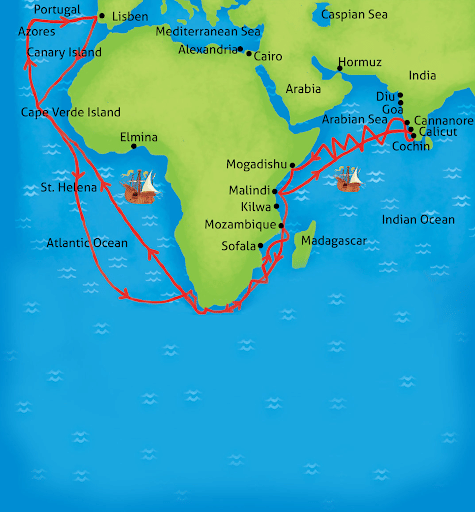
Advent of Europeans to India can be traced back to the arrival of Vasco da Gama of Portugal who discovered a new sea route from Europe to India in 1498. After this discovery, many trading companies from all across Europe such as French East India Company, British East India company etc. came to India and established their centers. Trade increased after Vasco da Gama discovered a new sea route via the Cape of Good Hope in 1498, and many trading companies came to India to establish trading centres. Gradually all European superpowers of the contemporary period the Dutch, English, French, Danish etc established their trade relations with the Indian Subcontinent. This article will explain to you about the Advent of Europeans in India which will be helpful in Modern Indian History preparation for the UPSC Civil service exam.
|
Table of Contents |


The Advent of Europeans in India
Portuguese in India
- The Portuguese were the first Europeans to arrive in India, and they were also the last to go.
- The spirit of the Renaissance, with its demand for adventure, captivated Europe in the fifteenth century.
- During this time, Europe achieved significant breakthroughs in shipbuilding and navigation. As a result, there was a strong desire throughout Europe for daring maritime trips to the East's unexplored reaches.
| Other Relevant Links | |
|---|---|
| Portuguese Settlements in India | Vasco Da Gama |
| Francisco De Almeida | French Conquests in India |
Discovery of a Sea Route to India
- Historians have noted that discovering an ocean route to India had become an obsession for Prince Henry of Portugal, known as the 'Navigator,' as well as a method to sidestep the Muslim dominance of the eastern Mediterranean and all the roads connecting India and Europe.
- The kings of Portugal and Spain split the non-Christian world between them in 1497, under the Treaty of Tordesillas (1494), by an imaginary line in the Atlantic, about 1,300 miles west of the Cape Verde Islands.
- Portugal could claim and occupy anything to the east of the line, while Spain could claim everything to the west, according to the pact.
- As a result, the scene was set for Portuguese intrusions into the Indian Ocean seas.
- Bartholomew Dias, a Portuguese navigator, crossed the Cape of Good Hope in Africa in 1487 and travelled along the eastern coast, believing that the long-sought maritime path to India had been discovered.
- However, an expedition of Portuguese ships set off for India barely 10 years later (in 1497) and reached India in little less than 11 months, in May 1498.
Portuguese Administration in India
- The Bahmani Kingdom in the Deccan was dissolving into smaller kingdoms.
- None of the powers possessed a fleet worth mentioning, and they had no plans to improve their maritime capabilities.
- The Chinese emperor's imperial proclamation limited the nautical reach of Chinese ships in the Far East.
- The Arab merchants and shipowners who had previously controlled the Indian Ocean commerce had nothing on the Portuguese in terms of organisation and cohesiveness.
- The Portuguese also had guns mounted on their ships.
- The viceroy, who ruled for three years, was in charge of the administration, together with his secretary and, subsequently, a council.
- Next insignificance was the Vedor da Fazenda, who was in charge of income, cargoes, and fleet dispatch.

Portuguese, their Policies and Works in India
Significance of the Portuguese
- Most historians agree that the arrival of the Portuguese not only signalled the beginning of the European age, but also the growth of maritime power,this was the first time a foreign power had arrived in India by water.
- The Portuguese ships were armed with cannons, and this was the first step toward securing a monopoly over commerce by threatening or using force.
- The Portuguese used body armour, matchlock soldiers, and weapons landed from ships in the Malabar in the 16th century, demonstrating military innovation.
- On the other hand, a significant military contribution made by the Portuguese onshore was the system of drilling infantry groups, modelled after the Spanish model, which was implemented in the 1630s as a response to Dutch pressure.
- The Portuguese were masters of advanced maritime tactics.
- Their multi-decked ships were strongly built, as they were meant to fight out Atlantic gales rather than run before the regular monsoons, allowing them to carry heavy armament.
- Goa became a centre of complex filigree work, fretted foliage work, and metalwork incorporating diamonds as the silversmith and goldsmith arts thrived.
- Church Architecture: Numerous Churches were built under Portuguese rule.They are famous for their woodwork,sculptures,painted ceilings.They popularised the use of lime mortar and laterite stone in construction activities.
- They introduced several new crops in India including potatoes,tomatoes and chillies.
Vasco Da Gama
- The landing of three ships under Vasco Da Gama to Calicut in May 1498, headed by a Gujarati pilot called Abdul Majid, had a significant impact on Indian history.
- Vasco da Gama spent three months in India.
- When he returned to Portugal, he brought valuable cargo with him and profitably sold the goods on the European market.
- In 1501 Vasco da Gama returned to India.
- When Vasco Da Gama mixed economic avarice with violent hatred and inflicted revenge on Arab commerce everywhere he could, the Zamorin refused to exclude Arab merchants in favour of the Portuguese.
- At Cannanore, Vasco da Gama established a trading factory.
- Calicut, Cannanore, and Cochin gradually became key Portuguese commerce centres.
Portuguese Consolidation in India - Background
- Prince Henry's Vision: Prince Henry of Portugal, often referred to as the 'Navigator,' harbored an intense obsession with discovering a direct ocean route to India. This vision was not only driven by the allure of reaching the Indian subcontinent but also by the strategic objective of circumventing the dominant Muslim control over the eastern Mediterranean and the established land routes connecting India and Europe.
- Treaty of Tordesillas (1494): In 1497, the kings of Portugal and Spain formalized their aspirations under the Treaty of Tordesillas. This historic agreement delineated a boundary in the Atlantic, approximately 1,300 miles west of the Cape Verde Islands. The pact granted Portugal the right to claim and occupy territories east of this imaginary line, while Spain could assert control over everything to the west, setting the stage for Portuguese maritime expansion.
- Portuguese Exploration Unleashed: Bartholomew Dias, a Portuguese navigator, played a pivotal role in this quest by successfully crossing the treacherous Cape of Good Hope in Africa in 1487. His voyage along the eastern coast fueled the belief that the elusive maritime path to India had been discovered. Just a decade later, in 1497, Portuguese ships set sail for India and accomplished the journey in under 11 months, reaching their destination in May 1498.
- Deccan's Transforming Landscape: During this period, the Bahmani Kingdom in the Deccan was undergoing a dissolution, giving rise to smaller, fragmented kingdoms. None of these emerging powers possessed a formidable fleet, and there were no concerted efforts to enhance their maritime capabilities.
- Maritime Power Dynamics: The Indian Ocean geopolitical landscape witnessed a shift as the Arab merchants and shipowners, who once controlled commerce in the region, found themselves outmatched by the Portuguese in terms of organization and cohesiveness. Additionally, the Chinese emperor's imperial proclamation constrained the nautical reach of Chinese ships in the Far East.
- Technological Edge of the Portuguese: A significant factor contributing to Portuguese success was their military prowess, evident in the mounting of guns on their ships. This technological advantage, coupled with organizational superiority, propelled the Portuguese into a dominant position in the Indian Ocean trade routes.
- Administration in Portuguese India: The Portuguese presence in India was not only marked by maritime conquests but also by effective administration. A viceroy, serving a three-year term, held authority over the region, aided by a secretary and, later on, a council, shaping the governance and control of the Portuguese in the Indian subcontinent.
Francisco De Almeida
- In 1505, King Ferdinand I of Portugal appointed a three-year governor in India and provided him with adequate troops to preserve Portuguese interests.
- The newly appointed governor, Francisco De Almeida, was tasked with consolidating the Portuguese position in India and destroying Muslim trade by conquering Aden, Ormuz, and Malacca.
- The Portuguese squadron was beaten by the combined Egyptian and Gujarat navies in a naval action off the coast of Diu in 1507, and Almeida's son was killed here. The next year, Almeida avenged his defeat by annihilating both navies.
- Almeida's dream was to make Portuguese the master of the Indian Ocean.his policy was known as Blue Water Policy (Cartaz system).
-
Blue water policy: Almeida opposed establishing a territorial empire in India, preferring maintaining supremacy at sea and limiting their activities to purely commercial transactions. This is known as the Blue Water Policy.This maritime dominance allowed the Portuguese to establish trade monopoly especially in the lucrative spice trade.
Alfonso de Albuquerque
- Albuquerque, who took over as Portuguese governor of India when Almeida died, was the true creator of Portuguese authority in the East, a mission he finished before his death.
- By creating strongholds commanding all of the sea's exits, he ensured Portugal's strategic control over the Indian Ocean.
- Under Albuquerque's leadership, the Portuguese tightened their grip by instituting a permission system for other ships and exerting control over the region's key shipbuilding centres.
- The abolition of sati was a noteworthy element of his reign.
Nino da Cunha
- In November 1529, Nino da Cunha was appointed governor of Portuguese interests in India, and almost a year later, the Portuguese administration in India moved its headquarters from Cochin to Goa.
- During his struggle with Mughal emperor Humayun, Bahadur Shah of Gujarat enlisted the support of the Portuguese by transferring the island of Bassein, along with its dependents and income, to them in 1534.
- He offered them a base in Diu as well.
- Da Cunha also aimed to enhance Portuguese influence in Bengal by placing many Portuguese nationals in the city of Hooghly.
The Decline of the Portuguese
- The governors who succeeded Afonso de Albuquerque were weak and inept, and the Portuguese Empire in India finally fell apart.
- In religious affairs, the Portuguese were intolerant and fanatical. They used coercion to convert the indigenous people to Christianity.
- In this regard, their attitude was vehemently opposed by the people of India, where religious tolerance was the norm.
- The Portuguese administration was more concerned with amassing a fortune for itself, which further alienated the Indian people.
- They were also involved in heinous crimes and defiance of the law. They didn't even hesitate to engage in piracy and plunder. All of these actions culminated in an anti-Portuguese sentiment.
- During the 15th century and the first part of the 16th century, the Portuguese and Spanish had left the English and the Dutch well behind.
- However, throughout the latter part of the 16th century, emerging economic and naval powers England and Holland, and subsequently, France launched a determined battle against the Spanish and Portuguese monopoly of international commerce.
- The latter were defeated in this battle. Their authority in India was also diminished as a result of this.
- The Mughal Empire’s and the Marathas' developing influence also made it difficult for the Portuguese to maintain their commercial monopoly in India for long. For example, in c. 1631 CE, they struggled with the Mughal authorities in Bengal and were forced out of their town at Hughli.
- Brazil was founded by the Portuguese in Latin America, and they began to pay considerably more attention to it than to their Indian domains.
- When Portugal was annexed by Spain in 1580 CE, Spanish interests took precedence over Portuguese ones, which were later ignored.
The Dutch
- Under the name Vereenigde Oost Indische Compagnie (VOC), the Dutch East India Company was founded about 1602 CE.
- The Dutch established their first facility at Masulipatnam, Andhra Pradesh. They also created commercial terminals in Gujarat (Surat, Broach, Cambay, and Ahmedabad), Kerala (Cochin), Bengal (Chinsurah), Bihar (Patna), and Uttar Pradesh (Agra).
- Their major base in India was Pulicat (Tamil Nadu), which was subsequently superseded by Nagapattinam.
- They defeated the Portuguese in the 17th century and became the most powerful force in European commerce in the East.
- They expelled the Portuguese out of the Malay straits and the Indonesian islands and thwarted English attempts to settle there in 1623.
Anglo-Dutch Rivalry
- The English were also gaining importance in the Eastern trade at this time, posing a severe threat to the Dutch economic interests.
- The commercial competition quickly devolved into bloodshed.
- After years of fighting, both parties reached an agreement in 1667, in which the British promised to relinquish all claims to Indonesia and the Dutch agreed to leave India to focus on their more successful commerce in Indonesia.
- They had a monopoly on the black pepper and spice trade. Silk, cotton, indigo, rice, and opium were the most significant Indian goods sold by the Dutch.
- Also, the Anglo-Dutch competition lasted around seven years, during which time the Dutch lost one by one their colonies to the British until the Dutch were eventually beaten by the English in the Battle of Bedara in c. 1759.
The Decline of Dutch in India
- The English retaliation ended in the Dutch being defeated in the Battle of Hooghly (November 1759), thereby ending Dutch ambitions in India.
- The Dutch were not interested in establishing an empire in India; their main focus was trade.
- In any event, their major economic interest was in the Indonesian Spice Islands, from which they made a large profit.
The English
- The English Association or Company to Trade with the East was founded about 1599 CE by a group of merchants known as "The Merchant Adventurers."
- Queen Elizabeth granted the corporation a royal charter and the exclusive right to trade in the East on December 31, 1600 CE, and it became known as the East India Company.
The Rise of English
- Captain William Hawkins landed at the court of Mughal Emperor Jahangir in 1609 CE to request permission to open an English trading post in Surat.
- The Emperor, however, declined it owing to Portuguese pressure.
- Later, in 1612 CE, Jahangir gave the East India Company permission to build a factory at Surat.
- Sir Thomas Roe arrived at the Mughal court as an envoy for James I, King of England 1615, and was successful in obtaining an Imperial Farman to trade and develop factories in various regions of India.
- The English developed factories in Agra, Ahmedabad, Baroda, and Broach by c. 1619 CE.
- Masulipatnam was the site of the English's first factory in the south.
- Francis Day bought Madras from the Raja of Chandragiri in 1639 CE and erected a modest fort around their factory called Fort St. George.
- On the Coromandel coast, Madras quickly displaced Masulipatnam as the English headquarters.
- In c. 1668 CE, the English East India Company purchased Bombay from Charles II, the then-king of England, and Bombay became the company's west coast headquarters.
- Job Charnock founded an English workshop in a region named Sutanuti in 1690 CE.
- It ultimately became the city of Calcutta, which was home to Fort William and later became the capital of British India.
- British towns in Madras, Bombay, and Calcutta grew into thriving metropolises.
- As the British East India Company expanded in prominence, it was on the verge of becoming a sovereign state in India.
- An English mission headed by John Surman to the Mughal emperor Farrukhsiyar's court in 1715 gained three notable farmans, granting the Company numerous important rights in Bengal, Gujarat, and Hyderabad.
The French
- Colbert, a minister under Louis XIV, formed the French East India Company in 1664 CE.
- Francis Caron established the first French factory in Surat about 1668 CE. Maracara built a factory at Masulipatnam in 1669 CE.
- Francois Martin created Pondicherry (Fort Louis) in c. 1673 CE, which later became the seat of the French holdings in India, and he served as its first governor.
- The French took Chandranagore near Calcutta from the governor, Shaista Khan, in 1690 CE. At Balasore, Mahe, Qasim Bazar, and Karaikal, the French erected factories.
- The advent of French governor Joseph François Dupleix in India in around 1742 CE marked the start of Anglo-French warfare, which culminated in the legendary Carnatic wars.
Pondicherry - The Nerve Centre of French
- Francois Martin, the director of the Masulipatnam factory, was granted a location for a colony in 1673 by Sher Khan Lodi, the administrator of Valikandapuram (under the Bijapur Sultan).
- Francois Martin established Pondicherry as a significant location after gaining command in 1674. It became the French's bastion in India.Francois Martin was succeeded by Caron next year.
- The French East India Company's commercial centres included Mahe, Karaikal, Balasore, and Qasim Bazar.
First Carnatic War (1740–48)
- The Anglo-French War in Europe was triggered by the Austrian War of Succession, and the First Carnatic War was a continuation of that conflict.
- The Treaty of Aix-La Chapelle, which brought the Austrian War of Succession to a close, concluded the First Carnatic War in 1748.
- Madras was returned to the English under the provisions of this treaty, while the French received their colonies in North America in exchange.
Second Carnatic War (1749–54)
- Dupleix, the French governor who had led the French armies to victory in the First Carnatic War, aspired to expand his authority and political influence in southern India by engaging in local dynastic rivalries to beat the English.
- The English and the French agreed not to intervene in native rulers' quarrels.
- Furthermore, each side was left in control of the territory that they had occupied at the time of the pact.
- It became clear that Indian authority was no longer required for European success; rather, Indian authorities were becoming increasingly reliant on European backing.
Third Carnatic War (1758–63)
- When Austria attempted to reclaim Silesia in 1756, the Seven Years' War (1756–63) broke out in Europe.
- Once again, the United Kingdom and France were on opposing sides.
- The Treaty of Peace Paris (1763) restored the French industries in India, but after the war, French political dominance vanished.
- The Dutch having already been beaten in the Battle of Bidara in 1759, the English became the dominant European force on the Indian subcontinent.
English Success and the French Failure - Causes
- The English company was a private enterprise, which instilled in the people a sense of pride and self-assurance.
- The French company, on the other hand, was a government-owned enterprise.
- The French government-controlled and regulated it, and it was boxed in by government policies and decision-making delays.
- The English navy was superior to the French fleet, and it assisted in cutting off the important maritime route between France and its Indian colonies.
- Calcutta, Bombay, and Madras were all under English control, whilst Pondicherry was under French control.
- The French prioritised territorial ambition over business interests, leaving the French enterprise cash-strapped.
The Danes
- In 1616, the Danish East India Company was created, and in 1620, they opened a factory in Tranquebar, near Tanjore, on India's eastern coast.
- Serampore, near Calcutta, was their main settlement. In 1845, the Danish industries were sold to the British government, despite the fact that they were unimportant at the time.
- The Danes are better recognised for their missionary work than for their commercial endeavours.
English Success against Other European Powers
- The English East India Company, which was founded by the merger of many rival firms at home, was governed by a board of directors whose members were chosen on an annual basis, Therefore used to enjoy more autonomy in their functioning compare to their other counterparts whereas , state held a substantial portion of France's and Portugal's commercial firms, and their character was feudal in many aspects.
- The Royal Navy of Britain was not only the largest but also the most technologically sophisticated at the time.
- The industrial revolution arrived late in other European countries, allowing England to preserve its dominion.
- The British soldiers were well-trained and disciplined. The British commanders were thinkers who experimented with novel military techniques.
- In comparison to Spain, Portugal, and the Dutch, Britain was less religiously passionate and eager in spreading Christianity.
- The Bank of England, the world's first central bank, was formed to sell government debt to money markets on the promise of a fair return if Britain defeated competing countries such as France and Spain.
Conclusion
The expansion of European trading companies in India epitomises colonisation and imperialism in subsequent decades. The establishment of trade monopolies by the Portuguese, Dutch, and English laid the foundation for future colonial ventures, leading to profound changes in India's socio-economic and political landscape. The relentless pursuit of economic interests by these European powers not only transformed the Indian subcontinent into a theatre of geopolitical competition but also initiated a period of colonisation that endured for centuries.
| Other Relevant Links | |
|---|---|
| Modern India History Notes | The advent of European and the Consolidation of British power in India |
| The French(1664-1760) | The Dutch(1602-1759) |
| The Portuguese | The English(1599-1947) |
FAQs
Question: Who was the first European to establish a sea route to India?
Answer: The first European to establish a sea route to India was Vasco da Gama, a Portuguese explorer, who arrived in Calicut in 1498.
Question: Which European power established its base in Goa?
Answer: The Portuguese established their base in Goa, which became their headquarters in India.
Question: What was the main objective of the English East India Company?
Answer: The main objective of the English East India Company was to carry out trade, especially in spices, textiles, and indigo, but it later expanded its political influence over India.
Question: Which treaty ended the French presence as a major political power in India?
Answer: The Treaty of Paris (1763) ended the French presence as a major political power in India, with the French retaining only a few trading posts like Pondicherry.
Question: Which was the first trading post established by the Dutch in India?
Answer: The Dutch established their first trading post in Pulicat, near Chennai, in the early 17th century.
MCQs
- Which European power was the first to establish trade in India?
A. French
B. Portuguese
C. Dutch
D. British
Answer: (B) See the Explanation
The Portuguese, led by Vasco da Gama, were the first European power to establish trade in India, arriving at Calicut in 1498.
- The Treaty of Paris (1763) marked the end of the political ambitions of which European power in India?
A. Dutch
B. Danish
C. French
D. Portuguese
Answer: (C) See the Explanation
The Treaty of Paris (1763) marked the end of the French political ambitions in India. The French were allowed to keep their trading posts but could not engage in political activities.
- Which of the following cities was the first base of the English East India Company in India?
A. Madras
B. Bombay
C. Calcutta
D. Surat
Answer: (D) See the Explanation
The first base of the English East India Company in India was Surat, where they established their first factory in 1613.
- Where did the Dutch establish their first trading post in India?
A. Goa
B. Pulicat
C. Pondicherry
D. Tranquebar
Answer: (B) See the Explanation
The Dutch established their first trading post in Pulicat, which became an important center for trade in spices and other goods.
- The Portuguese established their base in which of the following locations in India?
A. Madurai
B. Goa
C. Chandernagore
D. Calicut
Answer: (B) See the Explanation
The Portuguese established their base in Goa, which later became the headquarters of Portuguese India.
GS Mains Questions and Model Answers
Q1: Discuss the impact of the arrival of Europeans on the economic and political landscape of India.
Answer: The arrival of the Europeans in India, starting with the Portuguese in 1498, had a profound impact on both the economic and political landscape of the subcontinent. The initial interest of the Europeans was primarily in trade, particularly in spices, textiles, and indigo. The Portuguese established their trading posts along the western coast, followed by the Dutch, British, and French in other parts of India. The establishment of these trading posts soon gave way to political ambitions, especially in the case of the British and the French. The British East India Company expanded its influence after defeating the French in several wars, most notably the Battle of Plassey (1757) and the Battle of Buxar (1764), marking the beginning of British dominance in India. The Europeans also introduced new technologies, administrative practices, and military techniques, reshaping the Indian economy and politics.
Q2: Examine the role of the Portuguese in the establishment of European dominance in India.
Answer: The Portuguese were the first European power to establish dominance in India with the arrival of Vasco da Gama in 1498. They set up trading posts along the west coast, with Goa becoming their main base. The Portuguese controlled several key ports like Diu, Daman, and Cochin. Their control over the spice trade and their naval superiority allowed them to dominate the Indian Ocean trade routes. However, over time, their influence waned due to the arrival of other European powers like the Dutch, English, and French. Despite this, the Portuguese laid the foundation for European dominance in India by establishing trade networks and fortifications along the coast.
Q3: Analyze the significance of the English East India Company in transforming India from a trading hub into a colony under British rule.
Answer: The English East India Company played a pivotal role in transforming India from a trading hub into a colony under British rule. Initially, the Company focused on trade, establishing its first factory in Surat in 1613 and later expanding to Madras, Bombay, and Calcutta. Over time, the Company became involved in local politics, forming alliances and waging wars. The turning point came with the Battle of Plassey (1757), where Robert Clive defeated Nawab Siraj-ud-Daulah, securing British control over Bengal. This victory, followed by the Battle of Buxar (1764), laid the foundation for British political dominance in India. The Company eventually expanded its influence across the subcontinent, leading to the establishment of direct British colonial rule by the mid-19th century.
Previous Year Questions on Advent of Europeans in India
1. UPSC CSE Prelims 2020
Question: Who was the first European power to establish trade in India?
A. British
B. Dutch
C. Portuguese
D. French
Answer: C
Explanation: The Portuguese, led by Vasco da Gama, were the first European power to establish trade in India, arriving in Calicut in 1498.
2. UPSC CSE Mains 2018 (GS Paper 1)
Question: "The advent of Europeans in India marked a significant shift in India's trade and political landscape." Discuss the role of different European powers in shaping India’s history during the 16th–18th centuries.
Answer : The arrival of Europeans in India during the 16th–18th centuries marked a crucial turning point in the country's trade and political landscape. The Portuguese were the first Europeans to establish a foothold in India, arriving in 1498 under Vasco da Gama. They set up trading posts along the western coast, primarily focusing on controlling the lucrative spice trade. Following the Portuguese, the Dutch established the Dutch East India Company in the early 17th century, aiming to dominate the spice trade as well. However, their influence waned as they focused more on the Indonesian archipelago.
The British and the French had the most lasting impact on India's history during this period. The British East India Company arrived in 1600, initially seeking trade in textiles and spices. Over time, their interests expanded, and they began to wield political influence, especially in Bengal. The French, through their East India Company, also pursued trade, but like the British, they began to engage in regional politics. The rivalry between these two powers culminated in conflicts such as the Carnatic Wars, where both sides vied for control of Indian territories.
Key events, such as the Battle of Plassey in 1757, were pivotal in establishing British dominance. The British victory in this battle, led by Robert Clive, gave them control over Bengal, marking the beginning of British political supremacy in India. The Treaty of Paris (1763), which ended the Seven Years' War, also had significant implications for India, as it curtailed French ambitions and solidified British dominance. The gradual expansion of British political control over the 18th century, transitioning from a trading company to a colonial power, profoundly shaped India’s history, leading to nearly two centuries of British rule.
*email: contactus@prepp.in
Download the PREPP App and attempt FREE IAS Exam Mock Tests and get complete study material!

Full Test - 04: UPSC CSE Prelims CSAT (Paper-II)
Full Test - 03: UPSC CSE Prelims CSAT (Paper-II)
UPSC CSE Prelims 2026 GS Paper 1 Question Paper (24-May-2026)
UPSC CSE Prelims 2026 CSAT Paper 2 Question Paper (24-May-2026)

17 February 2025 | The Hindu Must Read Articles | Current Affairs

16 February 2026 | The Hindu Must Read Articles | Current Affairs

13 February 2026 | The Hindu Must Read Articles | Current Affairs









Comments