Vasco Da Gama - Modern India History Notes
Vasco da Gama, a Portuguese explorer and the first European to reach India by water, was the first European to do so. The landing of three ships under Vasco Da Gama to Calicut in May 1498, headed by a Gujarati pilot called Abdul Majid, had a significant impact on Indian history. The arrival of Vasco da Gama at Calicut in 1498 is often recognized as the start of a new era in world history, particularly in Asia-Europe ties. This article will explain to you about the Vasco Da Gama which will be helpful in Modern Indian History preparation for the UPSC Civil service exam.
|
Table of Contents |

Vasco Da Gama
Vasco Da Gama
- Vasco da Gama was born in 1460 in Sines, one of the few seaports on the Alentejo coast in southwest Portugal, most likely in a home near Nossa Senhora das Salas church.
- Portuguese voyages led by Prince Henry the Navigator have been extending along the African coastline since the early 15th century, mostly in quest of west African riches (notably, gold and slaves).
- Vasco da Gama led a fleet of four ships and a crew of 170 men left Lisbon on July 8, 1497.
- The trek around Africa to India and back covered a distance larger than the length of the equator.
- Vasco da Gama landed in Kozhikode (Calicut), Kerala, on the Western sea coast of India on May 20, 1498, two years after setting sail from Lisbon, Portugal.
- This was the first time a European had landed in India by boat.
- As a result, Vasco da Gama is credited with discovering the maritime route to India.
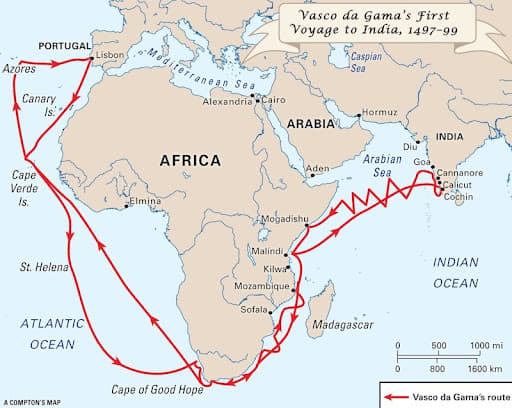
Voyage of Vasco Da Gama
|
|
|
|---|---|
| Portuguese Settlements in India | The Portuguese |
| Francisco De Almeida | French Conquests in India |
Arrival of Vasco da Gama and its Significance
- The landing of three ships under Vasco Da Gama to Calicut in May 1498, headed by a Gujarati pilot called Abdul Majid, had a significant impact on Indian history.
- However, the Hindu monarch of Calicut, the Zamorin (Samoothiri), was unconcerned about the Europeans' intentions.
- Calicut's location as an entrepot contributed to his kingdom's wealth, therefore he gave a warm welcome to Gama.
- The Arab traders on the Malabar Coast, who had a thriving business, were wary of the Portuguese gaining a foothold there.
- For centuries, the Indian Ocean trading system had many participants - Indians, Arabs, east coast Africans, Chinese, and Javanese, among others.
- But these participants had followed some unspoken rules of conduct, and none had sought overwhelming dominance, despite the fact that they were all in it for profit.
- The Portuguese altered that by attempting to monopolize the lucrative eastern trade by removing rivals, particularly Arabs.
- Vasco da Gama spent three months in India. When he returned to Portugal, he brought a valuable cargo with him and profitably sold the goods on the European market.
- The value of direct access to the pepper trade was demonstrated by the fact that Europeans would have had to pay 10 times as much for the same amount of pepper if they had to buy through Muslim intermediaries.
- Other profit-hungry merchants from European countries were enticed to travel to India and deal directly.
- In 1501 Vasco da Gama returned to India.
- When Vasco Da Gama mixed economic avarice with violent hatred and inflicted revenge on Arab commerce everywhere he could, the Zamorin refused to exclude Arab merchants in favor of the Portuguese.
- As a result, his break with the Zamorin was complete.
- At Cannanore, Vasco da Gama established a trading factory.
- Calicut, Cannanore, and Cochin gradually became key Portuguese commerce centers.
- The Portuguese gradually gained authorization to garrison these centers under the guise of safeguarding the manufacturers and their commercial activities.
- At Cochin and Cannanore, two adjacent kingdoms at war with the Zamorin, whose loyalties had been established by previous Portuguese voyages, Da Gama filled up on spices. In early 1503 the 4th armada set sail from India.
- The Zamorin's relationship with da Gama was difficult from the start due to da Gama's failure to pay ordinary customs taxes.
- Vasco da Gama returned to Portugal in September 1503, having effectively failed in his attempt to subdue the Zamorin.
- Da Gama sent a small squadron of caravels, led by his uncle Vicente Sodre, to monitor the Indian coast, and safeguard the Portuguese industries in Cochin and Cannanore from the Zamorin's expected retaliation.
- Vasco da Gama returned to Portugal in 1503, having effectively failed in his attempt to subdue the Zamorin. He sent a small squadron of caravels, led by his uncle Vicente Sodre, to monitor the Indian coast, and safeguard the Portuguese industries in Cochin and Cannanore from the Zamorin's expected retaliation.
- In 1505, when Portuguese King Manuel I of Portugal chose to pick the first governor and viceroy of Portuguese India, da Gama was noticeably ignored, and Francisco de Almeida was appointed instead.
- Vasco da Gama's body was first interred at St. Francis Church in Fort Kochi, Kochi, but his bones were eventually repatriated to Portugal in 1539.
- Vasco da Gama's remains were reinterred at Vidigueira in gold and jewel-encrusted coffin.
- Vasco da Gama's tomb is located at the Jeronimos Monastery in Belem, Lisbon.
- The Hieronymite Monastery at Belem, which would later become the necropolis of the Portuguese royal house of Aviz, was built in the early 1500s near the starting place of Vasco da Gama's maiden voyage and was sponsored by a tax on the earnings of the yearly Portuguese India Armadas.
- Vasco da Gama Church is a church in Kochi, Kerala, and a private home on the island of Saint Helena.
- Vasco, a Cape Town suburb, is also named after him.
Conclusion
Vasco da Gama's arrival at Calicut in 1498 is often recognized as the start of a new period in world history, particularly in the link between Asia and Europe. Despite the fact that Asia and Europe have had trade links since antiquity, the establishment of direct sea contact between the two was not just the realization of a long-held dream.
FAQs
Question: What was the primary objective of Vasco da Gama's expedition to India?
Answer: The primary objective of Vasco da Gama's expedition was to establish a direct maritime trade route to India, allowing Portugal to access the lucrative spice markets. King Manuel I of Portugal aimed to enhance Portugal's economic power by bypassing overland trade routes controlled by rival powers and to expand Portuguese influence in Asia. Da Gama's successful voyage opened up opportunities for trade in spices, silk, and other valuable commodities, which were in high demand in Europe.
Question: How did Vasco da Gama impact trade in the Indian Ocean?
Answer: Vasco da Gama had a significant impact on trade in the Indian Ocean by establishing Portuguese dominance in maritime commerce. His successful voyage to India initiated the Portuguese colonial presence, leading to the creation of trading posts in key locations such as Calicut, Cochin, and Goa. The Portuguese sought to control the spice trade, monopolizing the supply of valuable commodities like pepper, cinnamon, and cardamom. This control allowed them to influence trade routes and engage in direct trade with Asian markets, altering the dynamics of commerce in the region. Furthermore, da Gama's expeditions paved the way for other European powers, such as the Dutch and British, to enter the Indian Ocean trade network.
Question: What challenges did Vasco da Gama face during his voyages?
Answer: Vasco da Gama faced several challenges during his voyages, including:
- Hostile Encounters: Upon arriving in India, da Gama encountered resistance from local rulers and traders who were wary of foreign influences and competition in the spice trade.
- Navigation Difficulties: Navigating the uncharted waters of the Indian Ocean presented significant risks, including unpredictable weather conditions and lack of accurate maps.
- Logistical Issues: Supplying his fleet with food and provisions was a constant challenge during long voyages, particularly in unfamiliar territories.
- Competition from Other Powers: The presence of competing European powers, such as the Ottomans and the Arabs, posed a threat to Portuguese interests and trade routes.
- Cultural Barriers: Da Gama had to navigate complex cultural landscapes, requiring negotiation and diplomacy with local leaders to establish trade relations.
Question: What legacy did Vasco da Gama leave behind?
Answer: Vasco da Gama's legacy is profound and multifaceted:
- Maritime Exploration: He is credited with opening the sea route to India, significantly advancing maritime exploration and navigation.
- Portuguese Empire: Da Gama's voyages laid the foundation for the Portuguese colonial empire in Asia, leading to the establishment of trading posts and territorial claims.
- Cultural Exchange: His expeditions fostered cultural exchanges between Europe and Asia, influencing trade, religion, and cultural practices.
- Geopolitical Shifts: Da Gama's arrival in India marked the beginning of European colonialism in the region, altering the political landscape and trade dynamics.
- Inspiration for Future Explorers: His achievements inspired subsequent explorers, encouraging further maritime exploration and the pursuit of new trade routes.
Question: How did Vasco da Gama's voyages influence the relationship between Europe and India?
Answer: Vasco da Gama's voyages significantly influenced the relationship between Europe and India by establishing direct maritime connections that had lasting economic and cultural implications:
- Trade Relations: His successful establishment of a sea route facilitated direct trade between Portugal and India, allowing the exchange of spices, textiles, and other commodities that were highly valued in Europe.
- Cultural Exchange: The interactions between Portuguese explorers and Indian societies led to cultural exchanges, influencing art, language, and culinary practices in both regions.
- Colonial Ambitions: Da Gama's expeditions marked the beginning of European colonial ambitions in India, setting a precedent for other European powers to pursue similar endeavors.
- Religious Influence: The Portuguese sought to spread Christianity in India, establishing missions and converting local populations, which impacted the religious landscape.
- Geopolitical Dynamics: The competition among European powers for control over trade routes and territories intensified due to da Gama's discoveries, shaping future conflicts and alliances.
MCQs
1. Who was Vasco da Gama?
A) A Spanish explorer
B) An Italian navigator
C) A Portuguese explorer
D) A French sailor
Answer: (C) See the Explanation
Explanation: Vasco da Gama was a Portuguese explorer known for establishing the sea route to India.
2. What was the significance of Vasco da Gama's voyage in 1497?
A) It led to the discovery of America
B) It established a sea route to India
C) It resulted in the first circumnavigation of the globe
D) It found a route to China
Answer: (B) See the Explanation
Explanation: Vasco da Gama's voyage in 1497 was significant as it established a direct sea route to India, opening up trade opportunities for Portugal.
3. What challenges did Vasco da Gama face upon arriving in India?
A) Hostility from local rulers
B) Lack of supplies
C) Navigational errors
D) All of the above
Answer: (D) See the Explanation
Explanation: Vasco da Gama faced multiple challenges, including hostility from local rulers, lack of supplies, and navigational difficulties.
4. What was one of Vasco da Gama's major contributions to Portuguese exploration?
A) Discovering the Americas
B) Establishing trade routes to Asia
C) Mapping the entire globe
D) Finding a passage through the Arctic
Answer: (B) See the Explanation
Explanation: One of Vasco da Gama's major contributions was establishing trade routes to Asia, which significantly boosted Portuguese trade and colonial ambitions.
5. How did Vasco da Gama's voyages affect European colonialism?
A) They had no impact
B) They initiated competition among European powers
C) They discouraged exploration
D) They solely benefited local rulers
Answer: (B) See the Explanation
Explanation: Vasco da Gama's voyages initiated competition among European powers for control of trade routes and colonies, significantly shaping the landscape of colonialism.
GS Mains Questions and Model Answers
Q1: Analyze the impact of Vasco da Gama's voyages on the establishment of Portuguese colonialism in India.
Answer: Vasco da Gama's voyages had a profound impact on the establishment of Portuguese colonialism in India, marking the beginning of a new era in European exploration and expansion. His successful navigation to India in 1498 opened up a direct maritime trade route, enabling the Portuguese to bypass the traditional overland routes controlled by other powers. This strategic advantage allowed Portugal to dominate the spice trade and establish trading posts in key Indian port cities such as Calicut and Cochin. The influx of wealth and resources from these colonies fueled further explorations and military expeditions, consolidating Portugal's position as a major maritime power in the Indian Ocean. Furthermore, the cultural exchanges initiated by da Gama's voyages led to the spread of Christianity in the region, significantly influencing the socio-religious landscape of India. Overall, Vasco da Gama's expeditions laid the groundwork for a vast Portuguese empire in Asia, reshaping global trade dynamics and colonial relations.
Q2: Discuss the challenges faced by Vasco da Gama during his expeditions and their implications for subsequent explorers.
Answer: Vasco da Gama faced numerous challenges during his expeditions that had significant implications for subsequent explorers. One major challenge was navigating uncharted waters, which required exceptional skills in maritime navigation. The lack of accurate maps and knowledge of local conditions posed risks of shipwrecks and loss of supplies. Upon reaching India, da Gama encountered hostility from local rulers, who were often resistant to foreign intrusion in trade. This necessitated diplomatic negotiations and showcased the importance of understanding local cultures and politics. The hardships da Gama experienced highlighted the need for robust logistical planning and resource management, shaping future expeditions by instilling a cautious approach towards exploration. His encounters with local powers also underscored the importance of forming alliances, which became a crucial strategy for subsequent explorers seeking to establish trade relations in foreign territories.
Q3: Evaluate the long-term effects of Vasco da Gama's voyages on India and Europe.
Answer: The long-term effects of Vasco da Gama's voyages were significant for both India and Europe. For India, his arrival marked the beginning of European colonialism, leading to increased foreign influence in trade and politics. The establishment of Portuguese trading posts facilitated the introduction of new commodities, religions, and cultural practices, significantly impacting local economies and societies. However, this also resulted in conflicts with local powers and the exploitation of resources, laying the groundwork for subsequent colonial encounters by other European nations. For Europe, da Gama's voyages ignited a wave of exploration and colonization, inspiring other nations, including Spain, Britain, and the Netherlands, to seek their own routes to Asia. The resultant competition among European powers for trade dominance shaped global trade networks and contributed to the rise of capitalism in Europe. Ultimately, Vasco da Gama's expeditions transformed the dynamics of international relations and trade, leading to profound economic and cultural changes that continue to resonate today.
Previous Year Questions on Vasco da Gama
1. UPSC CSE Prelims 2021:
Question: Vasco da Gama is best known for which of the following achievements?
A) Discovering America
B) Establishing a sea route to India
C) Mapping the Pacific Ocean
D) Circumnavigating the globe
Answer: (B)
Explanation: Vasco da Gama is best known for establishing a direct sea route to India, which significantly impacted global trade.
2. UPSC CSE Mains 2019 (GS Paper 1):
Question: "Assess the significance of Vasco da Gama's voyages in the context of European expansion in Asia."
Answer: Vasco da Gama's voyages were significant as they opened up new maritime routes for European expansion into Asia, enabling Portugal to establish a colonial presence and control trade in the lucrative spice markets. His successful journey marked the beginning of a new era of European exploration and conquest, leading to competition among various European powers for dominance in Asia. Da Gama's expeditions laid the foundation for Portuguese colonialism, influencing economic, cultural, and political landscapes in both India and Europe for centuries to come.
Download the PREPP App and attempt FREE IAS Exam Mock Tests and get complete study material!

Full Test - 04: UPSC CSE Prelims CSAT (Paper-II)
Full Test - 03: UPSC CSE Prelims CSAT (Paper-II)
UPSC CSE Prelims 2026 GS Paper 1 Question Paper (24-May-2026)
UPSC CSE Prelims 2026 CSAT Paper 2 Question Paper (24-May-2026)

17 February 2025 | The Hindu Must Read Articles | Current Affairs

16 February 2026 | The Hindu Must Read Articles | Current Affairs

13 February 2026 | The Hindu Must Read Articles | Current Affairs









Comments