Law of Demand – Indian Economy Notes
In microeconomics, the law of demand states that if the prices are higher, consumers will demand a lower quantity of goods. The law of demand is one of the most fundamental concepts in economics. It works with the law of supply to explain how market economies allocate resources and determine the prices of goods and services that we observe in everyday transactions. The topic “Law of Demand” is one of the important concepts in the UPSC/IAS 2023 Economy syllabus which is discussed in this article in detail.
|
Table of Contents |
What is the Law of Demand?
- The Law of Demand states that all else being equal, as the price of a good or service decreases, the quantity demanded by consumers increases, and conversely, as the price increases, the quantity demanded decreases.
- This inverse relationship between price and quantity demanded forms the cornerstone of consumer behavior in economics.
- The Law of Demand is graphically represented by the demand curve—a downward-sloping line that demonstrates the negative relationship between price and quantity demanded.
- As price decreases along the curve, the quantity demanded rises, showcasing the law's practical implications.
- The law of demand is used along with the law of supply to determine an efficient resource allocation and the optimum quantity and price of goods.
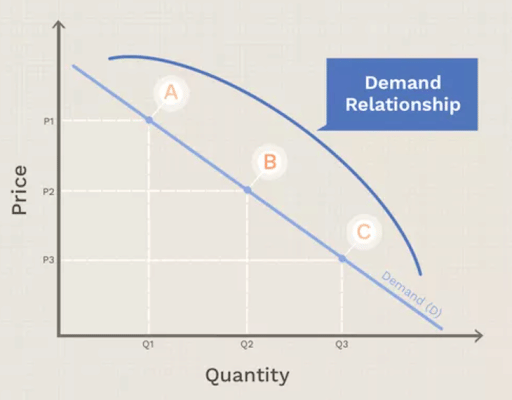
Law of Demand graph
Factors Affecting Demand
Income Effect
- As the price of a good falls, consumers experience an increase in their real income, allowing them to purchase more of the same good or other goods.
- This positive impact on purchasing power amplifies the quantity demanded.
Substitution Effect
- When the price of a good decreases, it becomes relatively cheaper compared to other goods.
- Consumers tend to substitute costlier alternatives with the now more affordable option, driving up its demand.
Diminishing Marginal Utility
- As consumers consume more of a good, the additional satisfaction (marginal utility) derived from each unit decreases.
- Lowering the price allows consumers to maximize utility by consuming more units, amplifying demand.
Consumer Preferences and Tastes
- Consumer preferences for goods impact their willingness to purchase.
- Changes in preferences can lead to shifts in demand curves, signaling altered consumer behavior.
Significance of Law of Demand
Price Elasticity of Demand
- The concept of price elasticity measures how much quantity demanded changes in response to price changes.
- Understanding elasticity helps businesses predict consumer responses and make informed pricing decisions.
Policy Implications
- Governments leverage the Law of Demand to design effective policies.
- Subsidies, for instance, lower prices and stimulate demand, while taxes can reduce demand by increasing prices.
Market Insights
Businesses analyze the Law of Demand to determine optimal pricing strategies and forecast demand for their products.
Exceptions to Law of Demand
There are a few exceptions to the law of demand. There are some products where the price and quantity do not inversely correlate. The demand curve for these products is therefore upward-sloping.
Giffen Goods
- These are inferior products that take up a substantial percentage of the consumer's income and have few alternatives.
- In the 19th century, Scottish economist Sir Robert Giffen hypothesized the existence of such things.
- Giffen products break the rule of demand since their costs rise as a result of rising consumer demand.
- Giffen goods, however, largely remain a theoretical idea because there is scant empirical support for their existence.
*To know more about the topic, click this link Giffen Good
Veblen Goods
- The demand law is broken by some sort of luxury items.
- After American economist Thorstein Veblen, Veblen products bear his name.
- They are typically expensive items that reveal the owner's social and economic standing.
- As a result, as prices rise, people are much more likely to buy Veblen products.
- Luxury vehicles, pricey wines, and fancy clothing are a few examples of Veblen goods.
*To know more about the topic, click this link Veblen Goods
Law of Supply
|
|
|
|
|---|---|
| Law of Demand & Supply | Elasticity of Demand |
| Demand for Money | Supply of Money |
Advantages of Law of Demand
The law of demand has a number of advantages, giving traders, consumers, and other linked parties opportunities. Here are a few of the benefits:
- It assists the party selling different products in setting the prices of their sold goods.
- It will inform them of the effects on the quantity that its clients will demand if they increase or lower demand pricing.
- The study of the law of demand in economics is crucial for the finance minister of every nation since changes in tax rates would impact the pricing of various goods, which will change consumer demand for those goods.
Limitations of Law of Demand
- In some circumstances, they may not be accurate. In events like war, depression, the Giffen paradox, speculation, the ignorance effect, and the need for basic requirements.
- For instance, if a war is anticipated, people would begin purchasing the supplies they will need and storing them for use when the war breaks out, even if the cost of those items keeps rising.
- As a result, this is an exception to the law of demand since, even though the prices of the items would rise, there will still be a need for them during a time of war.
- Assumptions about the law of demand exist. The law of demand will not apply in certain circumstances if any assumptions turn out to be false.
Demand vs Quantity Demanded
The difference between the phenomena of demand and the quantity demanded is important in economic thinking.
| Demand | Quantity Demanded |
|---|---|
|
|
Conclusion
The law of demand states that the quantity purchased varies inversely with the price. Demand is derived from the law of diminishing marginal utility, the fact that consumers use economic goods to satisfy their most urgent needs first. The shape and magnitude of demand shifts in response to changes in consumer preferences, incomes, or related economic goods, NOT to changes in price.
|
|
|
|---|---|
| Indian Economics Notes | Micro Economics |
| Economic Systems | Macro Economics |
| Branches of Economics | Sectors of Indian Economy |
FAQs
Question: What is the Law of Demand?
Answer: The Law of Demand states that, all else being equal, as the price of a good or service decreases, the quantity demanded by consumers increases, and conversely, as the price increases, the quantity demanded decreases. This inverse relationship between price and quantity demanded forms the cornerstone of consumer behavior in economics.
Question: What factors affect demand?
Answer: Several factors influence demand, including:
- Income Effect: As the price of a good falls, consumers experience an increase in their real income, allowing them to purchase more of the same good or other goods.
- Substitution Effect: When the price of a good decreases, it becomes relatively cheaper compared to other goods, leading consumers to substitute costlier alternatives with the now more affordable option.
- Diminishing Marginal Utility: As consumers consume more of a good, the additional satisfaction (marginal utility) derived from each unit decreases, prompting them to purchase more only if the price is lower.
- Consumer Preferences and Tastes: Changes in consumer preferences can lead to shifts in demand curves, signaling altered consumer behavior.
Question: What are the exceptions to the Law of Demand?
Answer: Exceptions to the Law of Demand include:
- Giffen Goods: Inferior goods for which an increase in price leads to an increase in quantity demanded, due to the strong income effect outweighing the substitution effect.
- Veblen Goods: Luxury items where higher prices make the goods more desirable as status symbols, leading to an increase in quantity demanded.
- Basic or Necessary Goods: Essential items for which demand remains constant regardless of price changes.
- Expectations of Future Price Changes: If consumers anticipate higher prices in the future, they may purchase more now, even at higher current prices.
Question: How does the Law of Demand relate to price elasticity?
Answer: Price elasticity of demand measures how much the quantity demanded of a good responds to a change in its price. It quantifies the sensitivity of demand to price changes, providing insights into how consumers might alter their purchasing behavior when prices fluctuate.
Question: Why is the Law of Demand significant in economics?
Answer: The Law of Demand is fundamental in economics as it helps explain consumer purchasing behavior, guides businesses in pricing strategies, and assists governments in policy formulation. Understanding this law enables stakeholders to predict how changes in prices can affect demand for goods and services.
MCQs
1. According to the Law of Demand, what happens when the price of a good increases, all else being equal?
A) Quantity demanded increases
B) Quantity demanded decreases
C) Quantity demanded remains unchanged
D) Quantity supplied decreases
Answer: (B) See the Explanation
Explanation: The Law of Demand states that, all else being equal, as the price of a good increases, the quantity demanded decreases.
2. Which of the following is an exception to the Law of Demand?
A) Normal goods
B) Inferior goods
C) Giffen goods
D) Complementary goods
Answer: (C) See the Explanation
Explanation: Giffen goods are an exception to the Law of Demand, as an increase in their price leads to an increase in quantity demanded.
3. What effect does the substitution effect have when the price of a good decreases?
A) Consumers buy less of the good
B) Consumers buy more of the good
C) Consumers' real income decreases
D) The good becomes less attractive compared to alternatives
Answer: (B) See the Explanation
Explanation: When the price of a good decreases, it becomes relatively cheaper compared to other goods, leading consumers to buy more of it—a phenomenon known as the substitution effect.
4. Which of the following best describes Veblen goods?
A) Goods with a downward-sloping demand curve
B) Inferior goods with an upward-sloping demand curve
C) Luxury goods where higher prices increase their desirability
D) Necessities with perfectly inelastic demand
Answer: (C) See the Explanation
Explanation: Veblen goods are luxury items where higher prices make them more desirable as status symbols, leading to an increase in quantity demanded.
5. How does the income effect influence consumer behavior when the price of a good falls?
A) Consumers feel poorer and buy less
B) Consumers feel richer and buy more
C) Consumers' preferences change
D) The good becomes less attractive
Answer: (B) See the Explanation
Explanation: When the price of a good falls, consumers experience an increase in their real income, making them feel wealthier and enabling them to buy more of the good.
GS Mains Questions and Model Answers
Q1: Discuss the significance of the Law of Demand in formulating economic policies and strategies.
Answer: The Law of Demand is significant in formulating economic policies and strategies as it explains consumer behavior in response to price changes. Governments use this law to design policies that can influence demand for essential commodities, stabilize markets, or control inflation. Businesses rely on the law to set prices, forecast demand, and optimize production. By understanding how demand reacts to price changes, policymakers and firms can make informed decisions that promote economic stability and growth, ensuring an efficient allocation of resources.
Q2: Explain how the exceptions to the Law of Demand impact consumer behavior and market dynamics.
Answer: Exceptions to the Law of Demand, such as Giffen goods and Veblen goods, impact consumer behavior and market dynamics in unique ways. For Giffen goods, a price increase leads to higher demand due to the strong income effect among low-income consumers. Veblen goods, on the other hand, are perceived as luxury status symbols, leading to increased demand with higher prices. These exceptions challenge conventional demand theory, highlighting the complexities of consumer preferences and market interactions. Understanding these nuances helps businesses and policymakers design better strategies to manage consumer behavior and market fluctuations.
Q3: Analyze the relationship between the Law of Demand and price elasticity of demand, providing examples of elastic and inelastic goods.
Answer: The Law of Demand is closely related to price elasticity of demand, which measures the responsiveness of quantity demanded to changes in price. For elastic goods, a small change in price results in a significant change in demand (e.g., luxury items, non-essential goods). Conversely, inelastic goods exhibit little change in demand despite price fluctuations (e.g., basic necessities like food and medicine). Understanding this relationship allows businesses and policymakers to predict consumer responses, optimize pricing strategies, and assess the impact of taxes and subsidies on demand patterns.
Previous Year Questions on the Law of Demand
1. UPSC CSE Prelims 2020:
Question: What does the Law of Demand state about the relationship between price and quantity demanded?
A) They move in the same direction
B) They move in opposite directions
C) They are not related
D) They remain constant
Answer: (B)
Explanation: The Law of Demand states that there is an inverse relationship between price and quantity demanded, meaning they move in opposite directions.
2. UPSC CSE Mains 2019 (GS Paper 3):
Question: "Evaluate the importance of the Law of Demand in determining market equilibrium and resource allocation."
Answer: The Law of Demand is crucial in determining market equilibrium and resource allocation. As prices fluctuate, the quantity demanded by consumers adjusts, helping markets reach an equilibrium where supply equals demand. This process ensures optimal resource utilization and market efficiency. By understanding how demand responds to price changes, businesses and policymakers can make strategic decisions to maintain balance, promote economic stability, and allocate resources effectively to maximize societal welfare.
Download the PREPP App and attempt FREE IAS Exam Mock Tests and get complete study material!

Full Test - 04: UPSC CSE Prelims CSAT (Paper-II)
Full Test - 03: UPSC CSE Prelims CSAT (Paper-II)
UPSC CSE Prelims 2026 CSAT Paper 2 Question Paper (24-May-2026)
UPSC CSE Prelims 2026 GS Paper 1 Question Paper (24-May-2026)

17 February 2025 | The Hindu Must Read Articles | Current Affairs

16 February 2026 | The Hindu Must Read Articles | Current Affairs

13 February 2026 | The Hindu Must Read Articles | Current Affairs









Comments