Giffen Goods – Indian Economy Notes
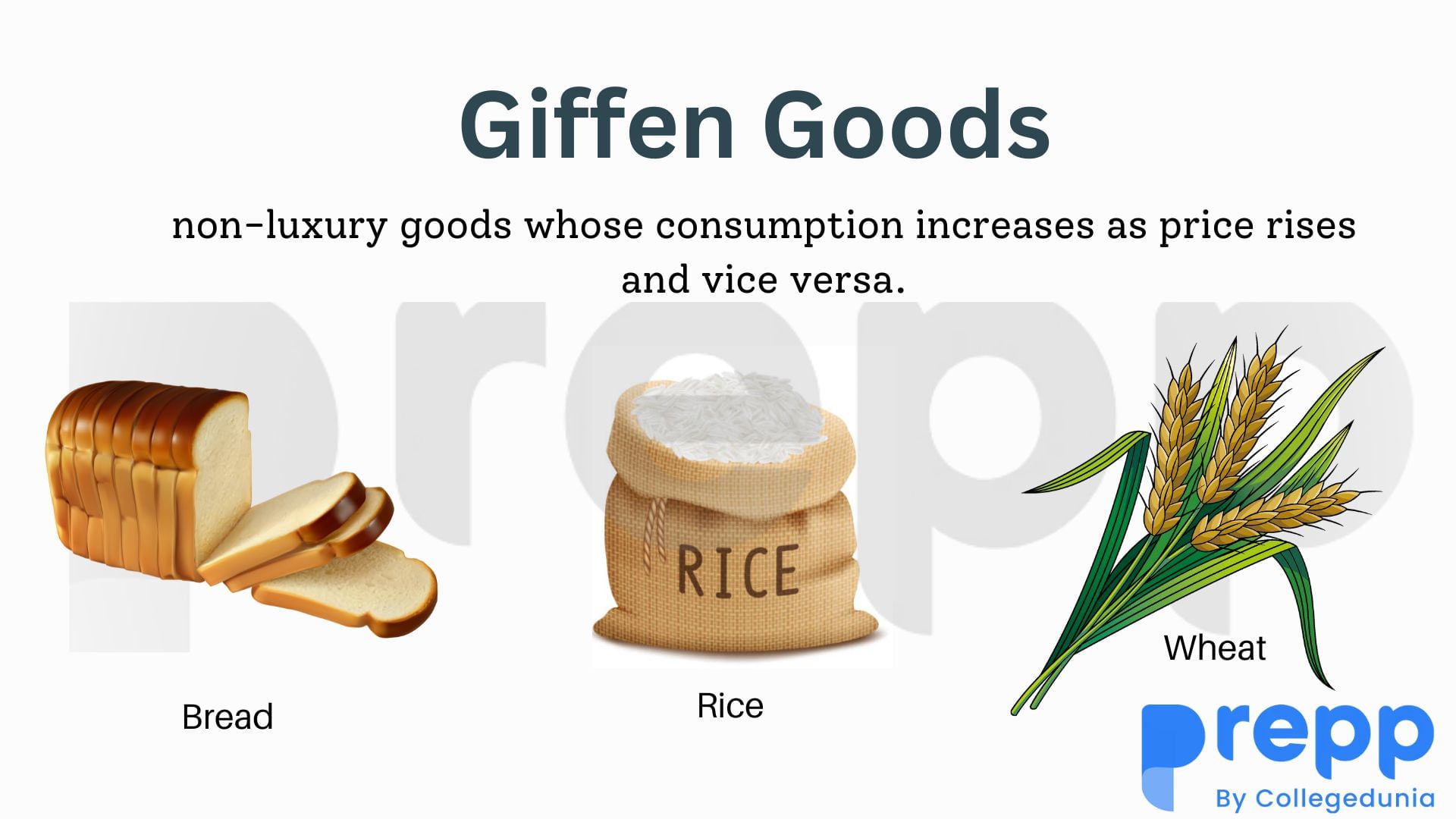
A Giffen good is a non-luxury, low-income good whose consumption increases as price rises and vice versa. It describes a good that individuals consume more of as the price rises. As a result, a Giffen good has an upward-sloping demand curve, which is in violation of the fundamental law of demand. Bread, rice, and wheat are the best examples of Giffen goods. The topic “Giffen Goods” is one of the important concepts in the UPSC/IAS 2023 Economy syllabus which is discussed in this article in detail.
|
Table of Contents |
 Giffen Goods
What is a Giffen Good?
- Giffen goods, a term coined after the Scottish economist Sir Robert Giffen, challenge conventional economic theories by presenting a unique scenario where the demand for a product increases as its price rises.
- This counterintuitive phenomenon contradicts the law of demand, which states that as prices rise, the demand for a product decreases.
- This produces an upward-sloping demand curve in econometrics, in contrast to the fundamental rules of demand, which produce a downward-sloping demand curve.
- Giffen goods are an intriguing aspect of economics that have implications for consumer behavior, market dynamics, and policy-making.
- Giffen goods focus on low-cost, non-luxury products with few close replacements.
- Wheat, potatoes, and Rice are some other examples of Giffen products. These items are basic needs with few near-dimensional replacements available at comparable prices.
- Giffen goods are related to Veblen goods, which challenge conventional economic theory and consumer demand theory while concentrating more on luxury items.
- Multiple market variables, such as supply, demand, pricing, income, and substitution, can result in Giffen goods.
- The basic theories of supply and demand economics rely on all of these variables.
- The effects of these variables on low-income, non-luxury items, which result in an upward-sloping demand curve, are studied in Giffen goods situations.
| Other Relevant Links | |
|---|---|
| Elasticity of Demand | Demand for Money |
| Law of Demand | Supply of Money |
| Price Elasticity of Demand | Veblen Goods |
Conditions for a Giffen Good
The basic criteria for a good to be determined as a giffen good are as follows:
- The good must be inferior.
- The good must form a large percentage of total consumption.
- There must be a lack of close substitute goods.
Characteristics of a Giffen Good
- Price-Effect Dominance: Giffen goods exhibit a strong price-effect dominance, where the impact of a price increase outweighs the income effect.
- As the price rises, consumers perceive the good as more valuable and, in some cases, essential, leading to increased demand.
- Income Elasticity: Giffen goods typically have low income elasticity of demand, implying that even as income increases, consumers continue to prioritize these goods over others due to their perceived indispensability.
What is Giffen Paradox?The Giffen paradox challenges conventional wisdom by defying the law of demand. Here's an illustrative example: The Potato Paradox
|
Giffen Goods vs. Veblen Goods
- Both Giffen and Veblen goods are out-of-the-ordinary items that defy supply and demand rules.
- The demand curve for both Giffen and Veblen items is upward sloping. As previously noted, income and substitution are important aspects in explaining the econometrics of the upward sloping demand curve for Giffen products.
- Veblen goods have an upward sloping demand curve as well, but with notable differences in the influences.
- Veblen products are high-end, luxury items. Perfumes promoted by celebrities or premium wines are two examples.
- The high price of these commodities is associated with a high social status symbol. As a result, these things are more desirable to high-income consumers at a greater price.
- Because income isn't a factor in these commodities, the income effect has little influence. Because the commodities are primarily status symbols and not cross-dimensional, substitution is also a minor factor.
| Aspect | Giffen Goods | Veblen Goods |
|---|---|---|
| Nature | Inferior goods with negative income elasticity | Luxury goods with positive income elasticity |
| Price-Demand Relationship | Demand increases as price rises | Demand increases with higher prices |
| Explanation | Price-effect dominance overrides income effect | Higher price enhances perceived status and prestige |
| Consumer Behavior | Consumers buy more due to affordability constraints | Consumers buy more for social status and exclusivity |
| Income Effect | Weak or negligible | May play a role in demand increase |
| Examples | Basic staple foods for impoverished populations | Designer clothing, luxury cars, high-end watches |
| Relationship with Income | Low income elasticity | High income elasticity |
| Policy Implications | Subsidy programs to mitigate price effects | Marketing and branding strategies to enhance status |
| Common Occurrence | Historically relevant, rare in modern economies | More prevalent in conspicuous consumption contexts |
*To know more about the topic, click this link Veblen Goods
Conclusion
In the realm of economics, Giffen goods stand as an enigmatic concept that challenges traditional notions of demand and price elasticity. The paradoxical nature of these goods, as witnessed in various instances worldwide, underscores the complexity of human behavior and its intersection with economics. The lack of close substitutes and income pressures have a big impact on Giffen's demand. Veblen goods are thus similar to Giffen goods, except they are more upscale. It's worth noting that while all Giffen goods are inferior, not all inferior goods are Giffen.
|
|
|
|---|---|
| Indian Economics Notes | Micro Economics |
| Economic Systems | Macro Economics |
| Branches of Economics | Sectors of Indian Economy |
FAQs
Q1: What are Giffen goods?
Answer: Giffen goods are a type of inferior good whose demand increases as the price rises, contrary to standard economic principles.
Q2: Why do people buy more Giffen goods when the price increases?
Answer: For low-income consumers, a rise in the price of a staple (like bread) forces them to forego more expensive items, increasing their consumption of the staple.
Q3: Give an example of a Giffen good.
Answer: Bread or rice in poor communities is often cited as a classic example of a Giffen good.
Q4: Are all inferior goods Giffen goods?
Answer: No, only those whose demand increases with price qualify as Giffen goods.
Q5: How are Giffen goods related to consumer behavior?
Answer: Giffen goods demonstrate how consumer preferences can shift based on economic constraints, particularly among low-income groups.
MCQs
- What characterizes a Giffen good?
(a) Higher price leads to higher demand
(b) Lower price leads to lower demand
(c) Higher price leads to lower demand
(d) Demand is constant
Answer: (a) See the Explanation
- Which of the following is often considered a Giffen good?
(a) Gold
(b) Bread
(c) Smartphones
(d) Diamond
Answer: (b) See the Explanation
- Giffen goods usually exist among:
(a) High-income groups
(b) Luxury goods market
(c) Low-income groups
(d) Price-inelastic goods
Answer: (c) See the Explanation
- The concept of Giffen goods challenges which law?
(a) Law of Demand
(b) Law of Supply
(c) Law of Diminishing Returns
(d) Law of Comparative Advantage
Answer: (a) See the Explanation
- Which economist is associated with the concept of Giffen goods?
(a) Adam Smith
(b) Robert Giffen
(c) John Maynard Keynes
(d) Milton Friedman
Answer: (b) See the Explanation
GS Mains Questions and Model Answers
Q1: Explain the concept of Giffen goods with examples.
Answer: Giffen goods are a type of inferior good where demand rises as the price increases, contradicting the usual Law of Demand. This occurs mostly in staple foods like bread or rice among low-income groups. When the price of these staples rises, people may buy more because they cannot afford substitutes, forcing them to rely on the cheaper option for sustenance. This phenomenon exemplifies how economic constraints influence consumer behavior differently across income groups.
Q2: Analyze how Giffen goods challenge traditional economic theories.
Answer: Giffen goods challenge the Law of Demand by showcasing an inverse relationship between price and demand in specific cases. Typically, as price rises, demand falls; however, for Giffen goods, higher prices can lead to increased consumption, especially among low-income groups. This anomaly highlights how consumer choices are not solely dictated by price but also by income levels and availability of alternatives, introducing complexities in demand theories within economics.
Q3: Discuss the conditions required for the existence of Giffen goods.
Answer: Giffen goods require certain conditions, such as the lack of affordable substitutes, strong income constraints among consumers, and a significant share of income spent on the good. This scenario typically applies to essential commodities like staple foods in impoverished communities, where rising prices force consumers to buy more of the good as they substitute it for costlier alternatives. Thus, Giffen goods illustrate unique cases within the framework of demand.
Previous Year Questions on Giffen Goods
1. UPSC CSE Mains 2017
Question: Evaluate the implications of Giffen goods in understanding consumer demand in low-income economies.
Answer: Giffen goods are significant in understanding consumer demand within low-income economies as they highlight how price changes affect necessities. For low-income groups, Giffen goods like staple foods may see increased demand as prices rise since alternatives are unaffordable. This defies the standard Law of Demand, underscoring how income constraints and the absence of substitutes drive consumption patterns. By focusing on Giffen goods, economists gain insights into the unique challenges low-income consumers face, shaping policies that better address affordability and access to essentials in developing economies.
2. UPSC CSE Mains 2019
Question: Critically analyze the limitations of the Law of Demand with reference to Giffen goods.
Answer: The concept of Giffen goods illustrates a key limitation of the Law of Demand, which assumes an inverse relationship between price and demand. However, for Giffen goods, such as staple items among low-income groups, higher prices may lead to increased consumption due to income constraints and lack of substitutes. This anomaly reveals that demand cannot always be understood through price alone; economic conditions and consumption needs play a role. Understanding this limitation is crucial for accurately assessing consumer behavior, especially in poverty-stricken regions where basic needs take precedence over traditional demand responses.
Download the PREPP App and attempt FREE IAS Exam Mock Tests and get complete study material!

Full Test - 04: UPSC CSE Prelims CSAT (Paper-II)
Full Test - 03: UPSC CSE Prelims CSAT (Paper-II)
UPSC CSE Prelims 2026 CSAT Paper 2 Question Paper (24-May-2026)
UPSC CSE Prelims 2026 GS Paper 1 Question Paper (24-May-2026)

17 February 2025 | The Hindu Must Read Articles | Current Affairs

16 February 2026 | The Hindu Must Read Articles | Current Affairs

13 February 2026 | The Hindu Must Read Articles | Current Affairs









Comments