Demand for Money – Indian Economy Notes
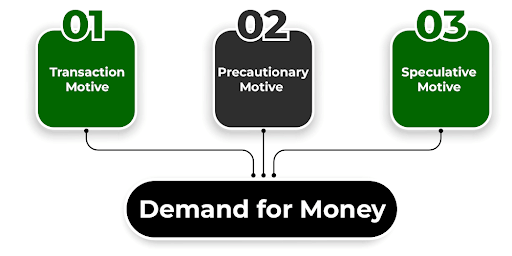
Demand for Money explains why people want a specific sum of money. According to Keynes, the demand for money, or liquidity preference refers to the desire to hold money. In general, the nominal demand for money increases with the level of the nominal output and decreases with the nominal interest rate. The amount of money that people want to keep depends on the value of the transactions that need to be managed. The quantity of money demanded increases with the volume of transactions “Demand for Money” is one of the important concepts in the UPSC/IAS 2023 Economy syllabus which is discussed in this article in detail.
|
Table of Contents |
What is Demand for Money?
- In economics, demand for money is commonly associated with cash or bank demand deposits. In general, the nominal demand for money increases with the level of the nominal output and decreases with the nominal interest rate.
- The demand for money is influenced by a variety of factors, including income level, interest rates, inflation, and future uncertainty.
- The late Lord Keynes, the famous English economist who gave birth to Keynesian Economics, proposed the modern concept of demand for money.
- Monetary policy can help to stabilise an economy when the demand for money is stable.
- When the demand for money is not stable, real and nominal interest rates change, and economic fluctuations occur.
- Money is required to manage transactions, and the value of the transactions determines how much money people wish to keep. The greater the number of transactions, the greater the amount of money demanded.
- Since the quantity of transactions is determined by earnings, it should be obvious that an increase in earnings leads to an increase in the demand for money.
- When people save their money rather than putting it in a bank where it earns interest, the money they save is also subject to the rate of interest.
- People become less focused on stockpiling money when interest rates rise because holding money leads to holding fewer interest-earning deposits.
- As a result, at high-interest rates, the amount of money demanded decreases.

| Other Relevant Links | |
|---|---|
| Cryptocurrency | Fiat money |
| Fiduciary money | Legal tender money |
| Commodity money | Supply of Money |
Reasons/ Motives for Demanding Money
Transaction Motive
- Transaction Motive refers to the demand for money to meet the current needs of individuals and businesses.
- Individuals require money to meet their immediate needs, which is referred to as the income motive.
- Businesses, on the other hand, require money to carry out their operations, which is known as the business motive.
(i) Income Motive
- Income Motive refers to the motivation of individuals who seek money in order to meet their own and their family's needs. In general, people keep cash to bridge the gap between their income and their expenses.
- The income is received once a month, but the expenses are incurred on a daily basis. As a result, some income must be held in order to make current payments.
- The holding amount is determined by an individual's income and the frequency with which he or she receives income.
(ii) Business Motive
- Business Motive refers to the need for money in liquid form by businesses to meet their current needs.
- Businesses require funds to purchase raw materials and pay transportation costs, as well as wages, salaries, and other expenses.
- The amount of money demanded by businesses is determined by their turnover. The higher the turnover, the greater the need for additional funds to cover expenses.
Precautionary Motive
- Precautionary Motive refers to people's desire to save money for various contingencies that may arise in the future.
- Unemployment, sickness, and accidents are examples of contingencies.
- The amount of money required for the precautionary motive is determined by a person's nature and living conditions.
Speculative Motive
- The speculative motive for demanding money arises when holding money is perceived to be less risky than lending the money or investing it in another asset.
- It refers to the motivation of individuals to hold cash in order to profit from market movements regarding changes in future interest rates.
- For example, if a stock market crash appeared to be imminent, the speculative motive for demanding money would come into play; those anticipating a crash would sell their stocks and keep the proceeds as money.
- The precautionary and speculative motives serve as a store of value for various purposes.
Liquidity Trap
- The demand for money is a decreasing function of the rate of interest.
- The higher the rate of interest, the lower the demand for money for speculative motives and less money would be kept as an inactive balance and vice versa.
- Money demand is perfectly elastic in a liquidity trap.
- Increasing the money supply has no effect on interest rates, and it has no effect on increasing demand.
- At a low rate of interest, people will hold money as an inactive balance which is called a liquidity trap.
- The expansion of the money supply gets trapped and cannot affect the rate of interest and the level of investment.
- However, the demand for money does not depend so much upon the current rate of interest as on expectations about changes in the rate of interest.

Factors Affecting Demand for Money
Interest Rates
- The amount of money people keep in reserve to pay for transactions and to meet precautionary and speculative demand is likely to vary with the interest rates they can earn on alternative assets such as bonds.
- People hold less money when interest rates rise relative to the rates available on money deposits.
- People hold more money when interest rates fall.
- The logic of these conclusions about money and interest rates is dependent on people's motivations for holding money.
Technological Changes
- Technological changes such as debit cards make the importance of holding cashless important.
- People who have easy access to current accounts may be able to keep less cash on hand.
- The transaction motive drives the demand for money (we want money so we can buy things).
- We keep less money on hand when new technologies make it easier to convert wealth into money.
Availability of Credit
If credit becomes more widely available, precautionary demand for money will fall as people believe they can borrow – even if they face short-term difficulties.
Irrational Behavior of Asset Prices
- Markets can go through booms and busts as a result of psychological factors such as over-exuberance.
- During these bubble periods, demand for assets rises while demand for holding money falls.
Changes in National Income
- When real GDP rises, more goods and services are available for purchase. They will cost more money to purchase.
- A fall in real GDP, on the other hand, will cause the money demand curve to fall.
Changes in the Price Level (inflation or deflation)
- If the price of everything increases by 20%, you will need 20% more money to buy things. When the price level rises, the demand for money rises as well.
- In contrast, when the price level falls, so does the demand for money.
Demand Curve for Money
- The money demand curve depicts the amount of money demanded at each interest rate, while all other variables remain constant.
- A rise in interest rates reduces the amount of money demanded. A decrease in interest rates raises the amount of money demanded.
- A shift in the money demand curve occurs when any non-price determinant of demand changes, resulting in a new demand curve.
Factors Causing a Shift in Demand
- The vertical axis (y) of a demand curve is the price, and the horizontal axis is the quantity (x).
- When any non-price determinant of demand changes, the money demand curve shifts, resulting in a new demand curve.
- Changes in non-price determinants cause demand to change even if prices remain constant. Prices are influenced by a variety of factors, such as:
- Variations in disposable income
- Variations in taste and preference
- Variations in expectations
- Variations in the price of related goods
- Size of the population
- Factors influencing demand include:
- Price reduction for a substitute
- Increase in the price of a supplement
- Reduce in consumer income if the good is a standard good
- Increase in consumer income if the goods are of poor quality.
- When the nominal level of output rises, so does the demand for money. It moves in tandem with the nominal interest rate.


Implications of Demand Curve Shift
- Money demand results from the trade-off between the liquidity advantage of holding money and the interest advantage of holding other assets.
- Money demand determines how a person's wealth should be held.
- When the demand curve shifts to the right and rises, the demand for money rises, and people are more likely to save money. The level of nominal output has risen, and there is a liquidity benefit to holding money.
- Similarly, a shift to the left in the demand curve indicates a decrease in the demand for money.
- As the nominal interest rate falls, there is a greater interest advantage in holding other assets rather than money.
Conclusion
The demand for money is affected by the price level, interest rate, and real GDP. These three factors combine to determine how much of a person's wealth is held in cash and how much is held in interest-bearing assets.
|
|
|
|---|---|
| Indian Economics Notes | Monetary Policy |
| Functions of money | Monetary Policy Tools |
| Types of Monetary Policy | Money Supply |
FAQs
Q1: What is meant by the demand for money?
Answer: The demand for money refers to the desire of individuals and businesses to hold money as cash or in bank deposits for various purposes, such as transactions, savings, and speculative investments.
Q2: What are the key motives for holding money?
Answer: According to Keynesian theory, the primary motives for holding money are the transaction motive, precautionary motive, and speculative motive.
Q3: How does interest rate affect the demand for money?
Answer: Higher interest rates reduce the demand for money since people prefer to invest their funds to earn returns, while lower interest rates increase the demand as people keep more liquid cash.
Q4: What is the significance of the speculative demand for money?
Answer: Speculative demand arises when individuals hold cash instead of investing it, anticipating that the value of assets like bonds may fall in the future.
Q5: What is the difference between real and nominal demand for money?
Answer: Real demand for money refers to the quantity of money adjusted for inflation, while nominal demand is the unadjusted value of money held.
MCQs
- What is the primary focus of the transaction motive for holding money?
a) Future investments
b) Daily expenses
c) Loan repayments
d) Speculative purposes
Answer: (B) See the Explanation
- How does a rise in interest rates affect money demand?
a) Increases speculative demand
b) Increases transaction demand
c) Decreases demand for money
d) Has no effect
Answer: (C) See the Explanation
- What motive for holding money is related to unforeseen circumstances?
a) Transaction motive
b) Precautionary motive
c) Speculative motive
d) Investment motive
Answer: (B) See the Explanation
- Which economist introduced the three motives for holding money?
a) Milton Friedman
b) Adam Smith
c) John Maynard Keynes
d) David Ricardo
Answer: (C) See the Explanation
- What happens to the speculative demand for money when bond prices are expected to rise?
a) Speculative demand increases
b) Speculative demand decreases
c) Transaction demand increases
d) Precautionary demand decreases
Answer: (B) See the Explanation
GS Mains Questions and Model Answers
Q1: Explain the three primary motives for holding money according to Keynes.
Answer: Keynes classified the demand for money into three motives: transaction motive, precautionary motive, and speculative motive. The transaction motive arises from the need for cash to meet day-to-day expenses. The precautionary motive refers to holding money as a safeguard against unforeseen circumstances. The speculative motive reflects the desire to hold money when people expect the value of other investments, such as bonds, to decline. These motives explain how individuals and businesses manage their cash flow in response to economic conditions.
Q2: How does the interest rate influence the demand for money?
Answer: Interest rate plays a critical role in determining the demand for money. When interest rates are high, people prefer to invest their money to earn returns rather than holding it as cash, leading to a decrease in demand. Conversely, when interest rates are low, the opportunity cost of holding cash is minimal, increasing the demand for money. Thus, the speculative motive for holding money is closely tied to fluctuations in interest rates, as individuals anticipate changes in bond prices and other investments.
Q3: Analyze the impact of inflation on real and nominal demand for money.
Answer: Inflation affects both real and nominal demand for money, though differently. Nominal demand refers to the total amount of money people hold without considering inflation, while real demand adjusts for the purchasing power of money. During high inflation, the value of money decreases, reducing its real demand, as people prefer to invest in assets like gold or real estate. However, nominal demand may increase if people need more cash to cover the rising costs of goods and services. Central banks must manage inflation carefully to maintain a balance between real and nominal demand for money.
Previous Year Questions on Demand for Money
1. UPSC CSE 2019
Question: "Discuss the role of interest rates in determining the demand for money."
Answer: Interest rates are a significant factor influencing the demand for money. Higher interest rates reduce the demand for money as people are incentivized to invest rather than hold cash, leading to greater savings and investments in bonds or other assets. In contrast, when interest rates are low, the opportunity cost of holding cash decreases, increasing the demand for money. This relationship is particularly evident in the speculative motive, where individuals anticipate future changes in bond prices. Central banks, such as the Reserve Bank of India, manipulate interest rates to control liquidity and inflation, balancing economic growth with price stability.
2. UPSC CSE 2021
Question: "Explain the concept of speculative demand for money with examples."
Answer: Speculative demand for money refers to holding cash rather than investing it, based on the expectation that the value of other assets may decline. For instance, when bond prices are expected to fall, individuals prefer holding money rather than buying bonds. This behavior reflects a cautious approach, as people anticipate buying assets later at a lower price. The speculative demand is inversely related to the interest rate—when interest rates rise, bond prices fall, and people reduce their cash holdings to invest in bonds. This aspect of money demand highlights the importance of expectations in financial decision-making and illustrates the dynamic relationship between investments and liquidity preferences.
Download the PREPP App and attempt FREE IAS Exam Mock Tests and get complete study material!

Full Test - 04: UPSC CSE Prelims CSAT (Paper-II)
Full Test - 03: UPSC CSE Prelims CSAT (Paper-II)
UPSC CSE Prelims 2026 GS Paper 1 Question Paper (24-May-2026)
UPSC CSE Prelims 2026 CSAT Paper 2 Question Paper (24-May-2026)

17 February 2025 | The Hindu Must Read Articles | Current Affairs

16 February 2026 | The Hindu Must Read Articles | Current Affairs

13 February 2026 | The Hindu Must Read Articles | Current Affairs









Comments