Functions of Money – Indian Economy Notes
Money has taken many forms and served many functions throughout the ages. Economists consider the following as main functions of money: store of value, the unit of account, and medium of exchange. “Functions of Money” is one of the important concepts in the UPSC/IAS 2023 Economy syllabus which is discussed in this article in detail.
|
Table of Contents |
What is Money?
- Money is any object or means of exchange that is accepted by consumers to pay for goods and services and to cover debt repayment.
- The universe revolves around money. Money is essential to economies because it enables trade and fuels financial expansion.
- Typically, economists are the ones who explain what money is, where it comes from, and how much it is worth.
- Above all, money serves as an accounting unit—a generally recognised unit of measure for valuing things.
What are the Functions of Money?
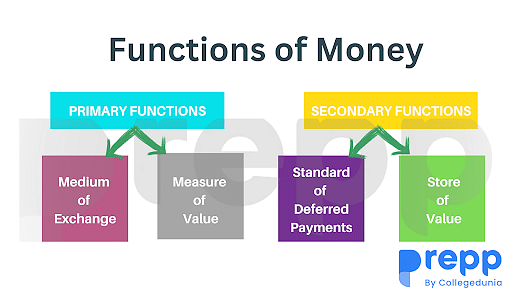
The functions of money are divided into two categories: primary and secondary functions.
Primary Functions
The primary functions of money refer to the fundamental or primary functions of money which include:
Medium of Exchange
- Medium of Exchange refers to a monetary function in which money is viewed as a means of exchanging goods.
- The medium of exchange function is regarded as the primary and unique function of money because it solved the primary problem of the barter system of double coincidences.
- The condition of double coincidence of wants describes the situation in which one person receives the commodity provided by the other person in the exchange.
- A butcher, for example, would not get the cloth unless the weaver did not require meat.
- In this case, it is critical that both parties require the goods that they are receiving from the other. As a result, obtaining the necessary goods was difficult.
- With the introduction of money, however, goods are easily made available without reliance on any other goods. This is because money is generally accepted throughout an economy.
- Aside from that, money is regarded as a medium of exchange because it is easily portable and divisible, as well as government-authenticated.
Measure of Value
- Measure of Value refers to a monetary function that aids in determining the value of goods and services. The value of all goods and services is expressed in terms of money.
- When calculating the monetary value of goods and services, money is used as the common denominator.
- Money as a measure of value has the following advantages:
- Aids in the comparison and calculation of exchange rates between two goods.
- Makes accounting systems more meaningful.
- Aids in calculating and comparing national incomes of various countries.
- Aids in comparing the costs of production and distribution to the revenue generated by the consumption of goods and services.
Secondary Functions
Secondary functions of money refer to important monetary functions derived from primary functions.
Store of Value
- Store of Value refers to a secondary function derived from money's medium of exchange function.
- Individuals typically keep their wealth in the form of money. As a result, money functions as an asset that retains its value over time.
- There was only one transaction in the barter system, which was a simultaneous sale and purchase of goods and services.
- In the money economy, however, the sale and purchase are considered two distinct functions.
- It is possible when money serves as both a medium of exchange and a store of value.
- For example, an individual's salary is not spent all at once; rather, it is consumed gradually for the purchase of various goods and services.
Standard of Deferred Payments
- Standard of Deferred Payments refers to one of the money's most important functions. Loans, salaries, pensions, insurance premiums, interest, and rents are examples of deferred payments.
- The amount of repaid money must be the same as it was at the time of purchase, which is a necessary condition for deferred payment.
- It was impossible to determine whether the amount returned in the form of a commodity was the same as it was at the time of purchase in the barter system.
- For example, the price of a quintal of rice today would not be the same after a year.
- However, the standard of deferred payment function of money is not without limitations, as the value of money has always fluctuated due to inflation.
Transfer of Value
- Money's utility extends to the transfer of value because it can be used to purchase goods not only within the country but also beyond its borders.
- Money as a standard tool can be used to sell or buy goods in the domestic or international market.
| Other Relevant Links | |
|---|---|
| Types of Money | Monetary Policy Tools |
| Money Supply | Types of Monetary Policy |
Conclusion
Money availability in the market has contributed to market stability and liquidity, as well as helping to form essential functions of money markets. Money facilitates transactions by serving as a widely accepted medium of exchange.
| Other Relevant Links | |
|---|---|
| Indian Economics Notes | Monetary Policy |
| Banking Sector in India | Inflation |
FAQs
Question: What are the primary functions of money in an economy?
Answer: The primary functions of money in an economy include serving as a medium of exchange, a unit of account, a store of value, and a standard of deferred payment. As a medium of exchange, money facilitates transactions by eliminating the inefficiencies of barter systems. It acts as a unit of account by providing a standard measure of value, allowing individuals to compare the worth of various goods and services. As a store of value, money retains its value over time, enabling individuals to save and plan for future expenditures. Lastly, money serves as a standard of deferred payment, making it possible to settle debts and obligations over time. These functions are crucial for the smooth operation of economic activities and the overall stability of the economy.
Question: How does money function as a medium of exchange?
Answer: Money functions as a medium of exchange by facilitating the buying and selling of goods and services. In a barter system, trading requires a double coincidence of wants, meaning both parties must want what the other offers. Money eliminates this complexity by providing a universally accepted token that can be exchanged for any product or service. This universality streamlines transactions, enhances market efficiency, and promotes economic growth by allowing individuals and businesses to focus on their core activities rather than engaging in complicated barter exchanges.
Question: What role does money play as a store of value?
Answer: As a store of value, money allows individuals to preserve their wealth over time. Unlike perishable goods, money maintains its value and can be saved for future use, making it an essential tool for saving and financial planning. This function enables individuals to defer consumption to a later date, ensuring they can meet future needs or invest in opportunities as they arise. The effectiveness of money as a store of value depends on its stability; inflation or devaluation can diminish the purchasing power of money, making it crucial for economies to maintain stable monetary policies.
Question: How does money serve as a unit of account?
Answer: Money serves as a unit of account by providing a common standard for measuring and comparing the value of different goods and services. This function simplifies economic calculations, allowing businesses and consumers to make informed decisions about pricing, budgeting, and investment. By establishing a clear measure of value, money facilitates the understanding of economic relationships and helps in the assessment of economic performance. For instance, businesses can analyze profit margins, while consumers can evaluate their spending power, all through the lens of a consistent monetary value.
Question: What is the significance of money in modern economies?
Answer: Money is of paramount significance in modern economies as it underpins all economic activities. It fosters trade, stimulates investment, and promotes economic growth by providing a reliable means of exchange and a framework for pricing. In addition to its traditional functions, money also plays a crucial role in monetary policy, influencing interest rates and overall economic stability. A well-functioning monetary system enhances trust and confidence among consumers and businesses, essential for the smooth operation of the economy. Ultimately, the efficiency and stability of money contribute to the overall prosperity of a nation.
MCQs
1. What is one of the primary functions of money?
A) To act as a commodity
B) To serve as a unit of account
C) To create inflation
D) To limit trade
Answer: (B) See the Explanation
Explanation: One of the primary functions of money is to serve as a unit of account, providing a standard measure of value for goods and services in an economy.
2. How does money eliminate the inefficiencies of barter systems?
A) By being easily destroyed
B) By serving as a universal medium of exchange
C) By reducing the number of goods available
D) By increasing transaction costs
Answer: (B) See the Explanation
Explanation: Money eliminates the inefficiencies of barter systems by serving as a universal medium of exchange, allowing individuals to trade goods and services without the need for a double coincidence of wants.
3. What does money function as when it retains its value over time?
A) Medium of exchange
B) Unit of account
C) Store of value
D) Standard of deferred payment
Answer: (C) See the Explanation
Explanation: Money functions as a store of value when it retains its value over time, allowing individuals to save and defer consumption to a later date.
4. In what way does money facilitate pricing?
A) By establishing interest rates
B) By serving as a unit of account
C) By creating currency
D) By increasing market volatility
Answer: (B) See the Explanation
Explanation: Money facilitates pricing by serving as a unit of account, providing a consistent measure for comparing the value of various goods and services.
5. What is the primary significance of money in modern economies?
A) To encourage barter
B) To limit trade
C) To support economic activities
D) To create scarcity
Answer: (C) See the Explanation
Explanation: The primary significance of money in modern economies is to support economic activities by facilitating trade, investment, and economic growth.
GS Mains Questions and Model Answers
Q1: Evaluate the importance of money in facilitating economic transactions. How does it contribute to overall economic stability?
Answer: Money plays a vital role in facilitating economic transactions by acting as a medium of exchange, a unit of account, and a store of value. As a medium of exchange, it simplifies transactions, allowing goods and services to be traded efficiently without the complications inherent in barter systems. This efficiency enhances market fluidity, promoting higher levels of trade and economic activity. As a unit of account, money provides a consistent measure for valuing products, enabling businesses and consumers to make informed economic decisions. Furthermore, as a store of value, it allows individuals to save and defer consumption, contributing to investment and future consumption. Overall, a stable monetary system fosters confidence in the economy, encouraging spending and investment, which are essential for economic growth and stability.
Q2: Discuss the implications of inflation on the functions of money. How does it affect purchasing power and economic behavior?
Answer: Inflation has significant implications for the functions of money, particularly as a store of value and a unit of account. When inflation rises, the purchasing power of money decreases, meaning that individuals can buy fewer goods and services with the same amount of money. This erosion of purchasing power can deter savings, as the value of money diminishes over time, leading individuals to spend rather than save. Additionally, inflation complicates the function of money as a unit of account; fluctuating prices can lead to uncertainty in pricing and valuation, disrupting economic decision-making. This unpredictability can result in altered consumer behavior, as people may accelerate purchases in anticipation of higher future prices or shift to alternative assets perceived as more stable. Managing inflation is crucial for maintaining the efficacy of money in its various functions and ensuring overall economic stability.
Q3: Analyze the role of central banks in regulating money supply and ensuring economic stability. What tools do they employ to manage inflation?
Answer: Central banks play a pivotal role in regulating the money supply and ensuring economic stability through various monetary policy tools. By managing the money supply, central banks aim to control inflation, stabilize the currency, and foster economic growth. Key tools include open market operations, where central banks buy or sell government securities to influence liquidity in the economy; setting interest rates, which affects borrowing and spending; and maintaining reserve requirements for commercial banks, influencing how much money they can lend. In times of rising inflation, central banks may raise interest rates to discourage borrowing and slow down spending, thereby curbing inflationary pressures. Conversely, during economic downturns, they may lower interest rates to stimulate borrowing and investment. Through these measures, central banks strive to maintain price stability, ensuring a conducive environment for sustainable economic growth.
Previous Year Questions on Functions of Money
1. UPSC CSE Prelims 2020:
Question: Which of the following is NOT a function of money?
A) Medium of exchange
B) Store of value
C) Unit of account
D) Source of wealth
Answer: (D)
Explanation: A source of wealth is not a function of money; rather, the functions of money include serving as a medium of exchange, store of value, and unit of account.
2. UPSC CSE Mains 2019 (GS Paper 3):
Question: "Assess the impact of digital currencies on the traditional functions of money. What challenges do they pose to monetary policy?"
Answer: Digital currencies impact the traditional functions of money by providing an alternative medium of exchange that can enhance transaction speed and reduce costs. They challenge the traditional roles of central banks and may complicate monetary policy as they can operate outside the regulatory framework. This can lead to difficulties in controlling the money supply and stabilizing the economy. Additionally, the rise of digital currencies raises concerns about security, privacy, and potential disruption of the financial system. Policymakers must adapt to these challenges by developing regulatory frameworks that address the implications of digital currencies while safeguarding economic stability.
Download the PREPP App and attempt FREE IAS Exam Mock Tests and get complete study material!

Full Test - 04: UPSC CSE Prelims CSAT (Paper-II)
Full Test - 03: UPSC CSE Prelims CSAT (Paper-II)
UPSC CSE Prelims 2026 GS Paper 1 Question Paper (24-May-2026)
UPSC CSE Prelims 2026 CSAT Paper 2 Question Paper (24-May-2026)

17 February 2025 | The Hindu Must Read Articles | Current Affairs

16 February 2026 | The Hindu Must Read Articles | Current Affairs

13 February 2026 | The Hindu Must Read Articles | Current Affairs









Comments