Types of Money – Indian Economy Notes
Money is widely accepted as a medium of exchange for goods and services in an economy. Anything can technically be considered money, but the most commonly accepted forms today are paper, coins, and credits. There are many different types of money and the most common types are commodity money, fiat money, and bank money. “Types of Money” is one of the important concepts in the UPSC/IAS 2023 Economy syllabus which is discussed in this article in detail.
|
Table of Contents |
What is Money?
- Money is any object or means of exchange that is accepted by consumers to pay for goods and services and to cover debt repayment.
- The universe revolves around money. Money is essential to economies because it enables trade and fuels financial expansion.
- Typically, economists are the ones who explain what money is, where it comes from, and how much it is worth.
- Above all, money serves as an accounting unit—a generally recognised unit of measure for valuing things.
Types of Money
Commodity Money
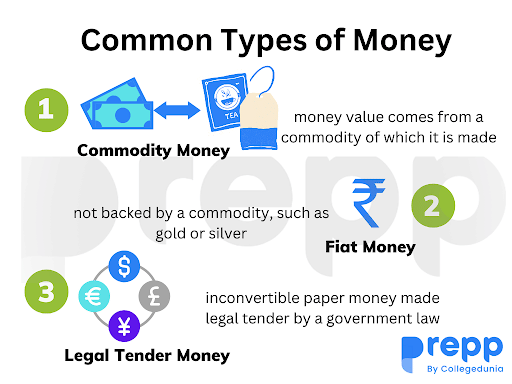
- Commodity money is a physical good with 'intrinsic value' – a use other than money.
- Alcohol, cocoa beans, copper, gold, silver, salt, seashells, tea, and tobacco are all historical examples.
- Commodity money has four main characteristics: durable, divisible, easily exchangeable, and rare.
- Commodity money is distinct in that it is the only type of money with an underlying value.
- Even though gold is no longer used as a form of money, it still has value as jewelry or gilding.
Fiat Money
- Fiat money is a currency issued by the government that is not backed by a commodity such as gold. Fiat money has “face value”.
- Since fiat money gives central banks control over how much money is to be printed, they have greater control over the economy.
- The value of fiat money is determined by the relationship between supply and demand, as well as the stability of the issuing government, rather than by the value of the commodity backing it.
- When fiat money is backed by a gold or silver standard, it is referred to as "representative money," and when the central bank promises "to pay bearer the sum of this many rupees," currency is referred to as "anonymous bearer bond with zero interest."
| FACE VALUE | INTRINSIC VALUE |
|---|---|
| The face value of a coin/currency is its legal value in relation to other forms of currency. | The market value of the constituent metal within a coin is referred to as intrinsic value. |
| Fiat money has a face value. | Fiat money does not have intrinsic value. Only metal currency has intrinsic value. |
| The selling of the constituent metal/currency cannot be used to calculate face value. | Intrinsic value can be derived from the selling of constituent metal itself. |
Fiduciary Money
- Fiduciary money is money that is accepted as a medium of exchange due to the trust that exists between the payer and the payee.
- The current monetary system is highly fiduciary. When a bank promises to pay its customers in different types of money and the customer can sell or transfer the promise to someone else, it is referred to as fiduciary money.
- Generally, fiduciary money is paid in gold, silver, or paper money.
- Cheques and banknotes are examples of fiduciary money because they are both tokens that are used as money and have the same value.
- Fiduciary money's value is determined by the expectation that it will be widely accepted as a medium of exchange.
- It is not declared legal tender by the government, unlike fiat money, which means that people are not required by law to accept it as a form of payment.
- Instead, the issuer of fiduciary money agrees to exchange it for a commodity or fiat money if the bearer requests it.
- People can use fiduciary money just like regular fiat or commodity money as long as they are confident that the promise will not be broken.
Legal Tender Money
- Any form of payment recognized by a government that is used to pay debts or financial obligations, such as tax payments, is considered legal tender.
- Legal tender laws effectively prohibit the use of anything other than existing legal tender in the economy as money.
- The RBI and the government issue legal tender money in the form of currency notes or coins. When this legal tender status is withdrawn, the process is known as demonetization.
- Legal tender performs the economic functions of money as well as a few other functions, such as making monetary policy and manipulation of currency possible.
- Meanwhile, some currencies, most notably the US dollar, are considered legal tender in countries that do not issue their own currency.
- For example, Ecuador, which does not have its own currency, has accepted the US dollar as legal tender since 2000.
Cryptocurrency
- A cryptocurrency is a type of digital asset that is based on a network that is distributed across many computers.
- Because of their decentralized structure, they can exist independently of governments and central authorities.
- Blockchain and related technology, according to experts, will disrupt many industries, including finance and law.
- The benefits of cryptocurrencies include cheaper and faster money transfers, as well as decentralized systems that do not fail at a single point.
- Cryptocurrency disadvantages include price volatility, high energy consumption for mining activities, and use in criminal activities.
- Cryptocurrencies are not widely accepted as money, owing to their lack of legal tender status.
- El Salvador, on the other hand, became the first country in the world to accept bitcoin as legal tender in June 2021.
| Other Relevant Links | |
|---|---|
| Commodity money | Fiat money |
| Fiduciary money | Legal tender money |
| Cryptocurrency | Demand for Money |
| Supply of Money | Money Multiplier |
Conclusion
Overall, the most common type of money used in economies today is fiat money, which has no value except that which the government orders. What is important is that all types of money serve as a medium of exchange, a store of value, and a unit of account.
| Other Relevant Links | |
|---|---|
| Indian Economics Notes | Monetary Policy |
| Functions of money | Monetary Policy Tools |
| Types of Monetary Policy | Money Supply |
FAQs
Q1: What are the main types of money in the Indian economy?
Answer: The main types of money in the Indian economy include commodity money, fiat money, and bank money. Commodity money has intrinsic value (like gold or silver), fiat money is government-issued currency without intrinsic value (like banknotes), and bank money refers to the money held in bank accounts that can be accessed via checks or electronic transfers.
Q2: How does fiat money differ from commodity money?
Answer: Fiat money differs from commodity money in that it has no intrinsic value and is not backed by a physical commodity. Instead, its value is derived from the trust and confidence that people have in the issuing government. Commodity money, on the other hand, has intrinsic value based on the material it is made of.
Q3: What role do banks play in the creation of bank money?
Answer: Banks play a crucial role in the creation of bank money through the process of fractional reserve banking. When banks accept deposits, they are required to keep a fraction as reserves while lending out the rest. This lending process effectively creates new money in the economy, represented as deposits in borrowers' accounts.
Q4: What is the significance of digital money in the Indian economy?
Answer: Digital money, including electronic transfers, cryptocurrencies, and mobile wallets, is increasingly significant in the Indian economy as it enhances the efficiency of transactions, promotes financial inclusion, and supports the growth of e-commerce. The rise of digital payment platforms has revolutionized how consumers and businesses conduct transactions.
Q5: How does the Reserve Bank of India regulate the types of money in circulation?
Answer: The Reserve Bank of India (RBI) regulates the types of money in circulation by controlling the money supply, setting interest rates, and overseeing the banking system. It issues currency notes, manages foreign exchange reserves, and ensures the stability of the financial system to maintain trust in the money supply.
MCQs
- Which of the following is an example of fiat money?
a) Gold coins
b) Indian Rupee (INR)
c) Silver bullion
d) Barter system
Answer: (B) See the Explanation
- What is the primary function of commodity money?
a) To serve as a medium of exchange
b) To act as a measure of value
c) To facilitate credit creation
d) To provide government backing
Answer: (A) See the Explanation
- How is bank money created in the economy?
a) Through government printing of currency
b) By lending practices of banks
c) Through foreign exchange transactions
d) By selling commodities
Answer: (B) See the Explanation
- Which type of money is most commonly used in daily transactions?
a) Commodity money
b) Fiat money
c) Digital money
d) Barter system
Answer: (B) See the Explanation
- What is a significant advantage of digital money?
a) It has intrinsic value
b) It can only be used offline
c) It enhances transaction efficiency
d) It is controlled by the government
Answer: (C) See the Explanation
GS Mains Questions and Model Answers
Q1: Discuss the importance of different types of money in the Indian economy.
Answer: Different types of money play crucial roles in the Indian economy, facilitating trade, ensuring liquidity, and contributing to economic stability. Commodity money, although less common today, historically provided intrinsic value that established trust in the currency system. Fiat money, such as the Indian Rupee, is essential for everyday transactions and serves as the backbone of monetary policy, allowing the Reserve Bank of India to regulate the money supply effectively. Bank money, generated through fractional reserve banking, is vital for credit creation and investment, promoting economic growth. Moreover, the emergence of digital money has transformed the landscape of financial transactions, enhancing accessibility and efficiency, thereby fostering greater financial inclusion. Each type of money contributes uniquely to the economy, supporting various functions that are essential for a robust economic framework.
Q2: Analyze the impact of digital currency on traditional banking systems in India.
Answer: The emergence of digital currency significantly impacts traditional banking systems in India by altering the way financial transactions are conducted. Digital currency, particularly through platforms like mobile wallets and cryptocurrencies, offers consumers alternative means of payment and investment, challenging the traditional banking model. As more individuals and businesses adopt digital currencies, banks face pressure to innovate and enhance their digital services to retain customers. This shift encourages competition and drives banks to lower transaction costs and improve service efficiency. Additionally, the increased use of digital currency can lead to a reduction in the demand for physical cash, prompting banks to adapt their cash management strategies. While digital currencies pose regulatory and security challenges, they also present opportunities for banks to engage with tech-savvy consumers and participate in the evolving digital economy. Overall, the impact of digital currency on traditional banking systems is profound, necessitating a transformation in banking practices and regulatory frameworks.
Q3: Examine the role of the Reserve Bank of India in regulating different forms of money in the economy.
Answer: The Reserve Bank of India (RBI) plays a pivotal role in regulating different forms of money in the economy, ensuring monetary stability and trust in the financial system. As the central bank, the RBI controls the issuance of currency, manages the money supply, and sets interest rates to influence economic activity. It oversees the banking sector, enforcing compliance with regulations to ensure sound financial practices and protect depositors' interests. The RBI also implements policies to promote digital payments and financial inclusion, adapting to the changing landscape of money with innovations in digital currencies and payment systems. Additionally, the RBI conducts research and analysis on various forms of money, including the implications of cryptocurrencies, guiding regulatory frameworks to mitigate risks while fostering innovation. Through these functions, the RBI ensures a balanced and resilient monetary system that supports economic growth and stability in India.
Previous Year Questions on Types of Money
1. UPSC CSE Prelims 2021
Question: Which of the following statements correctly describes the nature of money?
a) Money has intrinsic value in all forms.
b) Only commodity money is considered legal tender.
c) Fiat money is backed by government decree.
d) Bank money cannot be used for transactions.
Answer: c) Fiat money is backed by government decree.
Explanation: Fiat money, such as the Indian Rupee, derives its value from government decree rather than intrinsic value, making it the primary form of currency used in transactions.
2. UPSC CSE Mains 2019
Question: Analyze the impact of digital currencies on the monetary policy of the Reserve Bank of India.
Answer: Digital currencies significantly impact the monetary policy of the Reserve Bank of India (RBI) by introducing new dynamics in money supply and payment systems. As digital currencies gain popularity, they alter the traditional landscape of cash transactions, potentially affecting the effectiveness of monetary policy tools. The RBI must adapt its strategies to monitor and regulate digital currencies to prevent risks such as money laundering, fraud, and financial instability. Moreover, the rise of digital currencies may lead to a decrease in demand for physical cash, prompting the RBI to reconsider its cash management policies. This shift necessitates ongoing research and policy formulation to address the implications of digital currencies on overall economic stability, payment systems, and the efficiency of monetary transmission mechanisms. Consequently, the RBI's ability to implement effective monetary policy in the face of rapidly evolving digital currency landscapes is critical for maintaining financial stability and public trust.
Download the PREPP App and attempt FREE IAS Exam Mock Tests and get complete study material!

Full Test - 04: UPSC CSE Prelims CSAT (Paper-II)
Full Test - 03: UPSC CSE Prelims CSAT (Paper-II)
UPSC CSE Prelims 2026 GS Paper 1 Question Paper (24-May-2026)
UPSC CSE Prelims 2026 CSAT Paper 2 Question Paper (24-May-2026)

17 February 2025 | The Hindu Must Read Articles | Current Affairs

16 February 2026 | The Hindu Must Read Articles | Current Affairs

13 February 2026 | The Hindu Must Read Articles | Current Affairs









Comments