Fiat Money – Indian Economy Notes
Fiat money, also called fiat currency is a form of currency that is recognised as legal tender by the government but has no inherent value. It gains value only because people trust it due to the government order or law. Governments establish trust by declaring it legal tender, allowing all people and businesses to accept it as payment. The majority of modern economies are based on a fiat money system. Coins and bills are examples of fiat money. “Fiat Money” is one of the important concepts in the UPSC/IAS 2023 Economy syllabus which is discussed in this article in detail.
|
Table of Contents |
What exactly is Fiat Money?
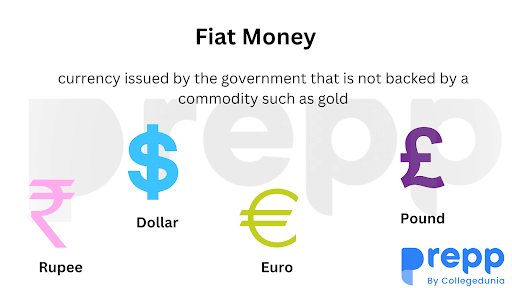
- Fiat money is a currency issued by the government that is not backed by a commodity such as gold.
- Since fiat money gives central banks control over how much money is to be printed, they have greater control over the economy.
- Governments then outlaw all other forms of money, further cementing trust.
- The value of fiat money is determined by the relationship between supply and demand, as well as the stability of the issuing government, rather than by the value of the commodity backing it.
- When fiat money is backed by a gold or silver standard, it is referred to as "representative money".
- And when the central bank promises "to pay the bearer the sum of this many rupees," fiat currency is referred to as an"anonymous bearer bond with zero interest."
- The majority of modern paper currencies, including the US dollar, the euro, and other major global currencies, are fiat currencies.
| Other Relevant Links | |
|---|---|
| Cryptocurrency | Commodity Money |
| Fiduciary money | Legal tender money |
Fiat Money – Historical Background
- The term "fiat" is a Latin word that means "it shall be" or "let it be done."
- The origins of fiat money can be traced back to the 11th century Chinese Tang dynasty.
- By the 12th century, fiat money had spread throughout the country. It was known by several names, including jiaozi, huizi, and guanzi.
- In his book The Travels of Marco Polo, Marco Polo described the Yuan Dynasty's fiat money in the 13th century:
- "All these pieces of paper are issued with as much solemnity and authority as if they were of pure gold or silver; and on every piece, a variety of officials, whose duty it is, have to write their names and put their seals."
Features of Fiat Money
The features of fiat money are:
- Fiat money is any currency that is not secured by a commodity.
- Money that has been declared legal tender by a person, organisation, or government is required to be accepted in certain situations as payment for a debt.
- Fiat money is state-issued money that is neither fixed in value according to any external benchmarks nor convertible into anything else through a central bank.
- Money is used as a result of a government order.
- It is a non-valuable item that is used as a means of exchange (also known as fiduciary money).
Why Do Modern Economies Favor Fiat Money?
- Prior to the 20th century, the majority of countries used some form of the gold standard or commodity backing.
- The limited supply of gold coming out of mines and in central bank vaults, however, was insufficient to keep up with the new value being created.
- Global markets and commerce have been severely disrupted as a result.
- Fiat money allows governments more freedom to control their own currencies, establish monetary policy, and maintain market stability.
- Additionally, it permits fractional reserve banking, which enables commercial banks to increase the amount of cash on hand to satisfy borrower demand.
- This is the reason why modern economies favour fiat money.
Fiat Money – Significance
- Fiat money has the potential to be more stable than commodities as a form of money.
- This is due to a consistent supply provided by the central bank or government – whoever is in charge.
- Since fiat money is not a scarce or fixed resource like gold, central banks have far greater control over its supply, allowing them to manage economic variables like credit supply, liquidity, interest rates, and money velocity.
- Fiat money is a good currency if it can perform the functions that a country's economy requires of its monetary unit, such as storing value, providing a numerical account, and facilitating exchange.
- It is less expensive to produce than a currency that is directly linked to a commodity.
- Fiat money gives governments more leeway in managing their own currency, setting monetary policy, and stabilizing global markets.
- It also permits fractional reserve banking, which allows commercial banks to multiply the amount of money on hand to meet borrowers' demands.
Fiat Money – Limitations
- Monetary policies that reduce the value of money result in overprinting of currency, which may result in hyperinflation.
- Itis still bulky to carry, reducing its movability.
- Theft risk and vulnerability to counterfeit (duplicate/fake currency)
- Money cannot be easily divided into small increments to more precisely match commodity values, which leads to the rounding-off problem.
- For example, due to a change problem, petrol pumps are not returning 60 paise per customer.
- Hyperinflation occurs when inflation rises at an extremely rapid rate. Inflation rates can rise from 50 to 300 times.
- If people lose faith in a country's currency, the money loses its value. This is not the same as a gold-backed currency.
- The 2007 mortgage crisis and subsequent financial meltdown, on the other hand, tempered the belief that central banks could always prevent depressions or severe recessions by regulating the money supply.
- Due toits unlimited supply, fiat money provides more opportunities for the creation of bubbles.
Conclusion
Fiat currencies have value only because the government maintains it; there is no utility to fiat money in and of itself. Since there is no underlying commodity backing fiat money, it is inconvertible and cannot be redeemed.
| Other Relevant Links | |
|---|---|
| Indian Economics Notes | Monetary Policy |
| Functions of money | Monetary Policy Tools |
| Types of Monetary Policy | Money Supply |
FAQs
Question: What distinguishes fiat money from commodity money?
Answer: The main distinction between fiat money and commodity money is that fiat money has no intrinsic value and is not backed by a physical asset. In contrast, commodity money is based on a tangible good, such as gold or silver, which has its own value. Fiat money derives its value from the trust placed in the government that issues it, whereas commodity money's value is tied to the market price of the underlying commodity. This makes fiat money more flexible for governments to manage and regulate monetary supply.
Question: Why is fiat money important for modern economies?
Answer: Fiat money is crucial for modern economies for several reasons:
- Monetary Policy: Fiat money allows central banks to implement monetary policy effectively, controlling inflation, interest rates, and money supply to stabilize the economy.
- Liquidity: It provides liquidity in the economy, making it easier for individuals and businesses to conduct transactions and access credit.
- Flexibility: Governments can adjust the supply of fiat money in response to economic conditions, providing flexibility to address economic challenges.
- Facilitation of Trade: Fiat money simplifies trade by serving as a common medium of exchange, enhancing efficiency in transactions.
- Stability: When backed by a credible government, fiat money can provide a stable currency that helps maintain confidence in the economy.
Question: What are the potential risks associated with fiat money?
Answer: The risks associated with fiat money include:
- Inflation: Excessive issuance of fiat money can lead to inflation, eroding purchasing power and destabilizing the economy.
- Loss of Confidence: If people lose faith in the currency or the government that issues it, the value of fiat money can plummet, leading to economic instability.
- Currency Devaluation: Governments may devalue their currency to boost exports, which can harm importers and lead to inflation.
- Dependence on Government Stability: The value of fiat money is heavily dependent on the political and economic stability of the issuing government.
- Market Speculation: Speculative activities in currency markets can cause fluctuations in fiat money's value, impacting international trade and investment.
Question: How does the value of fiat money remain stable?
Answer: The value of fiat money remains stable primarily through the confidence of its users in the issuing government and its economic policies. Key factors that contribute to this stability include:
- Central Bank Policies: Central banks regulate the supply of money and implement policies to maintain price stability and control inflation.
- Trust in Government: Public trust in the government and its ability to manage the economy significantly impacts the perceived value of fiat money.
- Legal Framework: Fiat money is designated as legal tender, which mandates its acceptance for payments, reinforcing its use in the economy.
- Market Demand: Demand for fiat money for transactions and savings can help maintain its value as long as it is widely accepted and used.
Question: What role does the central bank play in managing fiat money?
Answer: The central bank plays a pivotal role in managing fiat money by:
- Monetary Policy Implementation: Central banks set interest rates and control the money supply to manage economic growth and inflation.
- Currency Issuance: They are responsible for issuing currency notes and coins, ensuring sufficient supply for the economy.
- Stabilizing the Financial System: Central banks act as a lender of last resort during financial crises to maintain stability in the banking system.
- Regulating Banks: They regulate commercial banks and ensure they maintain adequate reserves, supporting the stability of the monetary system.
- Monitoring Economic Indicators: Central banks analyze various economic indicators to make informed decisions regarding monetary policy and fiat money management.
MCQs
1. What type of money is fiat money?
A) Commodity money
B) Asset-backed money
C) Legal tender without intrinsic value
D) International currency
Answer: (C) See the Explanation
Explanation: Fiat money is legal tender that has no intrinsic value and is not backed by a physical commodity, deriving its value from government regulation and trust.
2. Which of the following best describes the value of fiat money?
A) It is determined by the cost of production
B) It fluctuates based on the price of gold
C) It is based on trust in the issuing government
D) It is fixed by international standards
Answer: (C) See the Explanation
Explanation: The value of fiat money is primarily based on trust and confidence in the government that issues it, rather than on intrinsic value.
3. Which of the following is a characteristic of fiat money?
A) It has inherent value
B) It is easily convertible into gold
C) It is accepted as a medium of exchange by law
D) It requires collateral to be issued
Answer: (C) See the Explanation
Explanation: Fiat money is accepted as a medium of exchange by law, making it legal tender for transactions.
4. What is one major risk associated with fiat money?
A) Currency devaluation
B) Intrinsic value
C) Limited liquidity
D) Difficulty in conversion
Answer: (A) See the Explanation
Explanation: One major risk associated with fiat money is currency devaluation, which can occur if the government issues excessive amounts of money.
5. Which institution is primarily responsible for managing fiat money in a country?
A) Commercial banks
B) Central bank
C) Stock exchanges
D) Government ministries
Answer: (B) See the Explanation
Explanation: The central bank is primarily responsible for managing fiat money, including regulating the money supply and implementing monetary policy.
GS Mains Questions and Model Answers
Q1: Discuss the advantages of fiat money over commodity money.
Answer: Fiat money offers several advantages over commodity money, including flexibility and ease of management. Since fiat money is not tied to a physical commodity, central banks can adjust the money supply in response to economic conditions, allowing for effective monetary policy implementation. This flexibility helps stabilize the economy by controlling inflation and influencing interest rates. Additionally, fiat money reduces the costs and complexities associated with holding and transporting physical commodities, making transactions more efficient. Furthermore, the potential for greater economic growth exists because fiat money can support expanded credit systems, enhancing overall economic activity.
Q2: Analyze the potential consequences of excessive fiat money issuance by a government.
Answer: Excessive issuance of fiat money can lead to significant consequences, most notably inflation. When a government prints more money without a corresponding increase in goods and services, the result is too much currency chasing too few goods, leading to rising prices. This inflation erodes purchasing power, negatively impacting consumers and savers. In extreme cases, hyperinflation can occur, destabilizing the economy and undermining public trust in the currency. Furthermore, excessive fiat money can lead to currency devaluation, making imports more expensive and potentially resulting in a trade imbalance. Managing the money supply is critical to maintaining economic stability and confidence in the currency.
Q3: Evaluate the role of central banks in regulating fiat money and maintaining economic stability.
Answer: Central banks play a crucial role in regulating fiat money and maintaining economic stability through various tools and policies. They implement monetary policy by adjusting interest rates and controlling the money supply to manage inflation and promote economic growth. By setting benchmark interest rates, central banks influence borrowing and spending behavior in the economy, guiding it towards desired economic outcomes. Additionally, central banks monitor financial institutions to ensure they maintain adequate reserves, reducing systemic risks. Through transparency and communication, they also build public trust, which is essential for the effective functioning of fiat money. Ultimately, central banks act as the guardians of economic stability, using their regulatory powers to respond to changing economic conditions.
Previous Year Questions on Fiat Money
1. UPSC CSE Prelims 2021:
Question: Which of the following best describes fiat money?
A) Money backed by physical commodities
B) Money with intrinsic value
C) Currency issued by the government without backing
D) International currency accepted worldwide
Answer: (C)
Explanation: Fiat money is currency issued by the government that has no intrinsic value and is not backed by a physical commodity.
2. UPSC CSE Mains 2019 (GS Paper 1):
Question: "Examine the impact of fiat money on economic stability and growth." Discuss both advantages and challenges.
Answer: Fiat money has a significant impact on economic stability and growth. Its flexibility allows central banks to adjust monetary policies to respond to economic fluctuations, promoting growth and stability. However, excessive issuance can lead to inflation, eroding purchasing power and causing economic instability. The trust placed in fiat money is crucial; if confidence wanes, it can result in devaluation and a loss of stability. Balancing these dynamics is essential for harnessing the benefits of fiat money while mitigating its potential risks to ensure sustainable economic development.
Download the PREPP App and attempt FREE IAS Exam Mock Tests and get complete study material!

Full Test - 04: UPSC CSE Prelims CSAT (Paper-II)
Full Test - 03: UPSC CSE Prelims CSAT (Paper-II)
UPSC CSE Prelims 2026 GS Paper 1 Question Paper (24-May-2026)
UPSC CSE Prelims 2026 CSAT Paper 2 Question Paper (24-May-2026)

17 February 2025 | The Hindu Must Read Articles | Current Affairs

16 February 2026 | The Hindu Must Read Articles | Current Affairs

13 February 2026 | The Hindu Must Read Articles | Current Affairs









Comments