Cryptocurrency – Indian Economy Notes
Cryptocurrency is a digital currency that is an alternative payment method created using encryption methods. Cryptocurrency uses blockchain technology to achieve decentralisation, transparency, and immutability (the ability of a blockchain ledger to remain unchanged, unaltered and indelible). Cryptocurrency has a decentralised structure and so it can exist independently of governments and central authorities. “Cryptocurrency” is one of the important concepts in the UPSC/IAS 2023 Economy syllabus which is discussed in this article in detail.
| To Read update on this topic: |
|
Table of Contents |
What exactly is Cryptocurrency?
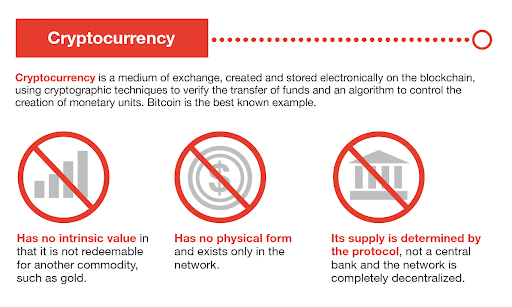
- Cryptocurrency or crypto-currency or crypto means online money created using digits or digital encryptions.
- A cryptocurrency is an internet-based medium of exchange that is distributed across many computers.
- A cryptocurrency conducts financial transactions using cryptographic functions.
- The most important characteristic of a cryptocurrency is that it is not controlled by any central authority. i.e., the decentralised nature of cryptocurrencies is theoretically immune to traditional methods of government control and interference.
- Blockchain and related technology, according to experts, will disrupt many industries, including finance and law.
- The benefits of cryptocurrencies include cheaper and faster money transfers, as well as decentralised systems that do not fail at a single point.
- Cryptocurrency disadvantages include price volatility, high energy consumption for mining activities, and use in criminal activities.
- Cryptocurrencies are not widely accepted as money due to their lack of legal tender status.
- El Salvador became the first country in the world to accept cryptocurrency as legal tender in June 2021.
|
The term "crypto" refers to the encryption algorithms and cryptographic techniques used to protect the entries such as elliptical curve encryption, public-private key pairs, and hashing functions. |
| Other Relevant Links | |
|---|---|
| Commodity Money | Fiat money |
| Fiduciary money | Legal tender money |
Evolution of Cryptocurrency
- Bitcoin, the first decentralized cryptocurrency, was created in 2009 by a presumably anonymous developer named Satoshi Nakamoto.
- Subprime mortgage crisis and recession in 2008-2009 resulted in Quantitative Easing (the introduction of new money into the money supply by a central bank) of the dollar in the United States, which increased dollar supply and eroded dollar purchasing power.
- Banks charge fees for online transfers, credit card transactions, and ATM withdrawals.
- From the creation of Bitcoin in 2009 to the present day, cryptocurrencies have grown in popularity all over the world.
- The gains made by this sector since the onset of the Covid-19 pandemic in January 2020 have been astounding; the "crypto market" has grown by more than 500%.
Bitcoin
- Bitcoin is an electronic or digital currency that operates on a peer-to-peer basis. It is decentralized, with no centralized authority in charge.
- Bitcoins can be digitally sent to anyone with a bitcoin address anywhere in the world. One person may have multiple addresses for various purposes such as personal, business, and so on.
- Satoshi Nakamoto proposed bitcoin, a mathematically-proofed electronic payment system.
- A bitcoin is not printed currency, but rather a non-reputable (assurance that no one can deny the legitimacy of something) record of every transaction that it has been through. All of this is part of a massive ledger known as the blockchain.
- Since no authority controls or tracks the generation of the coins, the system is designed in such a way that the network keeps a foolproof record of every transaction as well as tracking the issuance of the currency sent without either side knowing the identity of the other Bitcoins is 'mined' using computing power in a distributed network.
- It is the first example of a new type of currency known as cryptocurrency.
Types of Cryptocurrency
- There are thousands of types of cryptocurrencies. Some of the well-known types of cryptocurrencies are
- Bitcoin: Bitcoin is one of the most traded and covered cryptocurrencies to date. Bitcoin was established in 2009. The currency was created by Satoshi Nakamoto, who is generally believed to be a pseudonym for an individual or group of individuals whose exact identity is still unknown.
- Ethereum: Ethereum, a blockchain platform created in 2015, has its own digital currency called Ether (ETH), also known as Ethereum. After Bitcoin, it is the most widely used cryptocurrency.
- Litecoin: This currency is most related to bitcoin, although it has moved more quickly to build new features, such as speedier payments and processes to allow for more transactions.
- Ripple: A distributed ledger system called Ripple was created in 2012. Ripple is a tool that can be used to track more than just cryptocurrency transactions. The organisation that created it has collaborated with numerous banks and financial organisations.
- The term "altcoins" is used to distinguish non-Bitcoin cryptocurrencies from the original.
How does Cryptocurrency work?
- A distributed public database known as blockchain, which is updated and maintained by currency holders, is the foundation for cryptocurrencies.
- Through a process known as mining, which employs computer power to solve challenging mathematical problems, units of Bitcoin are created.
- Additionally, users have the option of purchasing the currencies from brokers, then storing and spending them in digital wallets.
- When a user holds cryptocurrencies, they don't actually own anything. What they possess is a key that enables them to transfer a record or a unit of measurement between people without the use of a reliable third party.
- Despite the fact that Bitcoin has been available since 2009, the financial applications of cryptocurrencies and blockchain technology are constantly developing, and more are anticipated in the future.
- The technology could someday be used to trade bonds, equities, and other financial assets.
|
Legality of Cryptocurrency
|
Cryptocurrency - Significance
- Cryptocurrencies represent a new, decentralized money paradigm.
- Centralized intermediaries, such as banks and monetary institutions, are not required in this system to enforce trust and police transactions between two parties.
- Thus, a cryptocurrency-based system eliminates the possibility of a single point of failure, such as a large bank, triggering a global crisis, such as the one triggered in 2008 by the failure of institutions in the United States.
- Cryptocurrencies promise to make it easier to transfer funds between two parties without the need for a trusted third party such as a bank or credit card company.
- Cryptocurrency transfers between two transacting parties are faster than traditional money transfers because they do not use third-party intermediaries.
- Profits can be made from cryptocurrency investments. The value of cryptocurrency markets has skyrocketed.
- It is a less expensive option when compared to other online transactions.
- The transfer of funds is completed with minimal processing fees.
Cryptocurrency - Limitations
- Cryptocurrencies, while claiming to be an anonymous form of transaction, are actually pseudonymous. They leave a digital trail that agencies can decipher.
- Cryptocurrencies have grown in popularity among criminals as a tool for nefarious activities such as money laundering and illegal purchases.
- Cryptocurrencies have also become popular among hackers, who use them to carry out ransomware attacks.
- In theory, cryptocurrencies are supposed to be decentralized, with their wealth distributed among many parties via a blockchain. In practice, ownership is extremely concentrated.
- One of the conceits of cryptocurrencies is that anyone with a computer and an internet connection can mine them.
- Mining popular cryptocurrencies, on the other hand, necessitates a significant amount of energy, sometimes equivalent to that consumed by entire countries.
- While cryptocurrency blockchains are extremely secure, other crypto repositories, such as exchanges and wallets, are vulnerable to hacking.
- Price volatility affects cryptocurrencies traded on public markets. Bitcoin's value has gone through rapid ups and downs.
- Some economists believe that cryptocurrencies are a passing fad or speculative bubble.
Cryptocurrency in India
- The RBI issued a circular in 2018 prohibiting all banks from dealing in cryptocurrencies. In May 2020, the Supreme Court ruled that this circular was unconstitutional.
- The government recently announced the introduction of a bill, Cryptocurrency, and Regulation of Official Digital Currency Bill, 2021, to create a sovereign digital currency while simultaneously prohibiting all private cryptocurrencies.
- The funds invested in Indian blockchain start-ups account for less than 0.2 percent of the total amount raised by the sector globally.
- The current cryptocurrency approach makes it nearly impossible for blockchain entrepreneurs and investors to gain significant economic benefits.
Way Forward
- Regulation is required to prevent serious problems, to ensure that cryptocurrencies are not misused, and to protect unsuspecting investors from excessive market volatility and potential scams.
- The regulation must be clear, transparent, and coherent, and it must be animated by a vision of what it seeks to achieve.
- A legal and regulatory framework must define crypto-currencies as securities or other financial instruments under applicable national laws and identify the regulatory authority in charge.
- Rather than outright prohibiting cryptocurrencies, the government should regulate their trading by instituting stringent KYC norms, reporting, and taxation.
- To address concerns about transparency, information availability, and consumer protection, steps such as record keeping, inspections, independent audits, investor grievance redressal, and dispute resolution may be considered.
- Cryptocurrencies and Blockchain technology have the potential to rekindle the entrepreneurial spirit in India's startup ecosystem by creating job opportunities at all levels, from blockchain developers to designers, project managers, business analysts, promoters, and marketers.
Conclusion
Cryptocurrencies provide unique opportunities for increasing people's economic independence all across the world. Even in nations with strict government restrictions over citizens' finances, unrestricted trade is facilitated by the intrinsic borderlessness of these digital currencies. Cryptocurrencies also can serve as an alternative to malfunctioning fiat currencies for savings and payments in regions where inflation is a major issue.
| Other Relevant Links | |
|---|---|
| Indian Economics Notes | Monetary Policy |
| Functions of money | Monetary Policy Tools |
| Types of Monetary Policy | Money Supply |
FAQs
Question: What is cryptocurrency?
Answer: Cryptocurrency is a type of digital or virtual currency that uses cryptography for security. It is decentralized, meaning it is not controlled by any central authority like a government or financial institution. Instead, cryptocurrencies operate on blockchain technology, which is a distributed ledger that records transactions across many computers. Bitcoin, created in 2009, is the first and most well-known cryptocurrency, but thousands of other cryptocurrencies have since been developed, each with its own features and use cases.
Question: How does blockchain technology work in cryptocurrencies?
Answer: Blockchain technology is the foundation of cryptocurrencies. It is a distributed database that stores transaction records across a network of computers, ensuring transparency and security. Each transaction is recorded in a "block," and these blocks are linked in a chronological "chain," forming the blockchain. Blockchain eliminates the need for a central authority to verify transactions, as each participant in the network has access to the same information. This decentralized approach makes it resistant to manipulation and fraud.
Question: What are the benefits of using cryptocurrency?
Answer: The primary benefits of cryptocurrency include: 1. Decentralization: Cryptocurrencies operate on decentralized networks, meaning no central authority controls the transactions. 2. Security: The use of cryptographic methods makes transactions highly secure. 3. Low Transaction Fees: Cryptocurrency transactions typically have lower fees compared to traditional financial systems. 4. Fast Transactions: Cryptocurrency transactions can be processed quickly, even across borders, without the need for intermediaries. 5. Privacy: Cryptocurrencies offer a higher degree of privacy compared to traditional payment methods.
Question: What are the risks associated with cryptocurrencies?
Answer: While cryptocurrencies offer several advantages, they also come with significant risks: 1. Price Volatility: The value of cryptocurrencies can fluctuate wildly, leading to potential financial losses. 2. Lack of Regulation: Cryptocurrencies are not regulated by any central authority, which can lead to issues such as fraud and market manipulation. 3. Security Concerns: Although blockchain is secure, exchanges and wallets can be hacked, leading to loss of funds. 4. Legal Risks: In many countries, the legality of cryptocurrency is uncertain, and some governments have imposed restrictions or banned its use. 5. Environmental Impact: The energy consumption required for mining cryptocurrencies like Bitcoin has raised environmental concerns.
Question: What is the future of cryptocurrency in India?
Answer: The future of cryptocurrency in India remains uncertain. While cryptocurrencies have gained popularity in India, the government has been cautious in its approach. The Reserve Bank of India (RBI) initially imposed a banking ban on cryptocurrency transactions in 2018, but the Supreme Court lifted the ban in 2020. Despite this, there is still no clear regulatory framework for cryptocurrencies in India. The government is considering various options, including the potential introduction of a central bank digital currency (CBDC) and regulations to control the use of private cryptocurrencies. The adoption of cryptocurrency in India will depend on regulatory decisions, technological advancements, and market developments.
MCQs
1. What is the key technology behind cryptocurrencies?
A) Cloud computing
B) Blockchain technology
C) Artificial Intelligence
D) Quantum computing
Answer: (B) See the Explanation
Explanation: Blockchain technology is the fundamental technology behind cryptocurrencies, providing a decentralized and secure method of recording transactions.
2. Which of the following is the first cryptocurrency?
A) Ethereum
B) Litecoin
C) Bitcoin
D) Ripple
Answer: (C) See the Explanation
Explanation: Bitcoin, created by an anonymous individual or group known as Satoshi Nakamoto in 2009, is the first and most well-known cryptocurrency.
3. What does the term "mining" mean in the context of cryptocurrencies?
A) Creating new cryptocurrencies
B) Transferring cryptocurrencies from one account to another
C) Verifying transactions on the blockchain
D) Storing cryptocurrencies securely
Answer: (C) See the Explanation
Explanation: Mining in cryptocurrencies refers to the process of verifying transactions on the blockchain by solving complex mathematical problems. Miners are rewarded with new coins for their efforts.
4. Which of the following is a major disadvantage of cryptocurrencies?
A) High transaction fees
B) Price volatility
C) Centralized control
D) Limited availability
Answer: (B) See the Explanation
Explanation: Cryptocurrencies are known for their price volatility, meaning their value can fluctuate dramatically over short periods, which poses a risk to investors.
5. What is the potential environmental impact of cryptocurrency mining?
A) Reduced carbon footprint
B) High energy consumption
C) No environmental impact
D) Decreased pollution
Answer: (B) See the Explanation
Explanation: Cryptocurrency mining, especially Bitcoin mining, consumes significant amounts of energy, leading to concerns about its environmental impact, particularly in terms of carbon emissions.
GS Mains Questions and Model Answers
Q1: Evaluate the economic implications of cryptocurrencies in India. How do they affect the Indian economy, both positively and negatively?
Answer: Cryptocurrencies in India present both opportunities and challenges for the economy. On the positive side, cryptocurrencies offer a new avenue for investment and can encourage technological innovation in the financial sector. They have the potential to improve financial inclusion by offering decentralized financial services to people without access to traditional banking. Cryptocurrencies can also facilitate faster cross-border transactions, reducing the need for intermediaries and lowering transaction costs. However, there are significant challenges as well. The volatility of cryptocurrencies poses a risk to investors, and the lack of regulation leads to concerns about money laundering and fraud. Additionally, the energy-intensive nature of cryptocurrency mining raises environmental concerns. The Indian government’s stance on cryptocurrencies remains uncertain, as it balances the potential benefits with the need for regulatory oversight.
Q2: Discuss the role of blockchain technology in transforming the financial services sector, particularly with regard to cryptocurrencies.
Answer: Blockchain technology has the potential to revolutionize the financial services sector by providing a decentralized, secure, and transparent method for recording transactions. Unlike traditional banking systems, which rely on central authorities, blockchain allows for peer-to-peer transactions, reducing costs and improving efficiency. The use of blockchain in cryptocurrencies ensures that transactions are tamper-proof and recorded in a way that is immutable, providing trust among users. Additionally, blockchain can enable faster cross-border payments and provide access to financial services for the unbanked. However, its implementation in mainstream financial systems requires overcoming challenges such as scalability, regulatory concerns, and the integration with existing infrastructure. The rise of cryptocurrencies is a direct result of blockchain’s capabilities, offering an alternative financial system that operates outside traditional banking norms.
Q3: Analyze the challenges and opportunities posed by the growing use of cryptocurrencies in India. What regulatory measures could the government take to address these concerns?
Answer: The growing use of cryptocurrencies in India presents both opportunities and challenges. On the opportunity side, cryptocurrencies can foster innovation in the financial sector, create new job opportunities, and drive digital literacy. They can also promote financial inclusion by enabling access to financial services for people in remote areas who lack access to traditional banking. On the other hand, cryptocurrencies pose several challenges. The volatility of cryptocurrencies can lead to significant financial risks for investors, and the lack of regulation has raised concerns about fraud, tax evasion, and money laundering. Furthermore, the environmental impact of cryptocurrency mining is a growing concern due to its high energy consumption. To address these issues, the Indian government could introduce regulations to govern cryptocurrency exchanges, enforce anti-money laundering measures, and provide clear guidelines for taxation. Additionally, the government could explore the development of a central bank digital currency (CBDC) to provide a state-backed digital currency alternative while maintaining regulatory control over the financial system.
Previous Year Questions on Cryptocurrency
1. UPSC CSE Prelims 2021:
Question: Which of the following statements about cryptocurrencies is true?
A) Cryptocurrencies are always regulated by the government.
B) Cryptocurrencies are backed by physical assets like gold.
C) Cryptocurrencies operate on blockchain technology.
D) Cryptocurrencies can only be used within their country of origin.
Answer: (C)
Explanation: Cryptocurrencies operate on blockchain technology, a decentralized ledger system that records transactions across multiple computers, ensuring security and transparency.
2. UPSC CSE Mains 2019 (GS Paper 2):
Question: "Examine the regulatory challenges associated with cryptocurrencies in India. What measures can be taken to ensure their safe use in the economy?"
Answer: The rise of cryptocurrencies presents several regulatory challenges in India. The decentralized nature of cryptocurrencies makes it difficult for the government to control transactions, which increases the risk of illegal activities such as money laundering and fraud. Additionally, the volatility of cryptocurrencies poses a risk to investors and the broader economy. To address these challenges, the Indian government could introduce regulations to ensure proper registration of exchanges, enforce anti-money laundering measures, and create a regulatory framework that defines how cryptocurrencies should be taxed. Furthermore, the government could explore the introduction of a central bank-backed digital currency to provide a more secure and regulated alternative to private cryptocurrencies.
Download the PREPP App and attempt FREE IAS Exam Mock Tests and get complete study material!

Full Test - 04: UPSC CSE Prelims CSAT (Paper-II)
Full Test - 03: UPSC CSE Prelims CSAT (Paper-II)
UPSC CSE Prelims 2026 CSAT Paper 2 Question Paper (24-May-2026)
UPSC CSE Prelims 2026 GS Paper 1 Question Paper (24-May-2026)

17 February 2025 | The Hindu Must Read Articles | Current Affairs

16 February 2026 | The Hindu Must Read Articles | Current Affairs

13 February 2026 | The Hindu Must Read Articles | Current Affairs









Comments