India’s Annual Solar Capacity Addition Needs To Increase Annually By 36% Till 2026-27 To Meet 14th NEP Targets
Relevance: Prelims - Environment, Renewable Energy Targets; GS3 - Infrastructure: Energy,
(Source: Down To Earth, 10/04/2023)
Click here for Daily Current Affairs
Why in the news?
Recently, a report by global energy think tank Ember revealed that India must increase its current annual solar capacity addition by about 36% annually to achieve the 14th National Electricity Plan’s target of 185.6 GW by 2026-27.
Table of Contents
What are the findings of the report?
- Expansion of solar capacity: India’s total national solar capacity is expected to rise to 66.7 GW after the commissioning of 12.9 GW in the current FY.
- However, this is still not sufficient to fulfill the NEP’s target of 185.6 GW by FY 2026-27.
- RWE energy: Last year, India generated about 22% of its electricity, i.e. around 330 terawatt-hour (TWh) from renewable energy sources, including large hydropower.
- If India continue to add renewable energy at the intended capacity, the share of renewable energy will double to 44% i.e. 1,180 TWh by 2032.
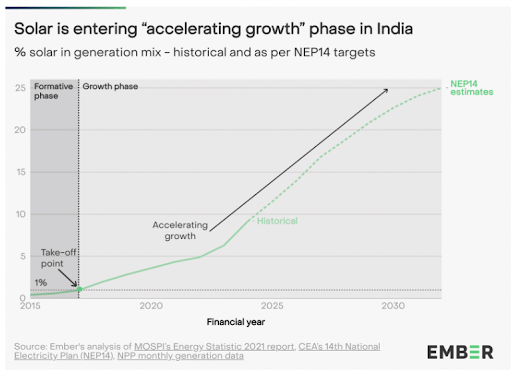
- Share of solar energy: The share of solar energy is expected to increase from 6.3% (102 TWh) in FY 2023 to 17% (339 TWh) in FY2027 and 25% (666 TWh) by FY2032.
- Solar energy’s share of the energy portfolio rose from 5% in FY 2022 to 6.3% in 2023.
- If the NEP14 targets are met, solar's share in the power mix is projected to grow from 6.3% in FY 2023 to 25% in FY 2032.
- Transition in Electricity Generation: There will be a significant transition from coal power-dominated generation to solar and wind energy generation.
- According to NEP14, India's total annual electricity generation will reach 1,174 TWh during 2022-32.
- Recommendation: India must commission a minimum of 17.5 gigawatts in FY 2024 and increase it up to 41 gigawatts by FY 2027 in order to meet the NEP targets.
- If India continues to commission solar capacity at this rate beyond FY 2027, it will surpass its target capacity of 365 GW by March 2032.
Challenges
- Grid flexibility and storage: The expansion of variable renewable energy (VRE) requires improved grid flexibility and storage solutions.
- As solar and wind energy is likely to drive the growth in energy generation in the next decade, it is necessary to develop storage capacity.
- This will help balance energy generation and demand.
- Challenges in VRE tenders: A major challenge faced by the energy sector is the under-subscription of tenders and reduced tender issue rates.
- According to the Institute of Energy Economics and Financial Analysis, VRE tenders issued annually in India have dropped from 40 GW in 2019 to around 28 GW in 2022.
- This is mainly due to the financial duress and the rising cost of solar modules.
- Rising solar tariffs: Solar tariffs in India rose from ₹1.99 per kWh in 2020 to ₹2.51 in Q1 2023.
- This was attributed to supply-chain disruptions, GST rate hikes, insurance costs, and customs duties.
- Model and Manufacturer Restrictions: The reinstatement of the Approved List of Models and Manufacturers which is suspended untill March 2024 is expected to raise costs.
- The List restricts participation in government-bid solar development projects only to specific indigenous models and manufacturers.
|
|
What is the National Electricity Plan?
- The NEP is a document that guides the development of the power sector in India.
- It is formulated by the Central Electricity Authority (CEA) every five years under the Electricity Act, 2003.
- It includes short-term (5-year) and long-term plans (15-year) to assess the demand for planning capacity addition and coordinate the activities of various planning agencies.
- Aim: Ensure the efficient and optimal utilization of resources in the power sector.
- Functions:
- Periodic Assessment: It conducts periodic assessments, including a review of the preceding five years (2017-22), to assess the power sector's performance.
- Capacity Planning: It formulates capacity addition requirements for the upcoming five-year period (2022-27) after considering the evolving demand and requirements for energy.
- Long-Term Vision: It provides projections for the period from 2027 to 2032, and offers a strategic outlook for the power sector.
2022-27 NEP
- Additional coal-based capacity: It recognizes the need for an increase in coal-based capacity, with a projected range of 17 GW to nearly 28 GW, to be achieved by 2031-32 in addition to the existing 25 GW of coal-based capacity that is presently under construction.
- Investment in battery storage: It highlights the need for investments in battery storage.
- Battery storage capacity must be increased from 51 GW to 84 GW by 2031-32.
- Plant load factor improvement: Enhance the Plant Load Factor (PLF) of coal-fired power plants by increasing the utilization rate 55% to 62% by 2031-32.
- It also emphasizes on the need for greater operational efficiency.
- Renewables: It recognizes the need for careful and strategic management of the energy sector given the increasing reliance on renewable energy sources.
(*Click this link to read prelims specific weekly current affairs articles)
FAQs
Question: What is variable renewable energy?
Answer:
Variable renewable energy (VRE) or intermittent renewable energy sources (IRES) are renewable energy sources that have a fluctuating nature. These sources only produce electricity in optimal weather conditions such as when the wind is blowing (wind) or the sun is shining (solar).
Question: What is the Central Electricity Authority (CEA)?
Answer:
The Central Electricity Authority (CEA) is a statutory organization constituted under the repealed Electricity (Supply) Act, 1948. It was initially established as a part time body in 1951 and made a full time body in 1975. The CEA is headed by a chairperson who also acts as the Chief Executive of the authority and consists of not more than 14 members of which not more than 8 full time members shall be appointed by the Union Government.
Question: What is Plant Load Factor (PLF)?
Answer:
PLF or Plant Load Factor refers to the ratio of actual energy generated by a power plant to the maximum possible energy that could have been generated by it in a given period.
UPSC Mains Practice Question:
|
MCQs
Question: With reference to solar power production in India, consider the following statements
- India is the third largest in the world in the manufacture of silicon wafers used in photovoltaic units.
- The solar power tariffs are determined by the Solar Energy Corporation of India.
Which of the statements given above is/are correct? (UPSC CSE 2018)
(a) 1 only
(b) 2 only
(c) Both 1 and 2
(d) None of the above
Answer: (d) See the Explanation
- India is not a leading manufacturer of silicon wafers for use in photovoltaic units. Hence statement 1 is incorrect.
- Solar tariffs in India are regulated under the Electricity Act and not by the Solar Energy Corporation of India. Hence statement 2 is incorrect.
Therefore, option (d) is the correct answer.
Download the PREPP App and attempt FREE IAS Exam Mock Tests and get complete study material!

Full Test - 04: UPSC CSE Prelims CSAT (Paper-II)
Full Test - 03: UPSC CSE Prelims CSAT (Paper-II)
UPSC CSE Prelims 2026 GS Paper 1 Question Paper (24-May-2026)
UPSC CSE Prelims 2026 CSAT Paper 2 Question Paper (24-May-2026)

17 February 2025 | The Hindu Must Read Articles | Current Affairs

16 February 2026 | The Hindu Must Read Articles | Current Affairs

13 February 2026 | The Hindu Must Read Articles | Current Affairs









Comments