Mission LiFE - Environment Notes
Mission LiFe which stands for 'Lifestyle For Environment' is a worldwide project launched by India to assist the world in combating climate change. It aims to encourage individual and collective acts toward environmental conservation and preservation. India proposed the LiFE concept to the United Nations Climate Change Conference of the Parties (COP26) in Glasgow in 2021. The notion supports an ecologically conscientious lifestyle that focuses on 'mindful and intentional use' instead of 'mindless and wasteful consumption.
This article explains about the Mission LiFe is important for UPSC IAS exam preparation.
|
Table of Contents |
Mission LiFe
- The Prime Minister of India proposed the concept of LIFE at COP26 in Glasgow in November 2021.
- LIFE Global Movement seeks ideas from around the world to foster climate-friendly behaviours in people, households, and communities.
- Mission LiFE stands for 'Lifestyle For Environment'.
- Mission LiFE was inaugurated at Statue of Unity in Gujarat.
- It is intended to mobilise at least one billion Indians and other global citizens to take individual and collective action to safeguard and conserve the environment between 2022 and 2028.
- By 2028, it is hoped that at least 80% of all villages and urban local bodies in India would be environmentally friendly.
- Mission LiFE is led by NITI Aayog and implemented by the Union Ministry of Environment, Forests, and Climate Change.
- Mission LiFE will be carried out by making individual environmentally friendly behaviour a mainstream movement.
Mission LiFE - Three Strategies
- Change in Demand (Phase I): Encouraging people all across the world to take basic but effective environmental activities in their everyday lives.
- Ex: Switching off the car / scooter engines at trac lights / railway crossings can save up to 22.5 billion kWh of energy
- Changes in Supply (Phase II): It is predicted that changes in large-scale individual demand would progressively drive industries and markets to adapt and adjust supply and procurement to the updated demands.
- Ex: Using a cloth bag instead of a plastic bag while shopping can save up to 375 million tonnes of solid waste from entering the landfill
- Policy Change (Phase III): Mission LiFE's long-term objective is to catalyse adjustments in large-scale industrial and government policies that may promote both sustainable consumption and production by influencing demand and supply dynamics in India and throughout the world.
- Ex: Electric mobility.
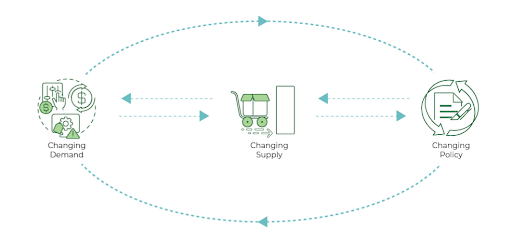
( Mission LiFE - Strategies)
Mission LiFE 2022-23
- In 2022-23, Mission LiFE will concentrate on Phase I, Demand Change, by encouraging people, communities, and institutions to engage in basic environmental-friendly acts (LiFE actions) in their everyday lives.
- Given that Mission LiFE is being launched in the 75th year of India's independence, a thorough and non-exhaustive list of 75 unique LiFE acts spanning 7 categories has been established, with the majority of actions falling into the following categories:
- Specific and measurable.
- Individuals, communities, and organisations may apply it easily, with little supply-side dependencies.
- Non-disruptive to existing economic activity and, in fact, encouraging economic activity in the near future.
Mission LiFe - Need
- Environmental degradation and climate change are global phenomena in which activities in one area of the world have an influence on ecosystems and communities in other parts of the world.
- Several macro initiatives, including policy changes, economic incentives, and laws, have been enacted internationally during the last two decades to address environmental degradation and climate change.
- Despite their great potential, acts at the individual, community, and institutional levels have gotten little attention.
- Individual and societal behaviour changes alone can make a substantial difference in the environmental and climatic challenges.
- According to the United Nations Environment Programme (UNEP), if one billion individuals out of the world's eight billion adopt environmentally beneficial behaviours in their everyday lives, global carbon emissions may be reduced by almost 20%.
Mission LiFe - Benefits and Features
- It aims to replace the present 'use-and-throw' economy with a circular economy, which would be characterised by intentional and purposeful use.
- Leverage social networks: It aims to use the power of social networks to impact societal norms and behaviours in order to propel the campaign.
- Global person networks: The mission is to establish and develop a global network of individuals known as 'Pro-Planet People' (P3) who are committed to adopting and promoting environmentally sustainable lives.
- Differentiated approach: The mission recognises that accountability is proportional to contribution. People who are responsible for increased emissions will be held more accountable. Each stakeholder is urged to act depending on their capabilities.
- Small efforts, huge impact: It demonstrates the ability of tiny actions to have a large influence. It believes in the power of the person to alter the world. It is the motto for righting historical and cultural wrongs done to the environment. Mission LiFE is a rallying cry for individuals and governments to take action to rescue the world.
Mission LiFE - Examples set by India
- Within a seven-year period, the Swachh Bharat Mission (SBM) resulted in the usage of over 100 million toilets in rural India.
- The Ujjwala Scheme boosted the proportion of households with LPG connections from 62% in 2015 to 99.8% by 2021.
- International Solar Alliance: It is a collaborative platform for expanded deployment of solar energy technology in member countries to improve energy access, provide energy security, and drive energy transformation.
- It demonstrates that the government is adopting ecologically friendly policies that encourage renewable energy while reducing the use of fossil fuels.
- National Hydrogen Mission: India has advanced toward a more environmentally friendly energy source through the National Hydrogen Mission.
- This will assist India and many other countries in achieving their aim of having a net zero carbon impact.
- India has communicated its vision of environmental conservation to the rest of the globe by spearheading the formation of the Coalition for Disaster Resilient Infrastructure. The next phase in this series is Mission LiFE.
- India had implemented numerous efforts to aid in the fight against climate change:
- National Afforestation Programme (NAP)
- National Mission for a Green India (GIM)
- National Action Plan on Climate Change (NAPCC)
- National Biodiversity Action Plan
- India’s environment-friendly culture and traditional practices: India shares information from its religious and cultural ethos with the rest of the globe.
- Several unique water collecting systems, tailored to local conditions, are used throughout India. These include Gujarat and Rajasthan's step wells, Tamil Nadu's subterranean tanks (tanqaa), Rajasthan's check dams (johads), and Nagaland's Zabo system.
- Clayware, for example, is frequently used for cooking and serving.
- Adaptive architectural forms that reduce power usage and encourage hand-washing and sun-drying of garments, as well as a nutritional preference for plant-based meals and millets, can serve as LiFE foundations.
- Shift toward more sustainable policies: India is already trying to create a circular economy and is on its way to meeting all of its energy needs with renewables. Our policies are all geared toward ensuring sustainable development, in which the environment is not sacrificed for growth, but the most disadvantaged are not abandoned to their fate by denying them progress.
LiFE and a Sustainable Development Goals (SDGs)
- The Sustainable Development Goals (SDGs) focusing on sustainable cities and communities (SDG 11), responsible production and consumption (SDG 12), climate change (SDG 13), life on land (SDG 15), and life under water (SDG 14) emphasise the importance of all individuals ensuring that their lifestyles are in sync with the resources available on the planet.
- Furthermore, according to the New Climate Economy study, strong environmental action might generate up to 65 million employment by 2030. (SDG 8: Decent Work and Economic Growth).
- Given the worldwide commitment to attaining the SDGs by 2030, it is vital to emphasise that Mission LiFE contributes to practically all of the SDGs, both directly and indirectly.
Future Prospects
- India, the United Nations, and the other 26 entities are proud and dedicated partners in our endeavour to give climate action a fresh lease on life.
- LIFE is a worldwide goal, and India is a great place to begin. With over 1.3 billion people, the momentum produced by a real Jan Andolan here will be huge.
- The next CoP 27 meeting in Egypt provides a critical political opportunity to demonstrate trust and expedite implementation across all pillars of the Paris accord.
- India, with its sensitivity to climate consequences and vast economy, can play an important bridging role.
- And, as India inherits the G20 presidency, it has the potential to usher in a new age of sustainability that is totally consistent with its history, culture, and tradition.
Conclusion
Mission LiFe is an international effort initiated by India to help the globe tackle climate change. Today, there is an urgent need for all of us to band together and launch the Lifestyle For Environment campaign. Climate change action is no longer a pipe dream, but a pressing imperative. Mission LiFE India is attempting to illustrate the climate catastrophe from an individual's point of view. Mission LiFE has the potential to make the climate change campaign a mass movement.
FAQs
Q1: What is Mission LiFE?
Answer: Mission LiFE (Lifestyle for Environment) is an initiative introduced by India to promote sustainable lifestyles and encourage individuals and communities to adopt environmentally-friendly practices in their daily lives. The mission aims to drive behavioral change to mitigate climate change and conserve natural resources.
Q2: Who launched Mission LiFE and when?
Answer: Mission LiFE was launched by Prime Minister Narendra Modi in 2022. It aligns with India's commitment to addressing climate change through individual and collective actions that promote sustainability and environmental conservation.
Q3: What are the primary objectives of Mission LiFE?
Answer: The primary objectives of Mission LiFE are to reduce environmental degradation, encourage sustainable consumption, promote resource conservation, and enhance awareness and community participation in environmentally-friendly practices.
Q4: How does Mission LiFE promote sustainable behavior?
Answer: Mission LiFE promotes sustainable behavior by encouraging individuals and communities to adopt simple lifestyle changes, such as reducing water and energy usage, minimizing waste, using public transportation, and promoting renewable energy sources. The initiative emphasizes collective and individual actions that contribute to a healthier planet.
Q5: What role do individuals play in Mission LiFE?
Answer: Individuals play a crucial role in Mission LiFE by making conscious choices that reduce their environmental impact. Simple actions like conserving water, reducing plastic use, practicing energy efficiency, and participating in community-driven sustainability projects can collectively contribute to significant environmental benefits.
MCQs
- What is the focus of Mission LiFE?
A) Increasing industrial output
B) Promoting sustainable lifestyles and environmental conservation
C) Enhancing international trade
D) Reducing public transportation
Answer: (B) See the Explanation
- Who launched Mission LiFE?
A) United Nations Secretary-General
B) President of the United States
C) Prime Minister Narendra Modi
D) World Bank President
Answer: (C) See the Explanation
- Which year was Mission LiFE launched?
A) 2020
B) 2018
C) 2022
D) 2015
Answer: (C) See the Explanation
- What is a key component of Mission LiFE?
A) Promoting unsustainable consumption
B) Encouraging individual and community actions for sustainability
C) Reducing awareness about climate change
D) Increasing fossil fuel consumption
Answer: (B) See the Explanation
- Which of the following actions aligns with Mission LiFE's goals?
A) Increasing plastic usage
B) Promoting renewable energy sources
C) Ignoring resource conservation
D) Using non-renewable resources freely
Answer: (B) See the Explanation
GS Mains Questions and Model Answers
Q1: Discuss the key objectives and significance of Mission LiFE in promoting sustainable living.
Answer: Mission LiFE (Lifestyle for Environment) aims to promote sustainable lifestyles by encouraging individuals and communities to adopt environmentally-friendly practices. Launched by Prime Minister Narendra Modi in 2022, it focuses on reducing environmental degradation, promoting resource conservation, and encouraging sustainable consumption. The initiative emphasizes collective and individual actions, such as reducing energy and water usage, minimizing waste, and using renewable energy sources. The significance of Mission LiFE lies in its potential to drive behavioral change at a grassroots level, creating a mass movement toward sustainability and climate resilience. By mobilizing individuals and communities, Mission LiFE seeks to mitigate climate change, conserve natural resources, and foster a culture of environmental responsibility.
Q2: Analyze the role of individual and community participation in achieving the goals of Mission LiFE.
Answer: Individual and community participation is central to the success of Mission LiFE, as behavioral changes at the grassroots level can collectively lead to significant environmental benefits. Simple actions, such as conserving water, reducing energy consumption, minimizing single-use plastic, and promoting waste segregation, can be adopted by individuals to reduce their ecological footprint. Communities can organize awareness campaigns, tree-planting drives, and sustainability initiatives that engage and educate people about environmentally-friendly practices. By fostering a sense of responsibility and encouraging collective action, Mission LiFE aims to create a widespread cultural shift towards sustainable living, contributing to climate change mitigation and environmental conservation.
Q3: Explain how Mission LiFE aligns with global climate change goals and sustainable development.
Answer: Mission LiFE aligns with global climate change goals by emphasizing sustainable lifestyles and reducing greenhouse gas emissions through individual and community actions. Its focus on resource conservation, waste reduction, and renewable energy usage supports the United Nations Sustainable Development Goals (SDGs), particularly those related to climate action, responsible consumption, and sustainable communities. By promoting behavior change and environmental awareness, Mission LiFE complements international efforts to limit global warming and protect ecosystems. The initiative demonstrates India’s commitment to climate leadership and highlights the importance of collective action in addressing the global climate crisis.
Previous Year Questions on Mission LiFe
1. UPSC CSE 2020
Question: Evaluate the impact of Mission LiFE on climate change mitigation efforts in India.
Answer: Mission LiFE, launched in 2022, represents a transformative approach to climate change mitigation by encouraging sustainable lifestyles and community-driven environmental actions. By focusing on reducing resource consumption, minimizing waste, and promoting renewable energy, the mission seeks to drive behavioral change and reduce India's carbon footprint. The impact of Mission LiFE lies in its potential to create a mass movement that mobilizes individuals and communities toward climate action. Its grassroots focus complements government policies and large-scale initiatives, contributing to India's broader climate goals. However, achieving its full impact requires effective awareness campaigns, policy support, and active participation from all sections of society.
2. UPSC CSE 2019
Question: Discuss the challenges and opportunities in implementing Mission LiFE in India.
Answer: Implementing Mission LiFE faces challenges such as limited public awareness, resistance to behavioral change, and lack of infrastructure for sustainable practices, such as waste segregation and renewable energy adoption. Socio-economic disparities may also hinder widespread participation. However, the mission presents significant opportunities for climate action, environmental conservation, and public engagement. By promoting simple, sustainable lifestyle changes, it can reduce environmental degradation and encourage collective responsibility. Government support, public-private partnerships, and community-led initiatives can help overcome challenges and ensure the successful implementation of Mission LiFE, creating a sustainable and resilient society.
Download the PREPP App and attempt FREE IAS Exam Mock Tests and get complete study material!

Full Test - 04: UPSC CSE Prelims CSAT (Paper-II)
Full Test - 03: UPSC CSE Prelims CSAT (Paper-II)
UPSC CSE Prelims 2026 GS Paper 1 Question Paper (24-May-2026)
UPSC CSE Prelims 2026 CSAT Paper 2 Question Paper (24-May-2026)

17 February 2025 | The Hindu Must Read Articles | Current Affairs

16 February 2026 | The Hindu Must Read Articles | Current Affairs

13 February 2026 | The Hindu Must Read Articles | Current Affairs









Comments