The Trouble With A Nobel For mRNA COVID Vaccines
Relevance: GS2 - Issues relating to the development and management of Social Sector/Services relating to Health; GS3 - Science and Technology- developments and their applications and effects in everyday life.
(Source: The Hindu, 10/04/2023)
Click here for Daily Current Affairs
Why in the news?
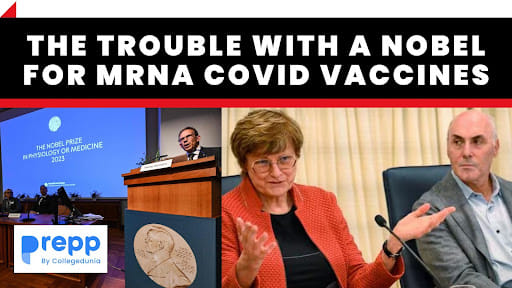
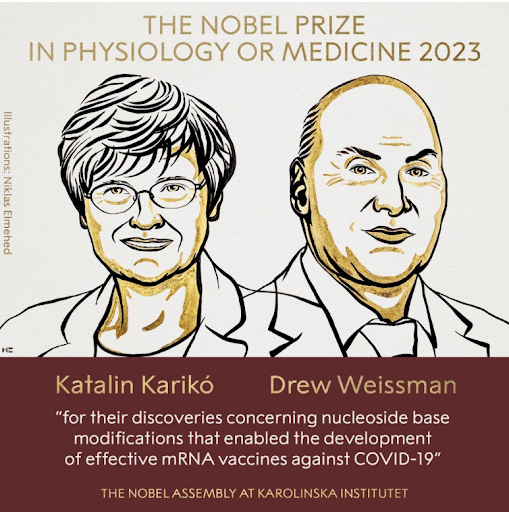
- Recently, the 2023 Nobel Prize for Physiology or Medicine was awarded to Katalin Karikó and Drew Weissman for their pioneering work on mRNA vaccine technology, which played a crucial role in the rapid development of COVID-19 vaccines.
- While their achievements are undeniable, a critical examination reveals complexities surrounding the accessibility and equitable distribution of these vaccines.
Table of Contents
Pioneers of mRNA Technology
- Karikó and Drew Weissman initiated their research on mRNA technology in the late 1990s at the University of Pennsylvania.
- Patents were licensed through a series of sublicensing agreements, ultimately leading to Moderna and BioNTech's involvement.
- Dr. Karikó joined BioNTech, and in collaboration with Pfizer, they developed an mRNA COVID-19 vaccine in 2020.
What is mRNA?
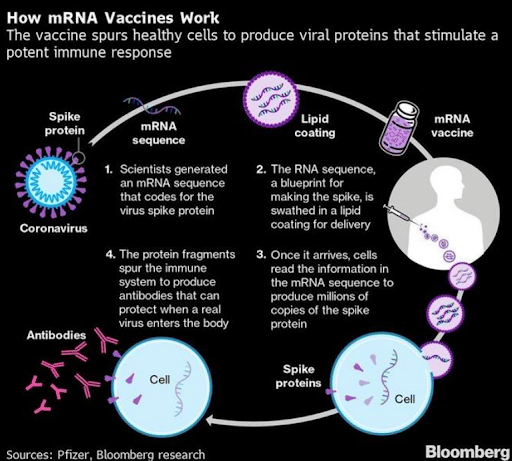
- Messenger RNA (mRNA) is a single-stranded RNA molecule, a type of Ribonucleic Acid (RNA), that serves as a copy of one of the DNA strands within a gene.
- This mRNA molecule exits the cell nucleus and relocates to the cytoplasm, where the process of protein synthesis takes place.
- In the protein synthesis process, a cellular structure known as a ribosome travels along the mRNA strand, interpreting its sequence of bases.
- Using the genetic code, the ribosome translates each three-base group, called a codon, into the specific amino acid it represents. This process ultimately leads to the assembly of proteins from the amino acids in the cytoplasm.
Challenges and Controversies in Drug Development and Vaccine Distribution
- Public Funding in Drug Development: Much of the foundational knowledge behind new drugs and vaccines is discovered with government and public funds. This phase involves identifying potential biomolecular targets and suitable chemical candidates, costing billions of dollars and taking several decades.
- Profit-Driven Drug Development Model: Companies often commercialize these discoveries, reaping significant profits, which can sometimes seem at odds with the public funding that supported the initial research. This model fosters innovation but can also lead to price disparities and profit-seeking attitudes among pharmaceutical companies.
- Vaccine Distribution Challenges: The rollout of mRNA COVID-19 vaccines faced challenges as North American and European countries prioritized their own needs over global distribution. Negotiations over pricing and liability complicated their use in other countries, including India.
Contrasting Approaches to Global Vaccination
- COVAX:
- It aimed to provide mRNA vaccines to poorer countries to address their purchasing power limitations.
- Challenges: COVAX faced challenges in meeting its targets due to overestimated manufacturing capacity in India and concerns over vaccine quality in Russia and China.
- Wastage: Several African countries had to discard vaccine doses due to proximity to expiry dates, highlighting logistical issues.
- WHO's Efforts: The World Health Organization encouraged using expired doses but faced hurdles in countries lacking community engagement and risk communication.
- Corbevax:
- A protein sub-unit vaccine developed by researchers at Baylor College of Medicine and licensed to India's Biological E for manufacturing.
- No Patent: Unlike mRNA vaccines, Corbevax was not patented, emphasizing a commitment to global vaccine access.
- Recognition: Texas politician Lizzie Fletcher nominated the vaccine's developers for a Nobel Prize for Peace, praising their efforts in providing a low-cost COVID-19 vaccine to the world without patent restrictions.
Difference between mRNA and DNA vaccines
| mRNA Vaccines | DNA Vaccines |
|---|---|
| Use messenger RNA (mRNA) as genetic material. | Use DNA (deoxyribonucleic acid) as genetic material. |
| mRNA is relatively fragile and needs lipid protection to remain stable. | DNA is more stable and does not require lipid protection. |
| mRNA vaccines deliver instructions directly to the cell to produce viral proteins. | DNA vaccines often use a harmless virus (vector) to deliver DNA instructions to cells. |
| mRNA vaccines require ultra-low temperatures for storage and transportation. | DNA vaccines can typically be stored at less extreme temperatures (so more suited for tropical countries like India). |
| Both mRNA and DNA vaccines can be adapted quickly to address emerging variants and new diseases by changing the genetic code. | DNA vaccines offer flexibility but may require additional development steps for adaptation. |
| Pfizer/BioNTech and Moderna COVID-19 vaccines are mRNA-based . | Zydus Cadila’s ZyCoV-D vaccine; Covishield (by Serum and Oxford) uses DNA wrapped in another virus, which then instructs cells to make the spike protein. |
Conclusion
- The Nobel Prize awarded to mRNA vaccine developers recognizes their significant scientific contributions but also highlights the disparities in vaccine access and distribution during the COVID-19 pandemic.
- Scientists, including those involved in mRNA vaccine development, often seek to profit from their work.
- The pandemic spotlighted the need for altruism and equitable vaccine distribution. The mRNA technology could have been more universally beneficial if different decisions were made during the pandemic.
- The story of these vaccines underscores the importance of balancing profit motives with global health equity in scientific endeavors.
(*Click this link to read prelims specific weekly current affairs articles)
FAQs
Question: What is mRNA?
Answer:
Messenger RNA (mRNA) is a single-stranded RNA molecule, a type of Ribonucleic Acid (RNA), that serves as a copy of one of the DNA strands within a gene.
Question: Who won the 2023 Nobel Prize for Physiology or Medicine?
Answer:
Recently, the 2023 Nobel Prize for Physiology or Medicine was awarded to Katalin Karikó and Drew Weissman for their pioneering work on mRNA vaccine technology, which played a crucial role in the rapid development of COVID-19 vaccines.
Question: What is the Nobel Prize?
Answer:
The Nobel Prizes are five separate prizes that, according to Alfred Nobel's will of 1895, are awarded to "those who, during the preceding year, have conferred the greatest benefit to humankind." It is awarded in the fields of Physics, Chemistry, Physiology or Medicine, Literature, Economics, and Peace.
UPSC Mains Practice Question:
|
MCQ
Question: In the context of the developments in Bioinformatics, the term ‘transcriptome’, sometimes seen in the news, refers to (UPSC 2016)
(a) a range of enzymes used in genome editing
(b) the full range of mRNA molecules expressed by an organism
(c) the description of the mechanism of gene expression
(d) a mechanism of genetic mutations taking place in cells
Answer: (b) See the Explanation
A transcriptome is the full range of messenger RNA, or mRNA, molecules expressed by an organism. The term "transcriptome" can also be used to describe the array of mRNA transcripts produced in a particular cell or tissue type.
Therefore, option (b) is the correct answer.
Download the PREPP App and attempt FREE IAS Exam Mock Tests and get complete study material!

Full Test - 04: UPSC CSE Prelims CSAT (Paper-II)
Full Test - 03: UPSC CSE Prelims CSAT (Paper-II)
UPSC CSE Prelims 2026 GS Paper 1 Question Paper (24-May-2026)
UPSC CSE Prelims 2026 CSAT Paper 2 Question Paper (24-May-2026)

17 February 2025 | The Hindu Must Read Articles | Current Affairs

16 February 2026 | The Hindu Must Read Articles | Current Affairs

13 February 2026 | The Hindu Must Read Articles | Current Affairs









Comments