Trio Wins Physics Nobel For Finding Way To ‘See’ Electrons
Relevance: GS3 - Science and Technology- developments and their applications and effects in everyday life. Prelims - current events of international importance
(Source: The Hindu, 10/04/2023)
Click here for Daily Current Affairs
Why in the news?
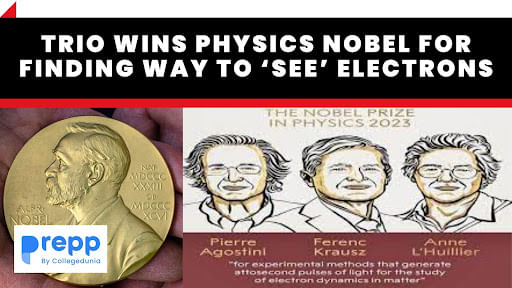
- Recently, the Nobel Prize for Physics was awarded to Pierre Agostini, Ferenc Krausz, and Anne L’Huillier for their groundbreaking contributions to attosecond science.
- They demonstrated a way to create extremely short pulses of light that can be used to measure the rapid processes in which electrons move or change energy.
Table of Contents
Who has been awarded the Nobel Prize for Physics 2023?
- Pierre Agostini, Ferenc Krausz, and Anne L’Huillier won the Nobel Prize for Physics 2023 for their individual research using ultra-quick light flashes which enabled the study of electrons inside atoms and molecules.
- Their research techniques use flashes measured in attoseconds which has made it possible to observe changes that were earlier too fast to be studied.
- Ms. L’Huillier became the fifth woman to be awarded the Nobel Prize in Physics since 1901.
- The other woman winners are Marie Curie (1903), Maria Goeppert-Mayer (1963), Donna Strickland (2018), and Andrea Ghez (2020).
Contributions
- L’Huillier: In 1987, she discovered that when infrared laser light is transmitted through a noble gas, several overtones of light arise.
- Overtones are waves of light whose wavelength is an integer fraction of the beam.
- For instance, if the beam has a wavelength of 100, the overtones would have wavelengths of 10, 25, 50, etc.
- Agostini and Krausz: In the 2000s they worked on individual experiments that made it possible to isolate light pulses that lasted for just a few seconds attoseconds.
How is their research significant?
- “Seeing electrons”: Electrons are negatively charged particles of an atom that move rapidly around the nucleus.
- As a result, cameras that could not lower their exposure time to attoseconds would only capture blurs.
- The work of the three scientists helped observe subatomic motion.
- Understanding electron mechanism: Attosecond science will help scientists understand the mechanisms of atoms and molecules that are governed by electrons.
- It is similar to how high-speed photography helped scientists slow down and observe the flapping of hummingbird wings.
- According to Eva Olsson, Chair of the Nobel Committee for Physics, this will allow scientists to better understand electron-driven phenomena and explore their practical applications.
What are the possible applications of the research?
- The work done by the three scientists is expected to have numerous potential applications in fields like electronics and medical diagnostics.
- Attosecond pulses allow scientists to capture ‘images’ of activities that happen in incredibly short time spans.
- This will help scientists explore short-lived atomic and molecular processes in fields like materials science, electronics, and catalysis.
- Attosecond pulses can be used to detect certain molecules based on their fleeting signatures.
- They can also be used to develop faster and more efficient equipment for use in telecommunications, imaging, and spectroscopy.
- According to the Swedish Royal Academy of Sciences, the research is intimately related to technical developments in laser technology.
Electron dynamics
- The movement of an atom in a molecule occurs in the order of femtoseconds, i.e. one-millionth of a billionth of a second.
- This means that they can be studied with the very shortest pulses produced by a laser.
- However, electrons interact in the attosecond realm, making them much lighter and faster than atoms.
- Scientists initially believed that the light pulses of femtosecond lengths produced during the 1980s were the hard lower limit.
- However this was insufficient to study the interactions of electrons and in 1987, L’Huillier’s experiment revealed overtones of which many were as intense as the original beam.
- Later, research revealed that the overtones emitted were in the form of ultraviolet light and that when multiple overtones were created in the gas, they began to interact with each other.
- All light consists of waves of electric and magnetic energy with each wave having a sinusoidal shape (starting from a point, reaching a peak, dipping into a trough, and finally returning to the same level as the starting point).
- Constructive interference: When the peak of one overtone merges with the peak of another, an overtone of greater intensity is produced.
- Destructive interference: When the peak of an overtone merges with the trough of another, they cancel each other out.
- As a result, scientists concluded that it was possible to create intense pulses of light of a few attoseconds long due to constructive interference, with destructive interference ensuring that they didn’t last for longer.
- In 2001, Pierre Agostini and his research group successfully produced and investigated a series of 250-attosecond light pulses, or a pulse train, which allowed them to conduct some rapid experiments.
- At the same time, Ferenc Krausz and his team in Austria developed a technique to separate an individual 650-attosecond pulse from a pulse train using which researchers could measure the kinetic energy of some electrons released by some krypton atoms.
Nobel Prize
|
(*Click this link to read prelims specific weekly current affairs articles)
FAQs
Question: What is an attosecond?
Answer:
An attosecond is a unit of time equal to one quintillionth (10−18) of a second or one billionth of one billionth of a second.
MCQs
Question: Consider the following statements:
- The Nobel Prize Awarding Ceremony takes place on December 10, of every year.
- The Nobel Prize for Literature was added later on to the other five areas: Physics, Chemistry, Physiology or Medicine, Peace, and Economics.
Which of the statement(s) given above is/are correct? (UPSC CSE 2006)
(a) 1 only
(b) 2 only
(c) Both 1 and 2
(d) Neither 1 nor 2
Answer: (a) See the Explanation
- The Nobel Prizes, which have been awarded since 1901are presented to the Laureates on 10th December, the anniversary of Alfred Nobel's death. Hence statement 1 is correct.
- The will of Alfred Nobel stipulated that Nobel Prizes were to be awarded in Physics, Chemistry, Physiology or Medicine, Literature, and Peace.
- In 1968, Sveriges Riksbank, the Swedish central bank, established the Sveriges Riksbank Prize in Economic Sciences in Memory of Alfred Nobel, which is presented as the Nobel Prize in Economics. Hence statement 2 is incorrect.
Therefore, option (a) is the correct answer.
Question: Match List-I with List-II and select the correct answer using
the code given below the lists: (UPSC CSE 2007)
List-I (Person) List-II (Known As)
- John C Mather 1. Co-founder of Microsoft
- Michael Griffin 2. Space Walker
- Paul G Allen 3. Administrator of NASA
- Piers Sellers 4. Nobel Prize Winner, 2006 in Physics
(a) A-4; B-1; C-3; D-2
(b) A-2; B-3; C-1; D-4
(c) A-4; B-3; C-1; D-2
(d) A-2; B-1; C-3; D-4
Answer: (c) See the Explanation
- The correct arrangement is:
- John C. Mather - Nobel Prize Winner-2006 (Physics)
- Michael Griffin - NASA Administrator
- Paul G Allen - Microsoft Co-founder
- Piers Sellers - Space Walker
Therefore, option (c) is the correct answer.
Download the PREPP App and attempt FREE IAS Exam Mock Tests and get complete study material!

Full Test - 04: UPSC CSE Prelims CSAT (Paper-II)
Full Test - 03: UPSC CSE Prelims CSAT (Paper-II)
UPSC CSE Prelims 2026 GS Paper 1 Question Paper (24-May-2026)
UPSC CSE Prelims 2026 CSAT Paper 2 Question Paper (24-May-2026)

17 February 2025 | The Hindu Must Read Articles | Current Affairs

16 February 2026 | The Hindu Must Read Articles | Current Affairs

13 February 2026 | The Hindu Must Read Articles | Current Affairs









Comments