Four Earthquakes In Nepal Cause Tremors In North India
Relevance: GS1 - Important Geophysical phenomena such as earthquakes, Tsunami, Volcanic activity, cyclone etc., GS3 - Disaster and disaster management
(Source: The Hindu, 10/04/2023)
Click here for Daily Current Affairs
Why in the news?
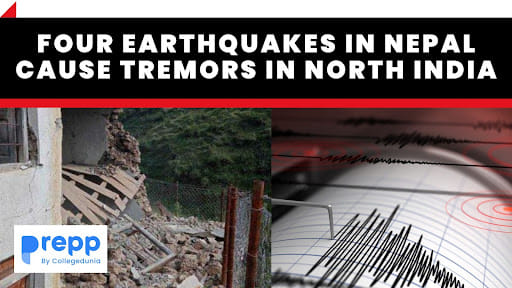
- On October 3rd, Nepal experienced a series of four earthquakes within an hour, with the strongest registering a magnitude of 6.2.
- The first quake had a magnitude of 4.6 and occurred at a depth of 10 kilometers, followed by the 6.2 magnitude jolt at a depth of 5km.
- Two more quakes with magnitudes of 3.6 and 3.1 hit the same region at a depth of 15 km and 10 km.
- These seismic events also sent tremors through parts of northern India, including Delhi-NCR, according to the National Centre for Seismology (NCS). In the region of Delhi the magnitude was 3.
- The epicenter for the strongest quake was 206 km southeast of the pilgrimage town of Joshimath in Uttarakhand and 284 north of Uttar Pradesh's capital Lucknow.
Table of Contents
Reasons of Occurrence of the Earthquakes
- The occurrence of earthquakes in the region is primarily attributed to the tectonic settings of the Himalayas, which include key geological features such as the Himalayan Frontal Thrust (HFT), Main Boundary Thrust (MBT), and Main Central Thrust (MCT).
- Several local faults and geological lineaments contribute to seismic activity in the area.
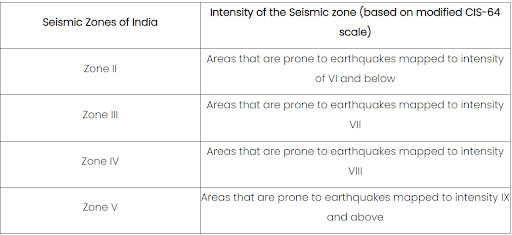
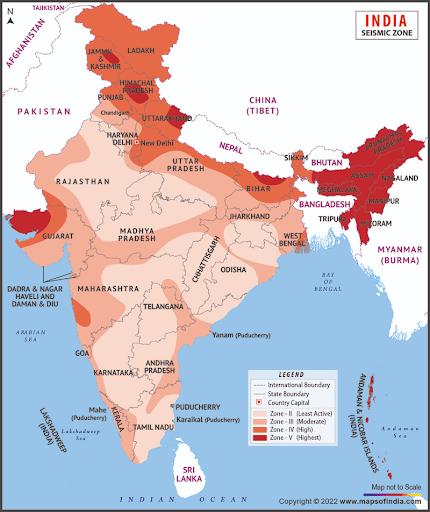
- The neighboring states in India that felt the tremors fall under seismic hazard zones V and IV. These zones indicate a high seismic risk, with zone V being the most susceptible to strong earthquakes.
- The seismic vulnerability of these areas underscores the importance of earthquake preparedness and mitigation measures.
Why is Nepal prone to so many earthquakes?
- Nepal lies in one of the most active tectonic zones (seismic zone IV and V) of the world, making the country extremely vulnerable to earthquakes.
- The 6.2 magnitude earthquake was the strongest in Nepal since the deadly 7.8 magnitude earthquake had hit Nepal in April 2015 that had killed more than 8,000 people and injured over 21,000.
- Large tectonic plates make up the crust of the Earth. These land masses, which contain entire continents, are in motion and colliding with one another all the time.
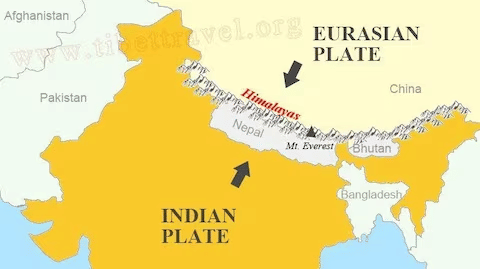
- Nepal sits on the boundary of two massive tectonic plates: the Indo-Australian and the Asian plates. It is the collision of these plates that has produced the Himalayan mountains, with them, the earthquakes.
- United Nation Development Programme (UNDP) ranks Nepal 11th on the list of the most vulnerable countries to earthquakes and Nepal's capital Kathmandu is one of the top cities prone to earthquakes.
What is an Earthquake?
|
|
|
Causes of Earthquakes
- Tectonic Plate Movements: The most common cause of earthquakes is the movement of tectonic plates that make up the Earth's crust. These plates are constantly in motion due to the heat generated from the Earth's interior.
- Volcanic Activity: Earthquakes can also be caused by volcanic activity. When magma moves within the Earth's crust, it can create pressure and fracturing, leading to volcanic earthquakes. These earthquakes often precede or accompany volcanic eruptions.
- Human Activities: Human activities, such as mining, reservoir-induced seismicity (due to the filling of large reservoirs), and hydraulic fracturing (fracking), can induce earthquakes. These are known as induced or anthropogenic earthquakes. The injection or extraction of fluids from the Earth's crust can alter subsurface pressure and stress conditions, potentially triggering seismic events.
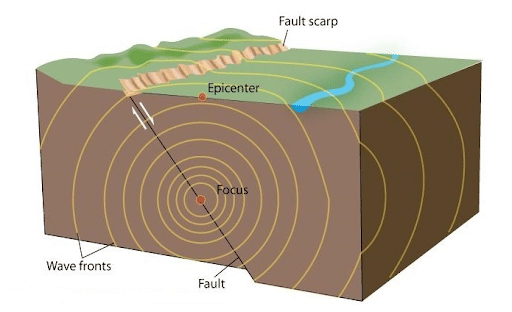
- Faults and Fault Zones: Faults are fractures in the Earth's crust along which movement has occurred. Stress can accumulate along these fault lines, and when it is released, it can result in an earthquake. Faults are often associated with tectonic plate boundaries, but they can also occur within plates.
- Other Natural Causes: Earthquakes can also be triggered by other natural events such as landslides, glacial rebound (the Earth's response to melting ice), and the collapse of underground caves.
(*Click this link to read prelims specific weekly current affairs articles)
FAQs
Question: What is an Earthquake?
Answer:
An earthquake is the shaking of the surface of the Earth resulting from a sudden release of energy in the Earth's lithosphere that creates seismic waves. Earthquakes can range in size from those that are so weak that they cannot be felt to those violent enough to toss people around and destroy whole cities.
Question: What are seismic zones?
Answer:
A seismic zone is an area where there is a high probability of earthquakes due to the area’s geology. Seismic zonation involves dividing areas based on expected ground motion. It assesses the hazards related to earthquakes in such areas to provide inputs for safer constructions and other practices.
Question: What are the Himalayas?
Answer:
The Himalayan Mountains are part of India’s northern mountain range. They are the world’s tallest mountain ranges. These mountain ranges begin at Pamir Knot in the west and continue to Purvanchal in the east. The Himalayas are the result of the Indian and Eurasian plates colliding.
UPSC Mains Practice Question:
|
MCQ
Question: Consider the following: (UPSC 2013)
- Electromagnetic radiation
- Geothermal energy
- Gravitational force
- Plate movements
- Rotation of the earth
- Revolution of the earth
Which of the above is responsible for bringing dynamic changes on the surface of the earth?
(a) 1, 2, 3 and 4 only
(b) 1, 3, 5 and 6 only
(c) 2, 4, 5, and 6 only
(d) 1, 2, 3, 4, 5 and 6
Answer: (d) See the Explanation
- Electromagnetic radiation causes changes in the field of microwaves wavelengths of radio UV rays, infrared rays X rays and gamma rays. Hence statement 1 is correct.
- Geothermal energy transfers to the surrounding layers of rock and heats up the nearby rocks and water which comes out as hot springs or geysers. Hence statement 2 is correct.
- Gravitational force constantly works on all physical bodies and causes them to fall to the ground when dropped. Hence statement 3 is correct.
- Plate movement is a dynamic change on the surface of the earth that affects earthquakes, volcanoes, etc. Hence statement 4 is correct.
- Rotation causes day and night while revolution causes seasons to change in the length of day and night. Hence statements 5 and 6 are correct.
Therefore, option (d) is the correct answer.
Download the PREPP App and attempt FREE IAS Exam Mock Tests and get complete study material!

Full Test - 04: UPSC CSE Prelims CSAT (Paper-II)
Full Test - 03: UPSC CSE Prelims CSAT (Paper-II)
UPSC CSE Prelims 2026 GS Paper 1 Question Paper (24-May-2026)
UPSC CSE Prelims 2026 CSAT Paper 2 Question Paper (24-May-2026)

17 February 2025 | The Hindu Must Read Articles | Current Affairs

16 February 2026 | The Hindu Must Read Articles | Current Affairs

13 February 2026 | The Hindu Must Read Articles | Current Affairs









Comments