Second Anti-Malaria Vaccine for Children Approved by WHO
Relevance: GS 3 - Awareness in the fields of Biotechnology
(Source: DTE,10/03/2023)
Click here for Daily Current Affairs
Why in the news?
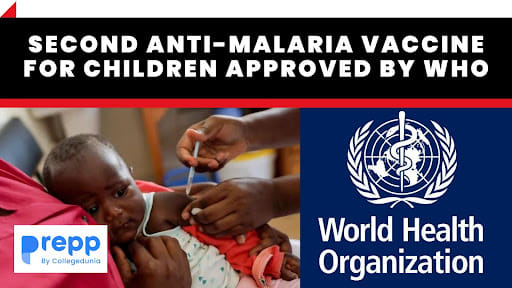
- The World Health Organization (WHO) approved a second anti-malaria vaccine (R21/Matrix-M) for children, which is developed by the University of Oxford with help of Serum Institute of India.
- After approval GAVI(A Global Vaccine Alliance) and UNICEF can buy vaccines from manufacturers.
- Along with this, WHO also recommended Takeda Pharmaceuticals’ vaccine against dengue and asked all countries of ‘meningitis belt’ to use Men5CV against ‘meningitis disease.
Table of Contents
About 2nd Malaria Vaccine
- The R21/Matrix-M vaccine is manufactured by the Serum Institute of India and has already been approved for use in Burkina Faso, Ghana and Nigeria.
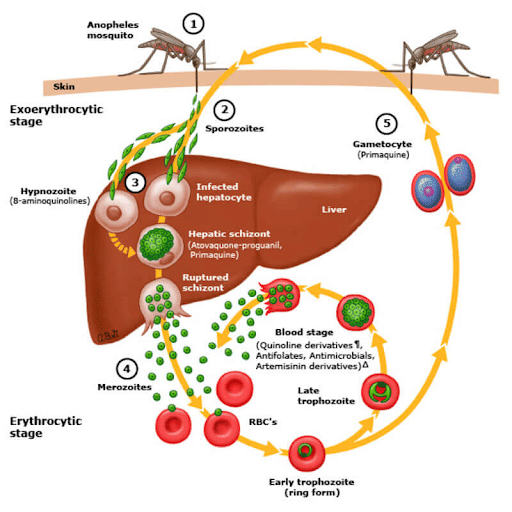
- Matrix-M vaccine works by triggering an immune response against one stage (known as sporozoite - when the parasite exits a mosquito and enters the human body) of that parasite's life cycle.
- During the testing phase, the vaccine appears to be highly effective, with preliminary studies in Burkina Faso showing up to 80% effectiveness when given in three initial doses and a booster a year later.
- The vaccine will be rolled out in those African countries in early 2024 and will be available in mid-2024 in other countries and will be given in 3 doses.
About 1st Malaria Vaccine (RTS,S)
|
About Malaria
- Malaria is caused by the bite of the female Anopheles mosquito if the mosquito itself is infected with a malarial parasite.
- There are five kinds of malarial parasites — Plasmodium falciparum, Plasmodium vivax (the commonest ones), Plasmodium malariae, Plasmodium ovale and Plasmodium knowlesi.
- The malaria parasite P falciparum is the deadliest and most common on the African continent. In most places outside of Sub-Saharan Africa, P. vivax is the most common malaria parasite.
- The earliest signs of malaria—fever, headache, and chills, come 10–15 days after the infective mosquito bite and might be mild and difficult to distinguish from other illnesses.
- P. falciparum malaria can escalate to severe sickness and death in as little as 24 hours if left untreated.
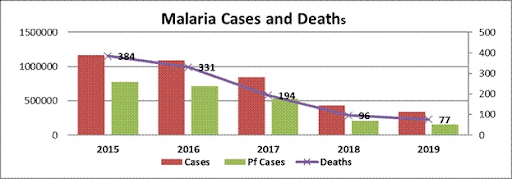
Malaria burden in India
|
Other remedies of Malaria
Vector control
- It means to control malaria parasite carriers such as Anopheles mosquito. This is a preventive method.
- Vector control is an essential component of malaria control and eradication methods because it is very successful in avoiding infection and disease transmission.
- Insecticide-treated nets (ITNs) and indoor residual spraying are the two main therapies (IRS).
Vaccine
- Since October 2021, WHO has additionally recommended that children living in areas with moderate to high P. falciparum malaria transmission receive the RTS,S/AS01 malaria vaccine.
- The vaccination has been found to drastically decrease malaria, particularly severe malaria, in young infants.
Treatment available
- Malaria is a treatable disease. Effective antimalarial medicines available today and the mainstay of recommended treatment for Plasmodium falciparum malaria, the deadliest malaria parasite globally.
- This is a punitive method.
Efforts on Global level to curb Malaria
Global Malaria Program
- The WHO Global Malaria Programme (GMP) is responsible for coordinating WHO's global efforts to control and eliminate malaria. Its work is guided by the "Global technical strategy for malaria 2016–2030" adopted by the World Health Assembly in May 2015 and updated in 2021.
E-2025 Initiative
- The WHO has also identified 25 countries with the potential to eradicate malaria by 2025 under its ‘E-2025 Initiative’.
Global technical strategy for malaria
- The WHO’s Global technical strategy for malaria 2016–2030 aims to reduce malaria case incidence and mortality rates by at least 40% by 2020, at least 75% by 2025 and at least 90% by 2030 against a 2015 baseline.
Other efforts
- Over the last two decades, 11 countries have been certified by the WHO Director-General as malaria-free: United Arab Emirates (2007), Morocco (2010), Turkmenistan (2010), Armenia (2011), Sri Lanka (2016), Kyrgyzstan (2016), Paraguay (2018), Uzbekistan (2018), Algeria (2019), Argentina (2019), and El Salvador (2021).
- Countries that have achieved at least 3 consecutive years of zero indigenous cases of malaria are eligible to apply for the WHO certification of malaria elimination.
Efforts in India to curb Malaria
National Vector Borne Disease Control Programme
- It was launched in 2003 and is managed by the Ministry of Health and Family Welfare.
- Directorate of National Vector Borne Disease Control Programme (NVBDCP) is the central nodal agency for prevention and control of six vector borne diseases (VBDs) i.e. Malaria, Dengue, Lymphatic Filariasis, Kala-azar, Japanese Encephalitis and Chikungunya in India.
National Framework for Malaria Elimination (NFME)
- Malaria elimination efforts were initiated in 2015 and were intensified after the launch of the National Framework for Malaria Elimination (NFME) in 2016 by the Ministry of Health and Family Welfare.
- NFME is in line with WHO’s 2016-2030 Malaria Strategy, which guides the WHO Global Malaria Programme (GMP).
National Strategic Plan for Malaria Elimination
- The National Strategic Plan for Malaria Elimination (2017-22) was launched in July 2017 which laid down strategies for the following five years.
- It gives year-wise elimination targets in various parts of the country depending upon the endemicity of malaria.
High Burden to High Impact (HBHI) initiative
- Implementation of the High Burden to High Impact (HBHI) initiative was started in four states (West Bengal, Jharkhand, Chhattisgarh and Madhya Pradesh) in July 2019.
- Distribution of Long Lasting Insecticidal Nets (LLINs) to high burden areas has led to a reduction in endemicity in these 4 very high endemic states.
- Apart from this, The Indian Council of Medical Research (ICMR) has established Malaria Elimination Research Alliance-India (MERA-India) which is a group of partners working on malaria control.
Some FactsWorld Malaria Day
World Malaria Report
|
(*Click this link to read prelims specific weekly current affairs articles)
FAQs
Question: What is Malaria?
Answer:
Malaria is a life-threatening mosquito borne blood disease caused by plasmodium parasites. It is predominantly found in the tropical and subtropical areas of Africa, South America as well as Asia.
Question: What is the 2nd malaria vaccine?
Answer:
The R21/Matrix-M vaccine is manufactured by the Serum Institute of India and has already been approved for use in Burkina Faso, Ghana and Nigeria. Matrix-M vaccine works by triggering an immune response against one stage (known as sporozoite - when the parasite exits a mosquito and enters the human body) of that parasite's life cycle.
Question: What is the Global technical strategy for malaria of WHO?
Answer:
The WHO’s Global technical strategy for malaria 2016–2030 aims to reduce malaria case incidence and mortality rates by at least 40% by 2020, at least 75% by 2025 and at least 90% by 2030 against a 2015 baseline.
MCQs
Question: Widespread resistance of malarial parasites to drugs like chloroquine has prompted attempts to develop a malarial vaccine to combat malaria. Why is it difficult to develop an effective malaria vaccine? (UPSC 2010)
(a) Malaria is caused by several species of Plasmodium
(b) Man does not develop immunity to malaria during natural infection
(c) Vaccines can be developed only against bacteria
(d) Man is only an intermediate host and not the definitive host
Answer: (b) See the Explanation
Malaria is a potentially fatal disease caused by Plasmodium parasites that are transmitted to humans by infected female Anopheles mosquitos. The malarial parasite has an extraordinary ability to evade the immune system, which explains the difficulty in developing an effective malaria vaccine. RTS,S/AS01 (RTS,S) is the first and only vaccine to show partial protection against malaria in young children.
Therefore, option (b) is the correct answer.
Question: Which of the following statements is/are correct regarding ‘RTS,S/AS01 vaccine’:
- It is an injectable vaccine targeting the most prevalent malaria strain in Africa.
- It helps in protecting against the liver infection with the Hepatitis B virus.
- It is highly effective in preventing severe cases of malaria in children.
Select the correct answer using the codes given below:
(a) 1 and 2 only
(b) 2 only
(c) 1 and 3 only
(d) 1, 2 and 3
Answer: (d) See the Explanation
RTS, S/AS01, often known as Mosquirix, is an injectable malaria vaccine that targets P. falciparum, the most common strain in Africa. It is the first and only vaccination to provide partial protection in children under the age of five. Hence, statements 1 & 3 are correct.
- GlaxoSmithKline, a British pharmaceutical company, created it in 1987.
- Mosquirix's active ingredient is a protein discovered on the surface of Plasmodium falciparum parasites (PFP).
- When the PFP enters the human host's circulation from a mosquito bite and infects liver cells, RTS, S tries to activate the immune system to protect against the earliest stages of malaria.
- It also aids in the prevention of Hepatitis B virus infection of the liver. Hence, statement 2 is correct.
- Potency: Although the vaccine's efficacy in preventing severe instances of malaria in children is only approximately 30%, it is the only one that has been authorised.
- It was authorised by the European Union's medicines agency in 2015, with the benefits outweighing the dangers.
- It has a few adverse effects, including a fever that might lead to brief convulsions.
Therefore, option (d) is the correct answer.
Question: Consider the following diseases (UPSC 2014)
- Diphtheria
- Chickenpox
- Smallpox
Which of the above diseases has/have been eradicated in India?
(a) 1 and 2 only
(b) 3 only
(c) 1, 2 and 3
(d) None
Answer: (b) See the Explanation
- Smallpox was a serious infectious caused by the Variola virus.
- Smallpox was eradicated, and no cases of naturally occurring smallpox have happened since 1977.
- It was mainly spread by direct and fairly prolonged face-to-face contact between people.
- So statement 3 is correct.
Diphtheria
- Diphtheria is a serious bacterial infection that affects the mucous membranes of the throat and Nose.
- A type of bacteria called Corynebacterium diphtheriae causes diphtheria.
Chickenpox
- The chickenpox infection caused by the Varicella-zoster virus (VZV).
- The virus can spread through: saliva, coughing, sneezing, contact with fluid from the blisters.
- Diphtheria and Chickenpox are still to be eradicated.
- So statements 1 and 2 are incorrect.
- Therefore the correct answer is option b.
Download the PREPP App and attempt FREE IAS Exam Mock Tests and get complete study material!

Full Test - 04: UPSC CSE Prelims CSAT (Paper-II)
Full Test - 03: UPSC CSE Prelims CSAT (Paper-II)
UPSC CSE Prelims 2026 GS Paper 1 Question Paper (24-May-2026)
UPSC CSE Prelims 2026 CSAT Paper 2 Question Paper (24-May-2026)

17 February 2025 | The Hindu Must Read Articles | Current Affairs

16 February 2026 | The Hindu Must Read Articles | Current Affairs

13 February 2026 | The Hindu Must Read Articles | Current Affairs









Comments