Final Goods – Indian Economy Notes
Final goods are finished products that do not require further processing. Final goods are sold in the market for consumption or investment. Furniture, television, milk, and medicines are examples of final goods. “Final Goods” is an important topic in the UPSC/IAS Exam 2023 Economy syllabus which is discussed in this article in detail.
|
Table of Contents |

What are Final Goods?
- Final Goods or consumer goods are produced by a company for consumer consumption thereafter. These products meet a consumer's needs or want.
- Final goods do not require additional processing.
- Final goods are not resold or employed in subsequent manufacturing changes.
- The goods purchased by local residents are intended for final consumption.
- For example, television, milk, ready-to-eat meals, medications, and so forth.
- It also includes products purchased by organisations for the aim of investment or capital generation.
Examples of Final Goods
- All goods (durable or non-durable) purchased by consumer households. For example: tv, fridge, vegetables, electricity, food, etc.
- Goods purchased by production units (producer) for investment (for capital formation). For example: machinery, furniture, etc.
- There is no clear dividing line between consumption and capital goods. The same good can be both a consumption and a capital good. It is determined by the ultimate use of the good.
- A machine purchased by a household is a consumption good, whereas a machine purchased by a firm for use in the business is a capital good.

Classification of Final Goods
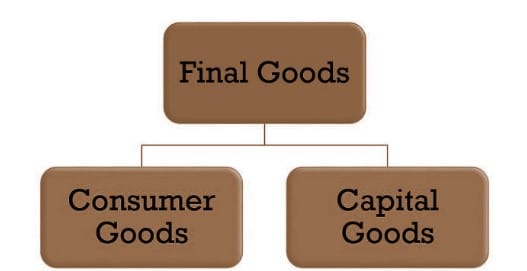
Final goods are divided into two groups: Consumption Goods and Capital Goods.
| Other Relevant Links | |
|---|---|
| Types of Goods | Intermediate Goods |
| Consumption Goods | Capital Goods |
| Aggregate Demand | Aggregate Supply |
| Law of Demand and Supply | Keynesian Economics |
Consumption Goods
- Consumption goods are those that directly satisfy the desires of consumers.
- Consumption goods include items such as food and clothes, as well as services acquired for consumption. Because of the nature of the product, it may or may not be durable.
- For example, Bread, butter, shirts, pens, televisions, furniture, and so on.
- Consumption goods are further sub-divided into following categories:
- Durable goods: Durable goods are items that can be used repeatedly over an extended period of time. For example, televisions, refrigerators, and so on.
- Semi-durable goods: Semi-durable goods are those that can only be used for a limited time. These items have a one-year shelf life. For example, clothing, crockery, shoes, and so on.
- Non-durable goods: Non-durable goods are goods that are consumed in a single act of consumption. These items can only be used once. For example, milk, bread, cereal grains, paper, and so on.
- Services: Services are non-material goods that directly satisfy human desires. They are intangible activities, which cannot be seen or touched. For example, the service of teachers, doctors, and banks.
Capital Goods
- Capital goods are finished goods that help in the production of other goods and services. For example, plant and machinery, equipment, and so on.
- They will be used for productive purposes in the future and have a life expectancy of several years.
- Capital goods do not lose their identity during the manufacturing process, i.e., they do not become merged during the manufacturing process.
- They will require repairs or replacement over time as they depreciate.
Final Goods and GDP
- Final goods are only considered as new goods for computing national income and production, i.e. when calculating GDP.
- GDP doesn't include the count of intermediate goods. It means that each intermediary stage in a supply chain counts the value added at each phase.
- GDP, for example, will not include things that were included in previous years while they were being manufactured. We don't want to count them twice (double counting) or more than once.
- When measuring GDP, the word "final goods" includes not just finished or new products, but also services.
Gross Domestic Product (GDP)
|
Conclusion
A final good is thus a product developed for direct use by end consumers. We do not utilize any final goods for the manufacturing of something else; rather, we do not use the final goods for the creation and sale of other commodities.
| Other Relevant Links | |
|---|---|
| Indian Economics Notes | Macro Economics |
| Micro Economics | Difference Between Macroeconomics and Microeconomics |
| Branches of Economics | Sectors of Indian Economy |
FAQs
Question. What are final goods?
Answer: Final goods are products that are ready for use by the end consumer and do not require any further processing. These goods are sold in the market for consumption or investment purposes, like televisions, food, and medicines.
Question. How are final goods classified?
Answer: Final goods are classified into two types: Consumption Goods and Capital Goods. Consumption goods are used directly by consumers, while capital goods are used to produce other goods and services.
Question. What is the difference between final goods and intermediate goods?
Answer: Final goods are completed products that are purchased for consumption or investment, while intermediate goods are used in the production of other goods. For example, flour is an intermediate good, while bread is a final good.
Question. How do final goods relate to GDP?
Answer: Final goods are included in GDP calculations because they reflect the value of goods and services produced for final consumption. Intermediate goods are excluded to avoid double counting.
Question. Can a good be both a consumption and capital good?
Answer: Yes, some goods can be both. For example, a machine bought by a household for personal use is a consumption good, while the same machine bought by a business for production purposes is considered a capital good.
MCQs
- Which of the following is a characteristic of final goods?
A) They require further processing
B) They are sold for consumption or investment
C) They are intermediate goods
D) They are used in the production of other goods
Answer: (B) See the Explanation
Final goods are products that are ready for use by the end consumer and are not further processed or used for production.
- Which type of final goods directly satisfies consumer needs?
A) Capital goods
B) Intermediate goods
C) Consumption goods
D) Investment goods
Answer: (C) See the Explanation
Consumption goods are final goods that directly meet the needs or desires of the consumer.
- Which of the following is an example of a capital good?
A) Furniture for a household
B) A machine purchased by a firm for production
C) Bread
D) Milk
Answer: (B) See the Explanation
Capital goods are used for the production of other goods and services, such as machinery and equipment.
- Which of these is NOT included in the calculation of GDP?
A) Final goods
B) Intermediate goods
C) Services
D) Capital goods
Answer: (B) See the Explanation
Intermediate goods are excluded from GDP calculations to avoid double counting, while final goods, including services and capital goods, are included.
- What is the difference between durable and non-durable consumption goods?
A) Durable goods are used only once, while non-durable goods last longer
B) Durable goods last for several years, while non-durable goods are used quickly
C) Durable goods are capital goods, while non-durable goods are consumption goods
D) There is no difference
Answer: (B) See the Explanation
Durable goods, like refrigerators and televisions, are used for a long time, while non-durable goods, such as food and milk, are consumed in a short period.
GS Mains Questions and Model Answers
Q1: Explain the classification of final goods and their significance in GDP calculation.
Answer: Final goods are classified into two main categories: Consumption Goods and Capital Goods. Consumption goods satisfy the immediate needs of consumers, such as food, clothing, and services. Capital goods, on the other hand, are used to produce other goods and services and are purchased by businesses for investment. The significance of final goods in GDP calculation lies in their direct contribution to national income, as they reflect the total market value of all goods and services produced for final consumption or investment. Intermediate goods are excluded to prevent double counting of their value in GDP.
Q2: Discuss the impact of consumption and capital goods on economic growth.
Answer: Both consumption and capital goods play essential roles in economic growth. Consumption goods directly affect the welfare of individuals, as they are used to meet immediate needs. The demand for consumption goods drives economic activity, creating jobs and promoting production. Capital goods, however, have a longer-term effect on economic growth. They enhance productivity and efficiency in the economy, leading to increased production of goods and services. Investment in capital goods, such as machinery and infrastructure, is crucial for expanding industrial capacity and fostering sustainable economic growth.
Q3: Analyze the relationship between final goods and the broader economic cycle.
Answer: The production and consumption of final goods are central to the economic cycle. Final goods, whether consumed directly by individuals or used as capital goods by businesses, are the endpoint of production processes and the driving force behind economic activity. Increased production of final goods boosts employment, stimulates investment, and generates income, which in turn increases demand for further production. The sale of final goods also reflects consumer confidence and investment levels, influencing broader economic indicators such as GDP and inflation. Thus, the production and consumption of final goods play a key role in shaping the economy's overall performance.
Previous Year Questions on Final Goods
1. UPSC CSE 2016
Question: "What are final goods, and how are they distinguished from intermediate goods in national income accounting?"
Answer: Final goods are goods that are ready for use by the consumer or for investment and are not further processed in the production of other goods. They are distinct from intermediate goods, which are used in the production of other goods. In national income accounting, only the value of final goods is included to avoid double counting, ensuring that only the value added at the final stage of production is counted in GDP.
2. UPSC CSE 2019
Question: "How do final goods contribute to the GDP of a country, and why are intermediate goods excluded from GDP calculations?"
Answer: Final goods contribute directly to a country's GDP as they represent the market value of all goods and services produced for final consumption or investment. Intermediate goods are excluded from GDP calculations to avoid double counting, as their value is already embedded in the price of the final goods. For example, the value of raw materials used in the production of a finished car is counted in the car’s final price, not separately as intermediate goods.
Download the PREPP App and attempt FREE IAS Exam Mock Tests and get complete study material!

Full Test - 04: UPSC CSE Prelims CSAT (Paper-II)
Full Test - 03: UPSC CSE Prelims CSAT (Paper-II)
UPSC CSE Prelims 2026 GS Paper 1 Question Paper (24-May-2026)
UPSC CSE Prelims 2026 CSAT Paper 2 Question Paper (24-May-2026)

17 February 2025 | The Hindu Must Read Articles | Current Affairs

16 February 2026 | The Hindu Must Read Articles | Current Affairs

13 February 2026 | The Hindu Must Read Articles | Current Affairs









Comments