Keynesian Economics – Indian Economy Notes
Keynesian economics is a "demand-side" theory that focuses on short-run changes in the economy. Keynesian economics was developed during the 1930s by the British economist John Maynard Keynes to understand the Great Depression. The topic “Keynesian Economics” is one of the important theories under macroeconomics in the UPSC/IAS Economy syllabus which is discussed in this article in detail.
|
Table of Contents |
 Keynesian Economics
What is Keynesian Economics?
- Keynesian economics is a macroeconomics theory that describes total economic spending and its effects on output, employment, and inflation.
- Keynesians believe that since prices are somewhat rigid, changes in any aspect of spending, whether government, investment, or consumer spending, affects the output.
- For example, the output will increase if government expenditure rises while all other spending factors stay the same.
- Keynes' theory was the first to distinguish between the study of individual economic behaviour and markets and the study of broad national economic aggregate variables and constructs.
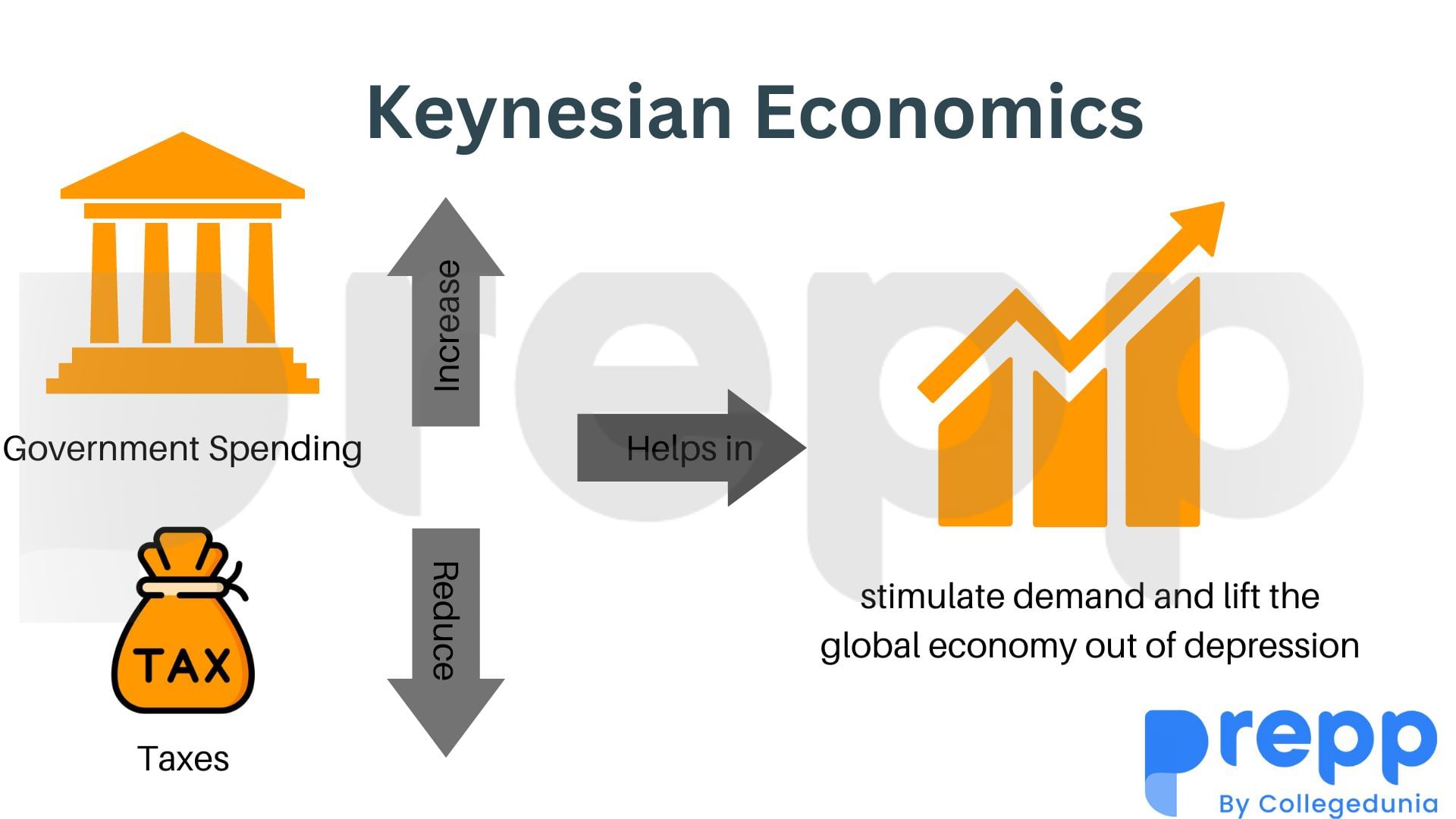
- Based on his theory, Keynes advocated for increased government spending and lower taxes in order to stimulate demand and lift the global economy out of depression.
- Since labour demand curves slope downward like any other normal demand curve, Keynesian economics challenges the notion held by some economists that lower wages can restore full employment.
| Other Relevant Links | |
|---|---|
| Aggregate Demand | Law of Demand and Supply |
| Types of Goods | Aggregate Supply |
Associated Factors & Principles - Keynesian Economics
Keynesian economic theory's central tenet is that government intervention can stabilise the economy. The following are the underlying principles of this supposition:
- Economic decisions made by the government public and the private sector have an impact on demand.
- Wages and prices react slowly to changes in supply and demand.
- Changes in demand have the greatest short-term impact on output and employment.
- Unemployment is unfavourable because it is subject to the whims of demand.
- To reduce the volatility of the business cycle, an active stabilisation policy is required.
- Unemployment is more important than inflation.
Keynesian Economics and Fiscal Policy
- The multiplier effect, developed by Richar Kahn, is a key component of Keynesian countercyclical fiscal policy.
- According to Keynes' theory of fiscal stimulus, an increase in government spending eventually leads to increased business activity and even more spending.
- This theory contends that spending increases aggregate output and generates more income.
- If workers are willing to spend their extra income, the resulting growth in the gross domestic product (GDP) could be even greater than the initial stimulus amount.
- The fiscal multiplier commonly associated with Keynesian theory is one of two broad multipliers in economics. The other multiplier is known as the money multiplier.
Keynesian Economics and Monetary Policy
- Keynesian theorists argue that economies do not stabilise quickly and that active intervention is required to boost short-term demand in the economy.
- Wages and employment are slower to respond to market needs and require government intervention to stay on track.
- Furthermore, they argue that prices do not react quickly and only gradually change when monetary policy interventions are made, giving rise to Monetarism, a branch of Keynesian economics.
- When prices change slowly, it is possible to use the money supply as a tool and change interest rates to encourage borrowing and lending.
- Lowering interest rates is one way for governments to intervene meaningfully in economic systems, encouraging consumption and investment spending.
- Short-term demand increases spurred by interest rate cuts re-energize the economy, restoring employment and demand for services.
- The new economic activity then fuels further growth and job creation.
- When lowering interest rates fails to produce results, Keynesian economists argue that other strategies, primarily fiscal policy, must be used.
- Other interventionist policies include direct control of the labour supply, changing tax rates to indirectly increase or decrease the money supply, changing monetary policy, or restricting the supply of goods and services until employment and demand are restored.
Implementation of Keynesian Economics in India
- In India, the government has made numerous efforts to come out of the vicious cycle of low economic growth.
- But what is really needed is a systematic application of Keynesian philosophy, which was once used to free the American economy from the clutches of the 1929 Great Depression.
- One of the guiding principles of this philosophy is that fiscal expenditure, rather than fiscal prudence, should be the guiding principle of any slowing economy.
- Fiscal spending will inject more money into the economy, increasing consumer purchasing power and, as a result, increasing consumer demand for industrial goods via the multiplier effect.
- In the case of India, one such programme that works on this principle is the implementation of the MNREGA programme.
- Similarly, the current government can make significant investments in the FMCG, infrastructure, and construction sectors.
- These industries will help the situation in two ways:
- Primarily, these sectors have enormous potential for the nation's overall economic growth because they have the potential to directly address the problem of structural bottlenecks in the economy.
- Secondly, these sectors have a high potential for job creation.
- According to Keynes, the export sector plays an important role because it is one of the major constituents of aggregate demand.
- What is required here is an increase in productivity rather than an increase in output.
- 'Make in India' is one such initiative launched by the government to address this issue.
- Domestically, imparting necessary skills for labour force training is critical, and internationally, there is a need to smooth out the restrictions of India's overall external barriers.
- In this case, the government must carefully manipulate the international forum in order to remove obstacles such as GSP and import tariff barriers, among others.
- Without a doubt, the Keynesian philosophy was designed primarily for developed economies, but it also has some utility and usability for the developing world, and it is precisely in this space that the Indian economy must move its elbow.
Keynesian Philosophy during Covid-19
- A post-corona world resembles a shattered, devastated, and fragmented post-World War world – politically, economically, and socially.
- It was in this context that Keynesian economics emerged as a new avatar of capitalism.
- It is encouraging that the government's financial stimulus packages to provide some relief to the agricultural sector, MSMEs, street vendors, NBFCs, DISCOMs, and real estate sector are very much in line with Keynesian economics, as the government intends to spend more, build more agro-infrastructure, and put more money in the hands of the people.
- India's unemployment rate remains high with no signs of improvement. Poverty is rapidly increasing, and the rural-urban divide is widening.
- At the moment, the private sector lacks both the capacity and the desire to fill this void.
- In any case, due to our country's dire and unique socio-economic conditions, it would take far more than private sector’s initiative to get the country back on track.
- This is the time that the government must step in.
Keynesian Economics vs. Classical Economics
| Keynesian Economics | Classical Economics |
|---|---|
| Keynesian Economics advocates government intervention in the business cycle, including borrowing, to boost demand. | Classical Economics favours laissez-faire (let it be) policies with little to no government intervention. |
| In this model, demand increases supply and reduces unemployment since more workers are required to keep up with increased demand. | It promotes a balanced budget while allowing an uncontrolled free market to self-regulate through the laws of supply and demand. |
| Prices and wages are relatively inflexible, and the government must assist in achieving full employment. | Prices and wages are flexible, and any unemployment is only temporary. |
Conclusion
After WWII, Keynesian economics dominated economic theory and policy until the 1970s, when many advanced economies experienced both inflation and slow growth, a condition known as "stagflation." Because the Keynesian theory did not offer a suitable policy response to stagflation at the time, it lost some of its appeals. The global financial crisis of 2007–08 sparked a revival of Keynesian thinking. However, the 2007–08 financial crisis demonstrated that Keynesian theory needed to be revised to better account for the role of the financial system. Keynesian economists are addressing this omission by integrating the economy's real and financial sectors.
| Other Relevant Links | |
|---|---|
| Indian Economics Notes | Macro Economics |
| Micro Economics | Difference Between Macroeconomics and Microeconomics |
| Branches of Economics | Sectors of Indian Economy |
FAQs
Question: What is Keynesian Economics?
Answer: Keynesian Economics is an economic theory developed by John Maynard Keynes, advocating for active government intervention to manage economic cycles. It emphasizes the role of government spending and fiscal policies in stabilizing the economy, especially during downturns.
Question: How does Keynesian Economics address unemployment?
Answer: Keynesian Economics suggests that unemployment can be reduced by increasing aggregate demand through government spending and fiscal stimulus. By boosting demand, production and job creation are encouraged, which helps reduce unemployment rates during economic recessions.
Question: What is the Keynesian multiplier effect?
Answer: The Keynesian multiplier effect refers to the concept that an initial increase in spending leads to a larger overall increase in economic output. This occurs because the initial expenditure creates additional income, which is then re-spent, thus magnifying the impact on aggregate demand and GDP.
Question: Why did Keynesian Economics gain prominence during the Great Depression?
Answer: Keynesian Economics gained prominence during the Great Depression as it provided a new approach to dealing with prolonged economic downturns. Keynes argued that private sector demand was insufficient to lift the economy, so government intervention was necessary to stimulate economic recovery.
Question: How does Keynesian Economics differ from classical economic theories?
Answer: Unlike classical economics, which advocates for minimal government intervention, Keynesian Economics supports active government involvement to regulate economic cycles. Keynesianism believes that aggregate demand is not always self-correcting and requires government actions to ensure economic stability.
MCQs
1. According to Keynesian Economics, what primarily drives economic growth?
A) Supply-side policies
B) Aggregate demand
C) Savings rate
D) Population growth
Answer: (B) See the Explanation
Explanation: Keynesian Economics emphasizes that aggregate demand, particularly during economic downturns, is the primary driver of economic growth. Government spending can help stimulate demand and prevent recessions.
2. The Keynesian multiplier effect implies that:
A) A decrease in taxes reduces GDP
B) An initial increase in spending leads to a larger increase in output
C) Savings stimulate investment
D) Inflation automatically reduces unemployment
Answer: (B) See the Explanation
Explanation: The Keynesian multiplier effect suggests that an initial increase in spending has a multiplied impact on output as it creates additional income and further increases in aggregate demand.
3. What did Keynes advocate to combat the Great Depression?
A) Reducing government spending
B) Implementing fiscal austerity
C) Increasing government spending
D) Raising interest rates
Answer: (C) See the Explanation
Explanation: Keynes advocated for increased government spending to boost aggregate demand, counteracting the economic downturn experienced during the Great Depression.
4. In Keynesian theory, which sector plays a key role during an economic downturn?
A) Private sector
B) Foreign sector
C) Government sector
D) Agricultural sector
Answer: (C) See the Explanation
Explanation: Keynesian Economics assigns a crucial role to the government sector during economic downturns, as government spending can help to stimulate demand and revive economic growth.
5. Which of the following is a key tool in Keynesian Economics?
A) Monetary policy
B) Supply-side policies
C) Fiscal policy
D) Trade liberalization
Answer: (C) See the Explanation
Explanation: Fiscal policy is a key tool in Keynesian Economics, involving government spending and tax policies to influence aggregate demand and stabilize the economy.
GS Mains Questions and Model Answers
Q1: Explain the role of government intervention in Keynesian Economics during an economic recession.
Answer: Keynesian Economics advocates for active government intervention during recessions to stabilize the economy. When aggregate demand falls, Keynes suggested that governments should increase public spending and reduce taxes to boost demand. This intervention helps offset decreased private sector demand and encourages economic activity. Government projects can create jobs, increase household incomes, and lead to a multiplier effect, further stimulating the economy. Such measures are considered essential for preventing prolonged recessions and achieving economic recovery.
Q2: Discuss the significance of the Keynesian multiplier effect in fiscal policy.
Answer: The Keynesian multiplier effect is fundamental in fiscal policy as it amplifies the impact of initial government spending on aggregate demand. When the government spends on infrastructure or public services, the resulting increase in income leads to further spending by consumers, boosting economic output. This effect helps fiscal policy achieve a more significant influence on GDP, making it a powerful tool in recessionary periods. By understanding the multiplier effect, policymakers can better estimate the required level of spending to reach economic growth targets and stabilize the economy.
Q3: Compare and contrast Keynesian Economics with classical economic theories regarding government intervention.
Answer: Keynesian and classical economics differ significantly in their approach to government intervention. While classical theories advocate minimal government interference, assuming markets are self-regulating and capable of achieving full employment naturally, Keynesian Economics argues for active intervention. Keynes believed that without government action, recessions could lead to prolonged unemployment and underutilized resources. Keynesians thus support fiscal stimulus to boost demand, whereas classical economists emphasize free markets, low taxes, and limited government spending, trusting that these conditions will lead to economic equilibrium over time.
Previous Year Questions on Keynesian Economics
1. UPSC CSE Prelims 2018:
Question: In the context of Keynesian Economics, what does the term "multiplier" refer to?
A) The increase in private savings
B) The effect of increased taxes on GDP
C) The magnified impact of initial spending on overall output
D) The reduction in government spending
Answer: (C)
Explanation: In Keynesian Economics, the "multiplier" refers to the concept that an initial increase in government spending leads to a more significant increase in total economic output due to re-spending of income generated by the initial expenditure.
2. UPSC CSE Mains 2020 (GS Paper 3):
Question: "Evaluate the role of fiscal policy in managing economic fluctuations with reference to Keynesian Economics."
Answer: Fiscal policy is essential in managing economic fluctuations under Keynesian Economics. By adjusting government spending and taxes, fiscal policy directly influences aggregate demand, helping stabilize the economy. During recessions, increased government expenditure can offset low private demand, creating jobs and stimulating growth. Conversely, during inflationary periods, reducing spending or raising taxes can curb demand. Thus, fiscal policy acts as a counter-cyclical tool, aligning economic activity with desired levels and preventing prolonged economic distress, which is crucial for achieving stability in a Keynesian framework.
Download the PREPP App and attempt FREE IAS Exam Mock Tests and get complete study material!

Full Test - 04: UPSC CSE Prelims CSAT (Paper-II)
Full Test - 03: UPSC CSE Prelims CSAT (Paper-II)
UPSC CSE Prelims 2026 GS Paper 1 Question Paper (24-May-2026)
UPSC CSE Prelims 2026 CSAT Paper 2 Question Paper (24-May-2026)

17 February 2025 | The Hindu Must Read Articles | Current Affairs

16 February 2026 | The Hindu Must Read Articles | Current Affairs

13 February 2026 | The Hindu Must Read Articles | Current Affairs









Comments