Aggregate Demand – Indian Economy Notes
Aggregate demand means the total amount of demand for all finished goods and services produced in a given economy. Aggregate demand includes all purchases made by individuals, businesses, the government, and foreigners (via exports), and excludes the portion of demand that is met by imports from other countries. In general, the aggregate demand and GDP increase or decrease together. The topic “Aggregate Demand” is one of the important concepts in the UPSC/IAS Economy syllabus which is discussed in this article in detail.
| To Read update on this topic: |
What is Aggregate Demand?
- Aggregate demand is a macroeconomic term that refers to the total demand for goods and services in a given period at any given price level.
- Since the two metrics are calculated in the same way, aggregate demand over time equals gross domestic product (GDP).
- The aggregate demand and GDP increase or decrease together as a result of the same calculation methods.
- Aggregate demand is sometimes called the domestic final demand (DFD).
Gross Domestic Product (GDP)
|
|
|
|
|---|---|
| Aggregate Supply | Law of Demand and Supply |
| Types of Goods | Keynesian Economics |
Components of Aggregate Demand
Government Spending (G)
- Government Spending (G) is the total amount spent by the government on infrastructure, investments, defense and military equipment, public sector facilities, healthcare services, and government employees.
- It does not include spending on transfer payments, such as pension plans, subsidies, and aid transfers to needy countries.
Consumption Spending (C)
- Consumption spending (C) is the largest component of aggregate demand in an economy.
- It refers to the total amount spent by individuals and households on goods and services in the economy.
- It is influenced by a number of factors, including disposable income, per capita income, debt, consumer expectations of future economic conditions, and interest rates.
- It is important to note that consumption spending excludes spending on residential structures, which is included in the investment spending component.
Investment Spending (I)
- Investment Spending (I) is the total expenditure on new capital goods and services such as machinery, equipment, inventory changes, investments in non-residential structures, and residential structures.
- Investment spending is influenced by factors such as interest rates (which determine the cost of borrowing), economic forecasts, and government incentives (such as tax benefits or subsidies for investing in renewable energy).
Net Exports (X-M)
- Exports are products manufactured by domestic producers and sold abroad, whereas imports are products manufactured abroad and imported for domestic consumption.
- It is important to remember that aggregate demand is the total demand for goods and services produced domestically; thus, exports are added to aggregate demand while imports are subtracted.
- Net Export is the measure of exports minus imports that is an important determinant of aggregate demand.
Calculating Aggregate Demand
The aggregate demand equation includes consumer spending, private investment, government spending, and the net of exports and imports. The formula is shown below:
Aggregate Demand = C + I + G + Nx
where,
C = Consumer spending on goods and services
I = Private investment and corporate spending on non-final capital goods (factories, equipment, etc.)
G = Government spending on public goods and social services (infrastructure, medicare, etc.)
Nx = Net exports(exports minus imports)
What is Aggregate Demand Curve?
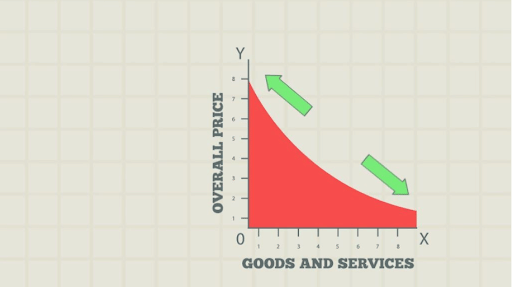
- The aggregate demand curve indicates the total amount of goods and services demanded by the economy at various price levels.
- The price level of all final goods and services is represented by the vertical axis.
- The horizontal axis represents the real quantity of all goods and services purchased as measured by real GDP.
- As the price of goods and services rises or falls, demand rises or falls along the curve.
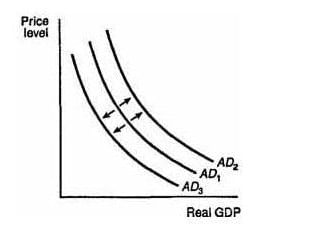
- Furthermore, the curve can shift due to changes in the money supply or tax rate increases and decreases.
- To fully comprehend why price increases lead to lower spending, we must first comprehend how price changes affect the various components of aggregate demand.
Factors Influencing Aggregate Demand
Pigou’s Wealth Effect
- According to Pigou's Wealth Effect, consumers are wealthier at lower price levels (assuming that wages are constant).
- At lower price levels, disposable income is higher, allowing consumers to spend more on goods and services, increasing demand for output.
- As the price level rises, the purchasing power of savings held in bank accounts and other assets decreases, being eaten away to some extent by inflation.
- Consumption spending will fall as the price level rises because an increase in the price level reduces people's wealth.
Interest Rate Effect
- The interest rate effect explains why, as outputs rise, the same purchases require more money or credit.
- Interest rates will rise as a result of the increased demand for money and credit.
- Higher interest rates, in turn, will reduce borrowing by businesses for investment purposes as well as borrowing by households for homes and automobiles, thus lowering both consumption and investment spending.
Exchange Rate Effect
- When the value of a country's currency falls in relation to other currencies, domestic goods become more affordable to foreigners while imports become more expensive.
- As a result, at lower price levels, when domestic goods are cheaper than imported goods, demand for exports rises, resulting in an increase in aggregate demand.
Changes in Aggregate Demand
|
Significance - Aggregate Demand
- It is a method of examining the total demand for goods and services in any economy.
- It is a macroeconomic tool used to help determine or predict overall economic strength within a country over a given time period, usually a year.
- It is a useful tool for assessing economic health and the factors that can influence it.
- It enables one to see how a country progresses from a slowdown to a recession, or how a country can recover from a recession.
- A country's trade position can also be deduced from aggregate demand. If the value of imports exceeds the value of exports, the country has a trade deficit with the countries from which it imports goods.
- According to Keynes' theory, the level of employment is determined by the level of aggregate demand rather than the price of labour, as classical economics proposed.
- Aggregate demand is also useful for estimating the impact of prices on productivity.
Drawbacks - Aggregate Demand
- Since aggregate demand is measured by market values, it only represents total output at a given price level and does not always reflect a society's quality of life or standard of living.
- Furthermore, aggregate demand measures a wide range of economic transactions involving millions of people and for a variety of purposes.
- As a result, determining the causality of demand and running a regression analysis, which is used to determine how many variables or factors influence demand and to what extent, can become difficult.
- The relationship between growth and aggregate demand has been the subject of major debates in economic theory for many years.
Conclusion
All consumer goods, capital goods, exports, imports, and government spending programs are included in aggregate demand. As long as the variables trade at the same market value, they are all considered equal. An increase in any of the aggregate demand components – consumption spending, investment spending, government spending, and net exports shifts the aggregate demand curve to the right, while a decrease in any of these components shifts the aggregate demand curve to the left.
FAQs
Question: What is aggregate demand in the context of the Indian economy?
Answer: Aggregate demand in the Indian economy refers to the total demand for goods and services in the economy at a given overall price level and in a given period. It is the sum of four main components: consumption expenditure, investment expenditure, government expenditure, and net exports (exports minus imports). The concept of aggregate demand plays a crucial role in understanding economic fluctuations, as an increase or decrease in aggregate demand can lead to changes in output and employment levels. In India, factors such as consumer spending, government policies, global trade, and investments heavily influence aggregate demand.
Question: What are the components of aggregate demand?
Answer: The four key components of aggregate demand are: 1. Consumption Expenditure (C): The total spending by households on goods and services. 2. Investment Expenditure (I): The spending on capital goods by businesses, including infrastructure, machinery, and inventory. 3. Government Expenditure (G): The total spending by the government on goods, services, and public welfare programs. 4. Net Exports (NX): The difference between the value of a country's exports and imports, i.e., exports minus imports. These components together determine the total demand for goods and services in the economy.
Question: How does an increase in aggregate demand affect the Indian economy?
Answer: An increase in aggregate demand can lead to higher economic growth and a rise in output. When aggregate demand increases, businesses tend to produce more to meet the higher demand, leading to higher levels of employment and income. This process can stimulate further consumption and investment, creating a positive economic cycle. However, if the increase in aggregate demand exceeds the economy’s productive capacity, it can lead to inflationary pressures. In India, factors such as increased consumer spending, government expenditure, or a rise in exports can drive an increase in aggregate demand.
Question: What is the relationship between aggregate demand and inflation in India?
Answer: The relationship between aggregate demand and inflation is inverse. When aggregate demand exceeds the economy’s productive capacity, it creates upward pressure on prices, leading to inflation. This scenario is often referred to as "demand-pull inflation." In India, factors such as increased government spending, rising exports, or a surge in consumer spending can drive up aggregate demand, contributing to inflation. The Reserve Bank of India (RBI) closely monitors these dynamics, as excessive inflation can hurt economic stability and erode purchasing power.
Question: What measures can the government take to increase aggregate demand in the economy?
Answer: The government can use several fiscal and monetary measures to increase aggregate demand: 1. Fiscal Policy: Increasing government spending on infrastructure, social welfare programs, and public services. Tax cuts for individuals and businesses can also stimulate consumption and investment. 2. Monetary Policy: The Reserve Bank of India (RBI) can reduce interest rates to make borrowing cheaper, encouraging investment and consumption. 3. Incentivizing Exports: Policies aimed at boosting exports, such as subsidies or trade agreements, can also raise aggregate demand by increasing net exports. 4. Encouraging Investment: The government can create a favorable environment for investment through policy reforms, tax incentives, and ease of doing business initiatives.
MCQs
1. What is the main purpose of measuring aggregate demand in an economy?
A) To determine the total supply of goods and services
B) To assess the total demand for goods and services
C) To calculate the inflation rate
D) To determine the rate of interest in the economy
Answer: (B) See the Explanation
Explanation: Aggregate demand measures the total demand for goods and services in an economy at a given price level and period, and is key to understanding economic performance and fluctuations.
2. Which of the following is NOT a component of aggregate demand?
A) Consumption Expenditure
B) Investment Expenditure
C) Government Expenditure
D) Business Profits
Answer: (D) See the Explanation
Explanation: Business profits are not a component of aggregate demand. The components are consumption, investment, government expenditure, and net exports.
3. What happens when aggregate demand exceeds the economy’s productive capacity?
A) Inflation decreases
B) Economic growth slows
C) Unemployment rises
D) Inflation increases
Answer: (D) See the Explanation
Explanation: When aggregate demand exceeds the economy’s productive capacity, it leads to "demand-pull inflation," which causes prices to rise as businesses cannot meet the increased demand with existing capacity.
4. How can the government stimulate aggregate demand in an economy?
A) By reducing government spending
B) By increasing interest rates
C) By increasing taxes
D) By increasing government spending
Answer: (D) See the Explanation
Explanation: The government can stimulate aggregate demand by increasing spending on infrastructure, public services, and social welfare programs, which boosts consumption and investment in the economy.
5. What effect does an increase in investment expenditure have on aggregate demand?
A) It decreases aggregate demand
B) It has no effect on aggregate demand
C) It increases aggregate demand
D) It causes inflation
Answer: (C) See the Explanation
Explanation: An increase in investment expenditure by businesses on capital goods and infrastructure leads to higher aggregate demand, stimulating economic growth and creating employment.
GS Mains Questions and Model Answers
Q1: Analyze the factors influencing aggregate demand in India and discuss how it affects the overall economy.
Answer: Aggregate demand in India is influenced by factors such as consumer spending, investment expenditure, government expenditure, and net exports. Consumer spending is heavily influenced by income levels, inflation, and interest rates. Investment expenditure depends on business confidence, access to credit, and government policies. Government spending, particularly on infrastructure, public services, and social welfare, directly impacts aggregate demand. Net exports are influenced by global trade conditions, exchange rates, and domestic production capabilities. An increase in aggregate demand can lead to higher production, employment, and income, driving economic growth. However, if aggregate demand exceeds the economy’s capacity to produce goods and services, it can lead to inflationary pressures. Managing aggregate demand is thus a critical aspect of macroeconomic policy, especially in a developing economy like India.
Q2: Discuss the role of the Reserve Bank of India (RBI) in managing aggregate demand and controlling inflation in the Indian economy.
Answer: The Reserve Bank of India (RBI) plays a pivotal role in managing aggregate demand through its monetary policy tools, primarily by adjusting interest rates. By raising interest rates, the RBI can make borrowing more expensive, thereby reducing consumer and business spending, which in turn decreases aggregate demand. Conversely, lowering interest rates can stimulate demand by encouraging borrowing and spending. The RBI also uses open market operations to manage liquidity in the economy, buying and selling government securities to influence money supply. Additionally, the RBI's control over inflation targets ensures that excessive demand does not lead to runaway inflation, which can erode purchasing power and destabilize the economy. The RBI’s management of monetary policy helps maintain a balance between growth and inflation, essential for sustainable economic development in India.
Q3: What are the potential risks of a significant increase in aggregate demand in the Indian economy?
Answer: A significant increase in aggregate demand in the Indian economy can lead to several potential risks. If demand rises too quickly, it may exceed the productive capacity of the economy, leading to inflation. This is known as "demand-pull inflation," where prices rise as businesses struggle to meet increased demand. In sectors like food and fuel, this can directly impact living costs, especially for low-income households. Additionally, rapid increases in demand can lead to overheating of the economy, causing imbalances in supply and demand, which may result in higher import dependency. In such situations, the Reserve Bank of India may raise interest rates to control inflation, but this can dampen growth prospects. Managing aggregate demand is thus crucial for maintaining both stable inflation and healthy economic growth.
Previous Year Questions on Aggregate Demand
1. UPSC CSE Prelims 2020:
Question: Which of the following is a component of aggregate demand in an economy?
A) Government Revenue
B) Government Expenditure
C) Exports only
D) Imports only
Answer: (B)
Explanation: Government expenditure is a key component of aggregate demand, along with consumption, investment, and net exports.
2. UPSC CSE Mains 2021 (GS Paper 3):
Question: "Analyze the importance of aggregate demand in the context of the Indian economy and discuss the potential consequences of a sudden increase in demand."
Answer: Aggregate demand is critical to understanding the functioning of the economy, as it represents the total demand for goods and services. In India, factors such as consumer spending, government policy, and global trade influence aggregate demand. A sudden increase in demand can stimulate economic growth by increasing production, employment, and income. However, it also carries the risk of inflation if the economy is unable to meet the increased demand. This can lead to price rises, particularly in essential goods, which may disproportionately affect lower-income households. The Reserve Bank of India’s role in managing interest rates and inflation becomes crucial in such scenarios.
Download the PREPP App and attempt FREE IAS Exam Mock Tests and get complete study material!

Full Test - 04: UPSC CSE Prelims CSAT (Paper-II)
Full Test - 03: UPSC CSE Prelims CSAT (Paper-II)
UPSC CSE Prelims 2026 GS Paper 1 Question Paper (24-May-2026)
UPSC CSE Prelims 2026 CSAT Paper 2 Question Paper (24-May-2026)

17 February 2025 | The Hindu Must Read Articles | Current Affairs

16 February 2026 | The Hindu Must Read Articles | Current Affairs

13 February 2026 | The Hindu Must Read Articles | Current Affairs









Comments