Aggregate Supply – Indian Economy Notes
Aggregate supply, also known as total output, is the total supply of goods and services produced within an economy in a given period at a given overall price. Aggregate supply is represented by aggregate supply curve (AS) that shows how the quantity of items and their price relate to a country's GDP. The topic “Aggregate Supply” is one of the important concepts in the UPSC/IAS Economy syllabus which is discussed in this article in detail.
|
Table of Contents |
What is Aggregate Supply?
- Aggregate Supply or Domestic Final Supply (DFS) means the total supply of goods and services produced within a national economy during a specific time period.
- In other words, the aggregate supply refers to consumer goods that consumers buy for their own use.
- Rising prices are usually an indication that businesses should increase production to meet increased aggregate demand.
- When demand rises in the face of constant supply, consumers compete for the goods available and, as a result, pay higher prices.
- Due to this dynamic, the firms are induced to increase output in order to sell more goods.
- As a result of the increased supply, prices normalize while output remains elevated.
What is Aggregate Supply Curve?
- The aggregate supply curve (AS) describes the relationship between price levels and the quantity of output that firms are willing to provide.
- Aggregate supply and the price level have a positive relationship. Aggregate supply is usually calculated over a year since the changes in supply tend to lag changes in demand.
- The horizontal axis of the diagram represents real GDP or GDP adjusted for inflation. The price level is depicted on the vertical axis.
- The average price of all goods and services produced in the economy is referred to as the price level. It is an index number, similar to the GDP deflator.
- The vertical axis shows the price level for final goods or outputs purchased in the economy, not the price level for intermediate goods and services that are inputs to production.
- The AS curve describes how suppliers will respond to higher prices for final outputs of goods and services while input prices such as labour and energy remain constant.
- If firms across the economy face a situation in which the price level of what they produce and sell rises while their production costs remain constant, the lure of higher profits will induce them to expand production.
| Other Relevant Links | |
|---|---|
| Aggregate Demand | Law of Demand and Supply |
| Types of Goods | Keynesian Economics |
Types of Aggregate Supply Curves
Short-run Aggregate Supply Curve (SRAS)
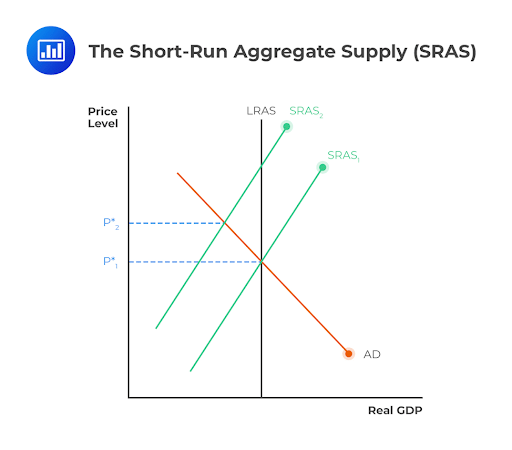
- The short-run aggregate supply curve (SRAS) is considered a valid description of the economy's supply schedule only in the short run.
- The short run is defined as the period that begins immediately after a price increase and ends when input prices have increased in proportion to the price increase.
- The prices paid to providers of input goods and services are referred to as input prices.
- Examples of input prices are the wages paid to employees, interest paid to capital providers, rent paid to landowners, and prices paid to suppliers of intermediate goods.
- The SRAS curve is based on the assumption that input providers do not or cannot immediately account for increases in the general price level, so it takes some time–referred to as the short run–for input prices to fully reflect changes in the price level for final goods.
- In the short run, sellers of finished goods receive higher prices for their goods without a proportional increase in the cost of their inputs.
- The higher the price level, the more willing these sellers will be to supply.
- The SRAS curve, depicted below figure is thus upward sloping, reflecting the positive relationship that exists in the short run between the price level and the number of goods supplied.

Long-run Aggregate Supply Curve (LRAS)
- The long-run aggregate supply (LRAS) curve describes the economy's supply schedule in the long run.
- The long run is defined as the time period during which input prices have completely adjusted to changes in the price level of final goods.
- In the long run, the increase in prices received by sellers for their finished goods is completely offset by the proportional increase in prices paid by sellers for inputs.
- As a result, the amount of real GDP supplied by all sellers in the economy is unaffected by changes in the price level.
- The LRAS curve, depicted in the figure below, is a vertical line, indicating that changes in the price level have no effect on long-run aggregate supply.
- It's worth noting that the LAS curve is vertical at the point labeled "natural level of real GDP."
- The natural level of real GDP is defined as the level of real GDP that occurs when all of the economy's available input resources are fully utilized.

Changes in Aggregate Supply Curve
- Shifts in the aggregate supply curve represent changes in aggregate supply.
- The figure given below depicts the various ways in which the SRAS and LRAS curves can shift.

- A shift to the right of the SRAS curve from SRAS 1 to SRAS 2 or of the LRAS curve from LRAS 1 to LRAS 2 indicates that the quantity supplied of real GDP has increased at the same price levels.
- A shift to the left of the SRAS curve from SRAS 1 to SRAS 3 or of the LRAS curve from LRAS 1 to LRAS 3 indicates that the quantity supplied of real GDP has decreased at the same price levels.
- Changes in aggregate supply, like changes in aggregate demand, are not caused by changes in the price level.
- They are instead primarily caused by changes in the following two factors:
Input Prices
- Since the SRAS curve is drawn under the assumption that input prices remain constant, the decrease in aggregate supply caused by an increase in input prices is represented by a shift to the left of the SRAS curve.
- A shift to the right of the SRAS curve represents an increase in aggregate supply as a result of lower input prices.
- For example, the price of oil, an input good, rose dramatically in the 1970s as a result of efforts by oil-producing countries to limit the amount of oil sold.
- Oil or oil products are used as inputs in many final goods and services. Due to rising costs, suppliers of these final goods and services were forced to reduce their supply at all price levels.
Economic Growth
- Positive economic growth occurs as a result of an increase in productive resources such as labour and capital.
- With more resources, it is possible to produce more final goods and services, resulting in an increase in the natural level of real GDP.
- Positive economic growth is thus characterized by a shift to the right of the LRAS curve.
- Negative economic growth, on the other hand, reduces the natural level of real GDP, causing the LRAS curve to shift to the left.
Significance of Aggregate Supply
- The importance of aggregate supply was discovered in the 1970s.
- A reduction in oil supply orchestrated by Saudi Arabia late in 1973 resulted in rising unemployment and inflation in the United States.
- Higher unemployment, according to the Phillips Curve, should have resulted in lower inflation.
- To explain the anomaly, economists coined the phrase "adverse supply shock."
Drawbacks of Aggregate Supply
- Changes in aggregate supply are a reaction to changes in aggregate demand, which are manifested as price changes.
- However, because many prices are sticky and economic agents take time to recognize changes in price levels, there is a difference between aggregate supply in the short run and aggregate supply in the long run.
- Keynes argued that since prices are sticky in the short run, they do not decline enough to stimulate aggregate demand which can return real GDP to its natural level.
- The only way to increase aggregate supply is to raise prices, which reduces aggregate demand. As a result, firms cut back on production.
- Input prices can also be affected by inflation expectations. For example, if union workers anticipate higher inflation, they will demand higher wages when their labour contract is renewed
- Factors that reduce productivity, such as increased regulations, strikes, or, depending on the industry, bad weather, can also cause the SRAS curve to shift to the left.
Conclusion
The goods and services produced by an economy are referred to as aggregate supply. It is propelled by four production factors: labour, capital goods, natural resources, and entrepreneurship. The availability of financial capital augments these factors.
| Other Relevant Links | |
|---|---|
| Indian Economics Notes | Macro Economics |
| Micro Economics | Difference Between Macroeconomics and Microeconomics |
| Branches of Economics | Sectors of Indian Economy |
FAQs
Question: What is Aggregate Supply (AS) in the context of the Indian economy?
Answer: Aggregate Supply (AS) refers to the total quantity of goods and services that producers in an economy are willing and able to supply at a given overall price level, within a specific period. In the context of the Indian economy, AS is influenced by factors such as labor, capital, technology, and the availability of raw materials. The aggregate supply curve in India is typically upward sloping in the short run, meaning that as the price level increases, the quantity of goods and services supplied also increases, as firms are incentivized to produce more. In the long run, however, the AS curve becomes vertical, reflecting the economy's potential output when all resources are fully utilized.
Question: What factors influence Aggregate Supply in the Indian economy?
Answer: Several factors influence Aggregate Supply in the Indian economy, including:
- Labor Force: The size and skill level of the labor force play a crucial role in determining the economy's productive capacity.
- Capital Formation: Investment in infrastructure, machinery, and technology helps increase productive capacity.
- Technological Advancements: Innovations and improvements in technology lead to greater efficiency in production, thus increasing aggregate supply.
- Natural Resources: The availability of raw materials such as minerals, energy sources, and agricultural land directly impacts production capabilities.
- Government Policies: Policies related to labor laws, taxation, subsidies, and trade can either stimulate or restrict production in the economy.
Question: How does Aggregate Supply relate to inflation in the Indian economy?
Answer: The relationship between Aggregate Supply and inflation in India is significant. In the short run, an increase in aggregate demand, without a corresponding increase in aggregate supply, can lead to demand-pull inflation. Conversely, if supply-side constraints like high production costs or shortages of key inputs (like energy or labor) persist, it can lead to cost-push inflation. For example, rising fuel prices or raw material shortages may reduce the economy's ability to produce goods and services at existing prices, leading to higher inflation. Therefore, managing both demand and supply factors is critical for maintaining price stability in the Indian economy.
Question: What is the long-run Aggregate Supply curve and how is it relevant to India's economic growth?
Answer: The long-run Aggregate Supply (LRAS) curve is vertical, indicating that in the long run, the total supply of goods and services in an economy is determined by the availability and efficiency of resources, and not by the price level. In the context of India's economic growth, the LRAS curve reflects the country's potential output, which is driven by factors such as labor force growth, capital accumulation, technological advancement, and efficient resource use. India's long-run growth potential depends on improving these factors, as the country continues to modernize its industries, expand its infrastructure, and increase human capital through education and skill development.
Question: How do supply-side reforms impact Aggregate Supply in India?
Answer: Supply-side reforms are aimed at increasing the productive capacity of the economy by improving the efficiency of labor, capital, and resources. In India, supply-side reforms such as liberalization, deregulation, infrastructure development, and improvements in education and health can lead to an increase in aggregate supply. For instance, by reducing red tape and improving business conditions, reforms can encourage more investments and better utilization of resources. Additionally, reforms in agriculture and labor markets can help enhance productivity, thus raising the overall supply in the economy. These measures are critical for fostering sustainable long-term growth in India.
MCQs
1. What does the long-run Aggregate Supply curve represent in an economy?
A) The total amount of goods and services produced in the short run
B) The economy’s potential output when all resources are fully utilized
C) The relationship between aggregate demand and inflation
D) The total income earned by all factors of production
Answer: (B) See the Explanation
Explanation: The long-run Aggregate Supply (LRAS) curve represents the economy's potential output when all resources are fully utilized, reflecting the productive capacity of the economy over time, independent of the price level.
2. Which of the following is a factor that directly influences Aggregate Supply?
A) Inflation rate
B) Monetary policy
C) Technological advancements
D) Consumer confidence
Answer: (C) See the Explanation
Explanation: Technological advancements directly influence Aggregate Supply by improving production efficiency, thereby increasing the total output of goods and services in the economy.
3. What is the relationship between Aggregate Demand and Aggregate Supply?
A) Aggregate Demand and Aggregate Supply are inversely related
B) Aggregate Demand and Aggregate Supply determine the equilibrium price and output
C) Aggregate Demand has no impact on Aggregate Supply
D) Aggregate Supply directly leads to inflationary pressures
Answer: (B) See the Explanation
Explanation: Aggregate Demand and Aggregate Supply determine the equilibrium price level and output in the economy. When aggregate demand exceeds aggregate supply, inflationary pressures may arise.
4. How does an increase in labor productivity impact Aggregate Supply?
A) It decreases Aggregate Supply
B) It increases Aggregate Supply
C) It has no effect on Aggregate Supply
D) It causes cost-push inflation
Answer: (B) See the Explanation
Explanation: An increase in labor productivity raises the economy's capacity to produce more goods and services, thus increasing Aggregate Supply.
5. What is a key characteristic of the short-run Aggregate Supply curve in the Indian economy?
A) It is vertical at all price levels
B) It slopes downward from left to right
C) It slopes upward from left to right
D) It is horizontal at all price levels
Answer: (C) See the Explanation
Explanation: In the short run, the Aggregate Supply curve in India is upward sloping, indicating that as the price level rises, producers are willing to supply more goods and services.
GS Mains Questions and Model Answers
Q1: Discuss the role of Aggregate Supply in the economic growth of India.
Answer: Aggregate Supply plays a crucial role in determining the productive capacity and economic growth of India. In the short run, it reflects the total supply of goods and services produced by the economy, influenced by factors such as labor, capital, and technology. In India, improving Aggregate Supply is essential for sustainable economic growth, as it drives the production of goods and services. Policy measures that enhance labor productivity, infrastructure, and technological advancements are key to boosting Aggregate Supply. Additionally, supply-side reforms, including deregulation, improving ease of doing business, and investing in human capital, can lead to higher efficiency and greater economic output, contributing to long-term growth. Addressing supply-side constraints is critical for India to achieve its growth potential and improve living standards across the country.
Q2: Explain the short-term and long-term effects of an increase in Aggregate Demand on the Indian economy.
Answer: An increase in Aggregate Demand (AD) in the Indian economy leads to higher output and prices in the short run. As demand for goods and services rises, producers increase production to meet the demand, which can lead to higher employment and higher income levels. However, if AD exceeds the economy’s short-run Aggregate Supply (AS), it may result in inflationary pressures. In the long run, however, the increase in Aggregate Demand may have a more limited effect if Aggregate Supply does not increase in tandem. Over time, sustained increases in Aggregate Demand can stimulate investment in infrastructure, capital formation, and technological advancements, which can lead to a higher potential output and a shift in the long-run Aggregate Supply curve. Thus, increasing Aggregate Demand can stimulate economic growth, but it must be accompanied by policies that enhance supply-side capabilities to prevent overheating and inflation.
Q3: How can supply-side reforms improve Aggregate Supply in India?
Answer: Supply-side reforms can significantly improve Aggregate Supply by enhancing the efficiency of the economy’s resources. Key reforms include:
- Labor Market Reforms: By simplifying labor laws and increasing labor force participation, productivity can be enhanced.
- Infrastructure Development: Investments in roads, ports, electricity, and telecommunications can lower production costs and increase efficiency.
- Technological Advancements: Promoting innovation through research and development (R&D) can increase the efficiency of production processes.
- Tax Reforms: Reducing business taxes can incentivize investment, increasing the productive capacity of industries.
These reforms contribute to an increase in the economy's productive potential, thereby enhancing Aggregate Supply and supporting sustained economic growth in India.
Previous Year Questions on Aggregate Supply
1. UPSC CSE Prelims 2020:
Question: Which of the following is NOT a factor influencing Aggregate Supply in the Indian economy?
A) Labor Force Size
B) Government Subsidies
C) Technological Innovation
D) Consumer Preferences
Answer: (D)
Explanation: Consumer preferences primarily influence Aggregate Demand, not Aggregate Supply. Factors like labor force size, government subsidies, and technological innovation directly impact Aggregate Supply.
2. UPSC CSE Mains 2019 (GS Paper 3):
Question: Examine the relationship between Aggregate Supply and inflation in India.
Answer: The relationship between Aggregate Supply and inflation in India is complex. In the short run, if Aggregate Demand exceeds Aggregate Supply, it can lead to demand-pull inflation, where rising demand outpaces the economy's ability to produce goods and services. On the other hand, cost-push inflation can occur when there are supply-side constraints, such as rising input costs or shortages in key resources, leading to higher production costs. Managing both demand and supply factors is critical to controlling inflation. Supply-side reforms such as improving productivity, reducing input costs, and enhancing the availability of resources can help control inflation and improve the long-term stability of the economy.
Download the PREPP App and attempt FREE IAS Exam Mock Tests and get complete study material!

Full Test - 04: UPSC CSE Prelims CSAT (Paper-II)
Full Test - 03: UPSC CSE Prelims CSAT (Paper-II)
UPSC CSE Prelims 2026 GS Paper 1 Question Paper (24-May-2026)
UPSC CSE Prelims 2026 CSAT Paper 2 Question Paper (24-May-2026)

17 February 2025 | The Hindu Must Read Articles | Current Affairs

16 February 2026 | The Hindu Must Read Articles | Current Affairs

13 February 2026 | The Hindu Must Read Articles | Current Affairs









Comments