Carbon Dioxide Levels - Keeling Curve - Environment Notes
CO2 (carbon dioxide) is a trace gas in the atmosphere, with current levels approximately 370 parts per million (ppm). CO2 is created as a byproduct of aerobic respiration. The process through which plants take CO2 and release oxygen is known as photosynthesis. The Keeling Curve is a graph that depicts the continuing shift in carbon dioxide concentrations in the Earth's atmosphere. This article explains about the Carbon Dioxide Levels - Keeling Curve which is important for UPSC IAS exam preparation.
Table of Contents
Carbon Dioxide Levels
- Changes in our atmosphere caused by reactive gases (gases that undergo chemical reactions) such as ozone and ozone-forming compounds such as nitrous oxides are generally transient.
- However, carbon dioxide is a different beast. Once injected into the atmosphere, it lingers for a long time: 300 to 1,000 years.
- As a result, as humans affect the atmosphere by producing carbon dioxide, such changes will last for many human lives.
- The Mauna Loa Observatory in Hawaii (USA) recently discovered the greatest levels of planet-warming carbon dioxide in the Earth's atmosphere since records began.
- The observatory measured a CO2 level of more than 415 parts per million (PPM).
- The last time this much CO2 existed in the atmosphere was more than three million years ago, when global sea levels were several metres higher and portions of Antarctica were covered in forest.
- Because of man-made emissions, the Earth's average surface temperature has already climbed 1°C since pre-industrial times, and despite the Paris agreement and greater public awareness of the problem, we have not succeeded in reducing carbon emissions.
- The Intergovernmental Panel on Climate Change (IPCC) estimated in 2018 that if present emissions continue, the globe would exceed the 1.5°C global warming limit between 2030 and 2052, causing catastrophic global warming.
| Other Relevant Links | |
|---|---|
| India's GreenHouse Gas Emissions | Net Zero Pledges |
| Karakoram Anomaly | HPCL - Cow Dung to Compressed Biogas Project |
| Triple Planetary Crisis | Arctic Amplification |
| CO2 Equivalent | Carbon Budget |
| Updated NDCs | Panchamrit |
| UNEP Production Gap Report | UN World Water Conference |
| Global Alliance for Industry Decarbonisation | Carbon Bombs |
Keeling Curve
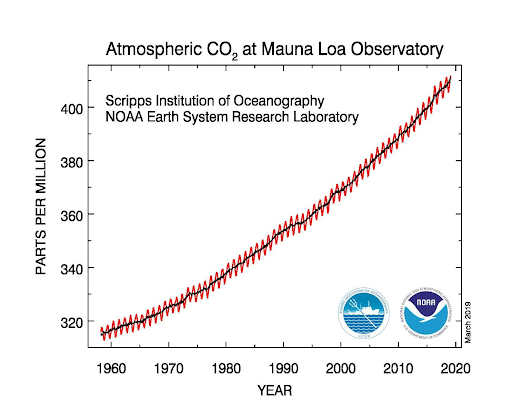
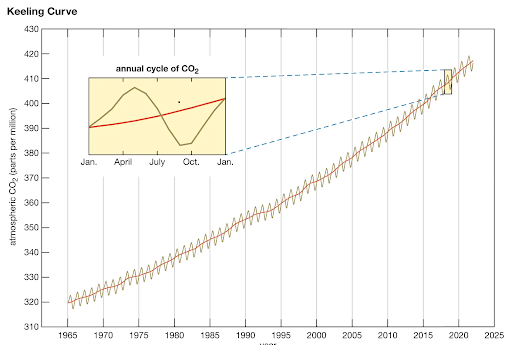
- The Keeling Curve is a graph depicting the buildup of carbon dioxide in the Earth's atmosphere from 1958 to the present, based on continuous observations obtained at the Mauna Loa Observatory on the island of Hawaii.
- The curve is named after the scientist Charles David Keeling, who initiated and oversaw the monitoring programme until his death in 2005.
- The Keeling Curve is both striking and significant. It demonstrates, for example, that when these atmospheric CO2 observations began in 1958, the quantity of carbon dioxide in the Earth's atmosphere was around 315 parts per million (ppm).
- The Keeling Curve will reach 420 ppm for the first time in human history in 2021, according to observations obtained at Mauna Loa and elsewhere around the world.
- Since 1958, measurements of the Keeling Curve have been practically constant. A temporary financing problem in 1964 and the most recent eruption in 1984 caused minor blips in the data.
Causes of CO2 Raises
- Carbon dioxide emissions are produced by both natural and manmade processes.
- Natural sources include decomposition, ocean release, and respiration.
- Human-caused factors include cement production, deforestation, and the usage of fossil fuels.
- Since the Industrial Revolution, human sources of carbon dioxide emissions have increased.
- The burning of coal, natural gas, and oil accounts for 87 percent of all human-produced carbon dioxide emissions.
- Decomposition and respiration: Respiration and decomposition are natural processes that exchange carbon dioxide and oxygen between animal blood and the environment.
- The use of fossil fuels:Deforestation, coal combustion, petrol production, and gas production all contribute to at least 87 percent of CO2 emissions into the environment.
- Deforestation has a greater impact on CO2 levels in the atmosphere than merely emitting additional CO2 into the atmosphere by burning coal and trees.
- Transportation industry: The transportation industry is another important producer of carbon emissions in the environment.
- Freight, automobiles, and light-duty vehicles account for around 72 percent of the transportation industry's carbon dioxide emissions, with freight, automobiles, and light-duty trucks being main emitters.
- Additional sources: Industrial processes are responsible for around 20% of CO2 emissions from fossil fuels.
- Among these processes are construction, agriculture, mining, lithium extraction, agriculture, and manufacturing.
- Several processes, including the production and consumption of mineral commodities such as cement, the production of metals such as iron and steel, and the production of chemicals, emit CO2 through chemical reactions that do not involve combustion.
Steps to Reduce CO2 emissions
- According to the 2016 Paris Climate Agreement, governments must collaborate to limit global warming below 2 degrees Celsius above pre-industrial levels.
- To do this, we must reduce CO2 emissions and extract more carbon from the atmosphere.
- According to several climate projections, by 2050, we will need to remove or store billions of metric tonnes of CO2 while lowering our carbon footprint.
- A recent Intergovernmental Panel on Climate Change study advocated for net zero GHG emissions by 2075 in order to meet the 2oC objective (by 2050 for the more aggressive 1.5 degree C aim).
- Net zero is attained when total emissions are offset by carbon dioxide absorption.
- This is accomplished through natural sinks such as trees or through artificial interventions that remove carbon dioxide from the atmosphere.
Conclusion
Carbon dioxide is the most significant greenhouse gas on Earth, a gas that absorbs and radiates heat. Greenhouse gases, unlike oxygen and nitrogen (which make up the majority of our atmosphere), absorb heat emanating from the Earth's surface and re-emit it in all directions, including back towards the Earth's surface. Once injected into the atmosphere, it lingers for a long time: 300 to 1,000 years. As a result, as humans affect the atmosphere by producing carbon dioxide, such changes will last for many human lives.
FAQs
Question: What is Carbon dioxide?
Answer:
Carbon dioxide (CO2) is a colourless and odourless natural gas. It has a vapour density of 1.53 and a sublimation boiling point of 70°C. Carbon dioxide is a greenhouse gas that helps to regulate the earth's temperature. Carbon dioxide is soluble in water and may be found in groundwater, rivers and lakes, ice caps and glaciers, and the ocean.
Question: What is a Keeling Curve?
Answer:
The Keeling Curve is a graph that depicts the accumulation of carbon dioxide in the Earth's atmosphere from 1958 to the present, based on continuous data gathered from Hawaii's Mauna Loa Observatory. The curve is named after Charles David Keeling, a physicist who created and led the monitoring experiment until his death in 2005.
Question: What is the Paris Climate Agreement?
Answer:
The Paris Agreement is a legally enforceable international climate change accord. It was accepted on December 12, 2015, by 196 Parties at the United Nations Climate Change Conference (COP21) in Paris, France. It went into effect on November 4, 2016. Its ultimate objective is to keep "the increase in global average temperature well below 2°C above pre-industrial levels" and to pursue initiatives "to limit the temperature increase to 1.5°C above pre-industrial levels."
MCQs
Question: Consider the following: (UPSC 2011)
- Carbon dioxide
- Oxides of nitrogen
- Oxides of sulphur
Which of the above is/are the emissions/emissions from coal combustion at thermal power plants?
(a) 1 only
(b) 2 and 3 only
(c) 1 and 3 only
(d) 1,2 and 3
Answer: (d) See the Explanation
Emissions from Thermal Power Plants:
- Water runoff from coal washeries delivers significant metal pollution loads that pollute groundwater, rivers, and lakes, damaging aquatic flora and animals.
- Pollutants and fly ash residues settle on soil, polluting areas and posing a particular threat to agriculture.
- In general, Indian coals have a lower calorific value and a higher ash content (up to 40%).
- Coal combustion in coal-fired power plants produces emissions of
- SO2 (sulphur dioxide),
- NOx (nitrogen oxides),
- PM (particulate matter),
- Carbon monoxide (CO), as well as
- VOCs are short for volatile organic compounds. Hence, 1, 2 and 3 are correct.
Therefore, option (d) is the correct answer.
Question: Consider the following statements about Intergovernmental Panel on Climate Change
- The World Meteorological Organisation (WMO) and the United Nations Development Programme (UNDP) founded it in 1988.
- IPCC assessments offer a scientific foundation for governments at all levels to establish climate-related policies, and they serve as the foundation for talks at the United Nations Climate Conference.
Which of the above statements is/are correct
(a) 1 only
(b) 2 only
(c) Both 1 and 2
(d) Neither 1 nor 2
Answer: (b) See the Explanation
- The Intergovernmental Panel on Climate Change is the worldwide body in charge of evaluating climate change science.
- The World Meteorological Organisation (WMO) and the United Nations Environment Programme (UNEP) established it in 1988 to offer policymakers with periodical evaluations of the scientific foundation of climate change, its consequences and future risks, as well as alternatives for adaptation and mitigation. Hence statement 1 is incorrect.
- IPCC assessments offer a scientific foundation for governments at all levels to establish climate-related policies, and they serve as the foundation for discussions at the United Nations Framework Convention on Climate Change (UNFCCC). Hence statement 2 is correct.
Therefore, option (b) is the correct answer.
*email: contactus@prepp.in
Download the PREPP App and attempt FREE IAS Exam Mock Tests and get complete study material!

Full Test - 04: UPSC CSE Prelims CSAT (Paper-II)
Full Test - 03: UPSC CSE Prelims CSAT (Paper-II)
UPSC CSE Prelims 2026 GS Paper 1 Question Paper (24-May-2026)
UPSC CSE Prelims 2026 CSAT Paper 2 Question Paper (24-May-2026)

17 February 2025 | The Hindu Must Read Articles | Current Affairs

16 February 2026 | The Hindu Must Read Articles | Current Affairs

13 February 2026 | The Hindu Must Read Articles | Current Affairs









Comments