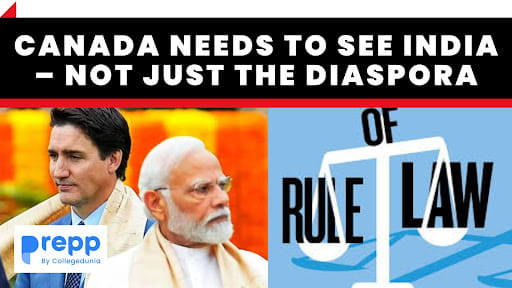
Canada Needs To See India – Not Just The Diaspora
Relevance: GS2 - Effect of policies and politics of developed and developing countries on India’s interests, Indian diaspora.
(Source: Indian Express, 09/22/2023)
Click here for Daily Current Affairs
Why in the news?
- Recently, India and Canada expelled diplomats in the aftermath of the allegations raised by Canadian Prime Minister Justin Trudeau about the killing of Khalistani activist Hardeep Singh Nijjar.
- This article discusses the influence of the diaspora on Canadian foreign policy.
Table of Contents
Canada-India relations over the years
- India and Canada have shared an up-and-down relationship over the last fifty years.
- During the Cold War, the two countries shared a positive relationship on the basis of their shared commonwealth status and convergent views on multilateralism, global development, and the importance of the UN.
- Bilateral ties became strained over Cold War crises in Korea, Hungary, and Vietnam and were worsened by India’s nuclear tests.
- Ties improved in the 1980s as a consequence of the increased immigration from India to Canada.
- However, the lack of meaningful trade and security engagement between the two countries restricted the scope for bilateral diplomatic engagement.
- Although the two countries have made efforts to revive the relationship, friction in the relationship has emerged due to the influence of the Indian diaspora in Canada, who have expressed an antagonistic attitude towards India.
- Common interests: Defending the international order, Balancing China’s rise and the Indo-Pacific policy, and Cooperation on climate change, global health, misuse of digital technologies, regulating AI, and assistance to developing countries.
Present stalemate
- The recent public allegations by Canadian PM Trudeau indicate a significant downturn in the relations between the two countries.
- Trudeau’s allegations make reference to the “rule of law” but do not consider the implications of the actions undertaken by such separatists on the rule of law in India and Canada.
- Eg: The bombing of Air India 182 in 1985 by Khalistani separatists, which is the largest terrorist attack in Canadian history.
- India has criticized Canada for its lack of action against Khalistani actors and their provocations such as offensive floats of Bharat Mata and the Indira Gandhi Assassination.
- India has also previously highlighted the desecration of Hindu temples by Khalistani separatists and the lack of action taken by Canada against them.
- India has also claimed that Khalistani separatists attempted to disregard the Indian lawmaking process through their involvement in the protests against the Indian farm laws.
To know more click the link.
Influence of the diaspora
Economic
- Diaspora influences national economies by sending remittances to family members in the home country, FDI, entrepreneurship, trade facilitation, and transfer of skills.
- They can participate in brain gain by returning to India or influencing others through knowledge transfer, and social and economic capital formation.
- The size of a diaspora population is positively correlated to the magnitude of international trade between the two countries.
Foreign policy
- The Canadian government’s foreign policy has been characterized by support for immigrants and diaspora elements like the Khalistanis.
- This has allowed diaspora elements to use Canadian soil for activities that threaten the interests and security of other countries.
- As a result of this, the Canadian government has been unable to ring-fence its national security and foreign policy priorities from short-term electoral pressures.
Challenge for India
- Indian foreign policy faces a major problem in realigning its approach towards the Indian diaspora in various countries.
- Previously, the foreign policy establishment had adopted a strategic view of most diaspora groups as key vectors of remittances, networks, and ideas in India.
- Engagement with the diaspora has intensified as part of the government’s efforts made to compel them to invest in India’s economic development.
- They have contributed to the advancement of India’s strategic ties with the United States and fostered national projects like Make in India and Digital India.
- However, there has been an increase in civil society protests centered around human rights violations during most of India’s high-level diplomatic visits to Western nations.
Caste discrimination
- Caste discrimination is becoming a rising concern across universities, firms, and organizations in the West.
- The growing popularity of digital technologies has affected and amplified the political outlook, linguistic choices, and ideological affinity of the Indian diaspora.
Concerns associated with India’s diaspora policy
- Lack of Diaspora Policy: Despite the significant socio-economic contributions of the Indian diaspora to the country's development, there is currently no established policy in place for the diaspora.
- The lack of up-to-date information on the Indian diaspora with Indian embassies has affected the efficient implementation of welfare schemes.
- Duplication of Grievance Redressal Portals: There are numerous platforms for migrants such as the e-Migrate and the Centralized Public Grievance Redressal and Monitoring System (CPGRAMS).
- However, this leads to a duplication of data and leads to delays in grievance redressal.
- Worker Rehabilitation: There is no effective policy for the rehabilitation of returning migrant workers.
- Such a scheme has to be implemented in order to ensure livelihood security for those who are unable to return abroad.
- Skilling: India faces a significant challenge in equipping its workers with the necessary skills that allow them to compete with labor markets in East Asia like Japan, Korea, and Taiwan.
- NRI Marriages: There have been numerous instances of women being abandoned in NRI marriages recently.
- However, the Registration of Marriage of Non-Resident Indian Bill from 2019 has not yet been enacted.
- The proposal to establish overseas centers to assist distressed NRI women has also not been implemented.
- Discriminatory Practices: The lingering racist, and colonial mindset among the countries of the West is another challenge faced by the Indian diaspora.
Conclusion
- India must exercise caution in engaging with the Indian diaspora in order to serve Indian interests as some such groups have been actively working against India’s national interests.
- However, dealing with the challenges in the bilateral relationship requires a political compact that addresses Canada’s Indian diaspora and the separatist elements among it.
Khalistan
|
(*Click this link to read prelims specific weekly current affairs articles)
FAQs
Question: What does the term diaspora mean?
Answer:
The term diaspora originates from the Greek word “diaspeiro” meaning dispersion. Indian diaspora refers to people whose origins can be traced to India or Indian citizens living abroad.
Question: What is the rule of law?
Answer:
Rule of law is a principle that means that no one is above the law and that everyone is subject to the authority of the ordinary courts of the land. Its origin can be traced to 13th C AD and was refined by British constitutionalist AV Dicey who stated that the Rule of law is the absence of arbitrary authority, equality before the law, and the precedence of individual rights.
UPSC Mains Practice Question:
|
MCQs
Question: In which one of the following groups are all four countries members of G20? (UPSC CSE 2020)
(a) Argentina, Mexico, South Africa and Turkey
(b) Australia, Canada, Malaysia and New Zealand
(c) Brazil, Saudi Arabia, and Vietnam
(d) Indonesia, Japan, Singapore, and South Korea
Answer: (a) See the Explanation
- The members of the G20 are - Argentina, Australia, Brazil, Canada, China, France, Germany, India, Indonesia, Italy, Japan, Republic of Korea, Mexico, Russia, Saudi Arabia, South Africa, Turkey, United Kingdom, United States, and the European Union.
- Malaysia, New Zealand, Vietnam, and Singapore are not members of the G-20.
Therefore, option (a) is the correct answer.
Question: Consider the following statements:
- The United Nations Convention against Corruption (UNCAC) has a "protocol against the smuggling of Migrants by Land, Sea and Air".
- The UNCAC is the ever-first legally binding global anti-corruption instrument.
- A highlight of the United Nations Convention against Transnational Organized Crime (UNTOC) is the inclusion of a specific chapter aimed at returning assets to their rightful owners from whom they had been taken illicitly.
- The United Nations Office on Drugs and Crime (UNODC) is mandated by its member states to assist in the implementation of both UNCAC and UNTOC.
Which of the following statements given above are correct? (UPSC CSE 2019)
(a) 1 and 3 only
(b) 2, 3 and 4 only
(c) 2 and 4 only
(d) 1, 2, 3 and 4
Answer: (c) See the Explanation
- The protocol against the smuggling of Migrants by Land, Sea and Air comes under the UN Convention against Transnational Organized Crime (UNTOC). Hence statement 1 is incorrect.
- The United Nations Convention Against Corruption is the only legally binding global anti-corruption instrument. Hence statement 2 is correct.
- The UNCAC contains a specific provision regarding the return of illicitly seized assets to their rightful owners. Hence statement 3 is incorrect.
- The United Nations Office on Drugs and Crime (UNODC) is mandated by its member states to assist in the implementation of both the UNCAC and UNTOC, the UN Drug Conventions of 1961, 1971, and 1988. Hence statement 4 is correct.
Therefore, option (c) is the correct answer.
Download the PREPP App and attempt FREE IAS Exam Mock Tests and get complete study material!

Full Test - 04: UPSC CSE Prelims CSAT (Paper-II)
Full Test - 03: UPSC CSE Prelims CSAT (Paper-II)
UPSC CSE Prelims 2026 GS Paper 1 Question Paper (24-May-2026)
UPSC CSE Prelims 2026 CSAT Paper 2 Question Paper (24-May-2026)

17 February 2025 | The Hindu Must Read Articles | Current Affairs

16 February 2026 | The Hindu Must Read Articles | Current Affairs

13 February 2026 | The Hindu Must Read Articles | Current Affairs









Comments