World Rhino Day 2023
Relevance: GS3- Conservation
(Source: Down To Earth, 09/22/2023)
Click here for Daily Current Affairs
Why in the News?
- World Rhino Day is celebrated on September 22 every year.
- World Rhino Day is a day of awareness for all five rhino species and the work being done to save them.
- On the occasion of World Rhino Day 2023, ‘STATE OF THE RHINO REPORT-2023’ is released by the International Rhino foundation.
- Since 2011, World Rhino Day has been celebrated internationally on September 22nd by rhino experts and advocates around the world!
- It was first announced by the World Wildlife Fund (WWF) – South Africa in 2010.
Table of Contents

Rhino Species around the world
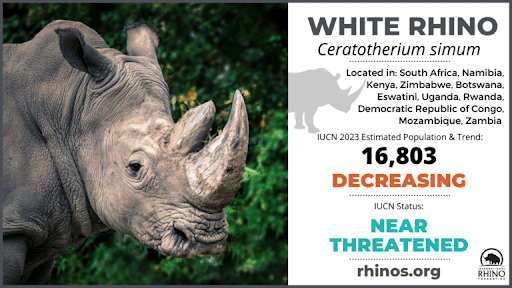
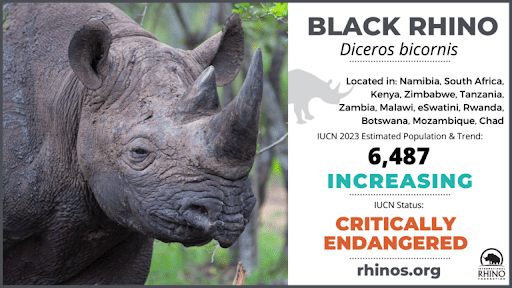
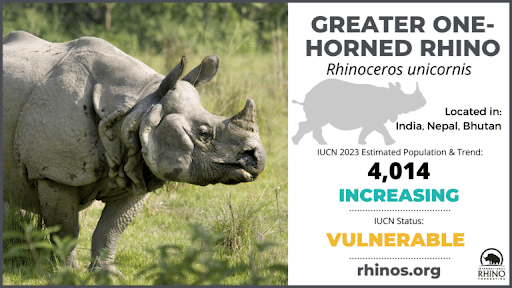
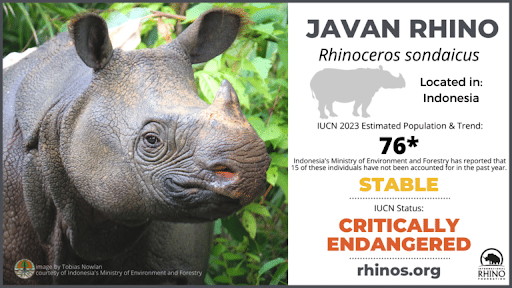
Current Status & threats around the world
- The global population of rhinos is estimated to be a little over 26,000.
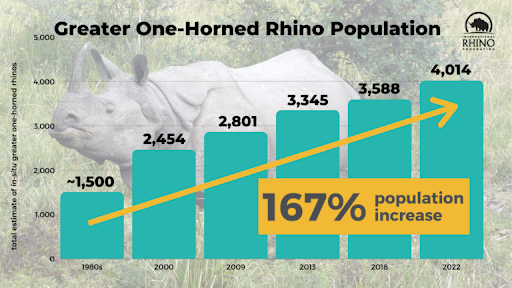
- The rhino population in India, Bhutan and Nepal is increasing and is estimated to touch 4,014.
- The population of Black rhinos, described as critically endangered, is increasing; the population is estimated at 6,195.
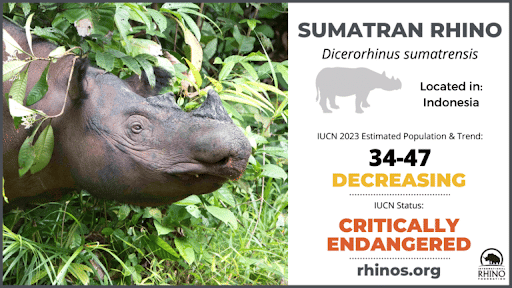
- However, populations of White rhinos and Sumatran rhinos are decreasing, estimated to be about 15,942 and 34 to 47.
Natural Threats
- Increased precipitation, longer monsoons and seasonal floods are already resulting in stranding, drowning or separation of calves from their mothers among Greater One-horned Rhinos
- intensified storms, increasing risks of diseases among rhinos.
- changes in weather conditions and landscape may lead to the expansion of invasive species and overtaking of rhino food plants, causing habitat degradation.
- Dry conditions due to drought increase the possibility of wildfires, causing habitat loss.
Anthropogenic Threats
- Poverty due to crop loss and reduction in livestock may result in increased cases of poaching as a means to earn income.
- poaching and and hunting
- Climate change-induced droughts have been threatening the rhino population.
Status and Conservation Efforts in India
- Out of 5 rhino species, the Greater One Horned Rhino is found in India.
- The presence of the species is restricted to small habitats in Indo-Nepal terai and northern West Bengal and Assam.
- Rhinos are now found in four Protected Areas in Assam: Pabitora Wildlife Reserve, Rajiv Gandhi Orang National Park, Kaziranga National Park, and Manas National Park.
| The current population of greater one-horned rhinos in India | |
|---|---|
| Kaziranga National Park | 2613 |
| Orang National Park | 125 |
| Pobitora Wildlife Sanctuary | 107 |
| Manas National Park | 40 |
| Jaldapara National Par | 287 |
| Gorumara National Park | 52 |
| Dudhwa National Park | 38 |
Conservation Efforts by India
- The government of India has launched and successfully achieved the targets under Indian Rhino Vision 2020 (IRV 2020).
- The five rhino range nations (India, Bhutan, Nepal, Indonesia and Malaysia) have signed a declaration ‘The New Delhi Declaration on Asian Rhinos 2019’ for the conservation and protection of the species.
- The Ministry of Environment Forest and Climate Change (MoEFCC) has begun a project to create DNA profiles of all rhinos in the country.
- National Rhino Conservation Strategy: It was launched in 2019 to conserve the greater one-horned rhinoceros.
- India is a signatory to CITES (Convention on International Trade in Endangered Species of Wild Flora and Fauna). Thus, it is illegal to sell the horns in the country anyway.
- Also, the case for the destruction of horns is a process that is in compliance with Section 39(3)(c) of the Wildlife (Protection) Act of 1972.
- A proposed rhino translocation to Manas National Park, scheduled for 2024, is expected to ensure better growth opportunities and increased security and free movement of the population.
- In 2022, the Assam government sanctioned about 200 square kilometres of land to Orang National Park in north central Assam to expand the protected area by almost double.
- The national park is connected to Burhachapori Wildlife Sanctuary in the east, and it can create link across all protected areas that house rhinos — Manas National Park, Pobitora Wildlife Sanctuary, Orang National Park, the Laokhowa and Burhachapori Wildlife Sanctuaries and Kaziranga National Park.
About IRV 2020The project is launched by the Forest Department, Government of Assam, in partnership with WWF India, International Rhino Foundation, and several other organisations. The goal of IRV2020 was to increase the rhino population in Assam to 3,000 by establishing populations in new areas. Assam Government and our partners to help increase the rhino population in Assam, India, by supporting implementation of a new strategy, Indian Rhino Vision 2.0 (IRV2.0). IRV2.0 will help secure and manage a minimum of three meta-populations with a total population of 4,500 – 5,000 greater one-horned rhinos in Assam by 2030. |
(*Click this link to read prelims specific weekly current affairs articles)
MCQs
Question: With reference to the Indian Rhinoceros, consider the following statements:
- It is listed as critically endangered on the IUCN Red List.
- Gir National Park has the highest population of rhinos in India.
Which of the statements given above is/are correct?
(a) 1 only
(b) 2 only
(c) Both 1 and 2
(d) Neither 1 nor 2
Answer: (d) See the Explanation
- The Indian rhinoceros is indeed listed as "vulnerable" on the IUCN Red List of Threatened Species, not "critically endangered". Hence, statement 1 is not correct.
- Kaziranga National Park, located in the Indian state of Assam, has the highest population of Indian rhinoceros in the world. Hence, statement 2 is not correct.
Therefore, option (d) is the correct answer.
Download the PREPP App and attempt FREE IAS Exam Mock Tests and get complete study material!
*The article might have information for the previous academic years, please refer the official website of the exam.
How likely are you to recommend Prepp.in to a friend or a colleague?
Not so likely
Highly likely
UPSC CSE (IAS) 2027 Prelims Mock Test Series
Live Quizzes
Quizzes
Live Tests
Full Tests

Full Test - 04: UPSC CSE Prelims CSAT (Paper-II)
120 Minutes
80 Questions
200 Marks
English, Hindi
MEDIUM
Attempted by 18 aspirants in 12 hours
Full Test - 03: UPSC CSE Prelims CSAT (Paper-II)
120 Minutes
80 Questions
200 Marks
English, Hindi
MEDIUM
Attempted by 20 aspirants in 12 hours
Previous Year Papers
UPSC CSE Prelims 2026 GS Paper 1 Question Paper (24-May-2026)
120 Minutes
100 Questions
200 Marks
3,048 Attempted
English, Hindi
MEDIUM
Attempted by 12 aspirants in 12 hours
UPSC CSE Prelims 2026 CSAT Paper 2 Question Paper (24-May-2026)
120 Minutes
80 Questions
200 Marks
3,233 Attempted
English, Hindi
MEDIUM
Attempted by 13 aspirants in 12 hours
Videos

17 February 2025 | The Hindu Must Read Articles | Current Affairs
7,206 Views
•4
•7 months ago

16 February 2026 | The Hindu Must Read Articles | Current Affairs
6,963 Views
•4
•7 months ago

13 February 2026 | The Hindu Must Read Articles | Current Affairs
8,765 Views
•5
•7 months ago

12 February 2026 | The Hindu Must Read Articles | Current Affairs
5,789 Views
•4
•7 months ago






Also Check
IAS Exam Overview
IAS Exam Admit Card
IAS Exam Question Paper 2026
IAS Exam Mains Syllabus
IAS Exam Application Process
IAS Exam Eligibility
IAS Exam Result
IAS Exam Exam Pattern
IAS Exam CSAT Syllabus
IAS Exam Answer Key
IAS Exam Previous Year Paper
IAS Exam Current Affairs
IAS Exam Mains Question Paper
IAS Exam IAS Courses
IAS Exam UPSC Study Notes
IAS Exam Foundation Course 2024
IAS Exam Prelims Question Paper
IAS Exam Exam Center
IAS Exam Foundation Course 2025
IAS Exam Notification 2026
IAS Exam IAS Success Stories
IAS Exam Salary
IAS Exam Cutoff
IAS Exam Mock Tests
IAS Exam News


Comments