Onion Traders From Nashik Surrender Licenses Over Demand To Roll Back 40% Export Duty
(Source: Down to Earth, 09/22/2023)
Click here for Daily Current Affairs
Why in the news?
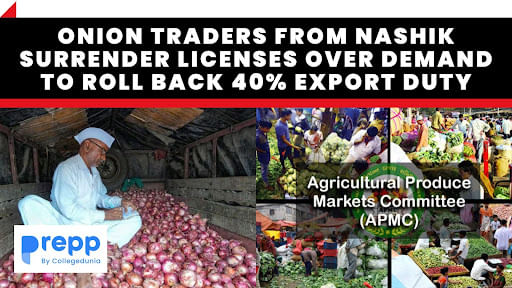
Recently, about 1,000 onion traders from 15 Agriculture Produce Market Committee (APMC) of Nashik district in Maharashtra called for a strike against the state government’s decision of imposing 40% export duty on onions and government agencies selling onions at subsidised rates.
Table of Contents
What are the concerns?
- Traders are urging the National Agricultural Cooperative Marketing Federation of India Ltd (NAFED) and the National Cooperative Consumers' Federation of India Limited (NCCF) to consider selling their onion buffer stock directly to consumers in retail markets or via ration shops, rather than distributing it through various Agricultural Produce Market Committees (APMCs) across the country.
- The onion traders are demanding the Centre develop its own supply chain to dispose of onion in retail markets. They traders stated that they cannot compete with the government prices at which the government sells onions.
Factors behind the surge in onion prices
- The current surge in onion prices can be attributed to two main factors:
- a shortage of stored onion produce and a lower-than-expected cultivation of onions.
- Unlike some other vegetables like okra or beans, onions are not grown year-round.
- The issue began to unfold last year when there was a decline in onion cultivation acreage.
- The Crop and Weather Watch Group reported that the onion sowing fell short of the target, with around 3.29 lakh hectares sown instead of the intended 3.76 lakh hectares.
- The situation was exacerbated by adverse weather conditions during March and April, affecting the Rabi crop.
- Many onion-producing states, including Maharashtra, experienced unseasonal rain and hailstorms during this crucial period.
- Due to concerns about the quality of stored onions, farmers were compelled to bring their Rabi crop to the market earlier than usual, starting in May. This increased the supply of onions in May, coupled with lower quality produce, which led to a price decline.
- In an attempt to support onion growers, the Maharashtra government introduced a special scheme in March, offering a subsidy of Rs 300 per quintal. However, many farmers have reported not receiving the benefits of this scheme.
- Consequently, the imbalance between supply and demand is a key factor contributing to the current surge in onion prices.
What has onion exports to do with the present price rise?
- The increase in onion prices in the domestic market is occurring at a time when there is significant demand for Indian onions in the international market, particularly from Bangladesh and West Asia.
- India's onion exports have risen from 15.37 lakh tonnes in 2021-22 to 25.25 lakh tonnes in fiscal year 2022-23. This export demand has been economically favorable for traders, with an average landed price of around Rs 25-26/kg for exported onions.
- However, the recent imposition of a 40% export duty threatens the price competitiveness of these exports.
- The government's rationale behind the increased export duty is to keep more onions within the country, ensuring a smoother supply and lower prices in the local market.
Production of Onion in India
- India is the second-largest onion-growing country in the world. The Indian onions are famous for their pungency and are available round the year.
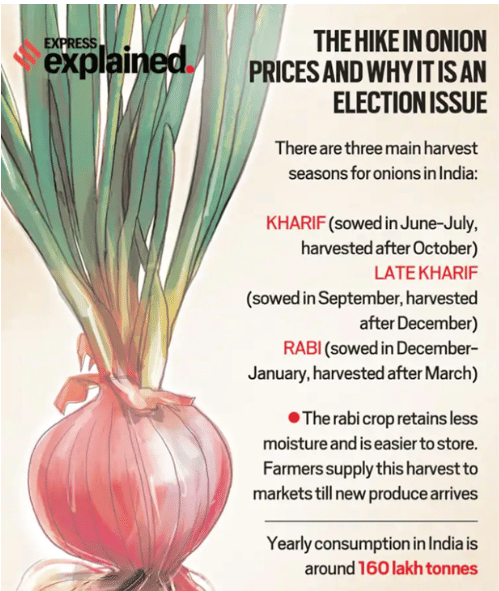
- Indian onions have three crop cycles. The choice of season depends on the region's climate and the onion variety being cultivated. Onions are more commonly associated with the Rabi season.
- Varieties: India cultivates various onion varieties, with the most common ones being red onions and white onions. There are certain varieties of yellow onion which are suitable for export in European countries.
- Cultivation Practices: Onions are primarily grown through seeds, although bulb-to-bulb planting is also practiced. The crop requires well-drained soil and is often cultivated in sandy or loamy soils. Adequate irrigation is essential, and farmers may use drip irrigation systems to conserve water.
- Onion producing states: Major onion-producing states in India include Maharashtra, which contributes 39% of the overall production, followed by Madhya Pradesh at 17%. Other significant onion-growing states include Karnataka, Gujarat, Bihar, Andhra Pradesh, Rajasthan, Haryana, and Telangana.
- Export: In 2022-23, India exported about 2.5 million tonnes of fresh onions. Major export destinations include Bangladesh, Malaysia, the UAE, Sri Lanka, Nepal, Indonesia, Qatar, Vietnam, Oman, and Kuwait.
Impact of Rising Onion Prices
- Consumer Burden: High onion prices burden consumers, especially lower-income families, impacting household budgets and prompting shifts in consumption patterns and dietary choices toward more affordable options.
- Food Inflation: Onions being a staple food item can have a cascading effect on overall inflation rates. When onion prices surge, it can trigger broader food inflation, affecting the prices of other essential food items. This, in turn, reduces the purchasing power of consumers and escalates the cost of living.
- Political Sensitivity: Historically, surges in onion prices trigger public protests and can affect a government's credibility and popularity by reflecting its competence in managing essential commodities.
- Economic Disruption: High onion prices can disrupt supply chains and impact businesses relying on onions as an ingredient, causing increased production costs, reduced profitability, and potential economic effects.
- Social Equity: Rising onion prices disproportionately impact lower-income households, worsening socioeconomic inequalities and undermining social equity due to their higher allocation of income to food expenses.
(*Click this link to read prelims specific weekly current affairs articles)
FAQs
Question: Which are the onion producing states in India?
Answer:
Major onion-producing states in India include Maharashtra, which contributes 39% of the overall production, followed by Madhya Pradesh at 17%. Other significant onion-growing states include Karnataka, Gujarat, Bihar, Andhra Pradesh, Rajasthan, Haryana, and Telangana.
Question: What are rabi crops?
Answer:
Rabi crops are also known as winter crops. These are the crops planted at the start of the winter season. Rabi crops include wheat, barley, oats, gram, mustard, and linseed.
MCQs
Question: With reference to pulse production in India, consider the following statements: (UPSC 2021)
- Black gram can be cultivated as both Kharif and rabi crops.
- Green gram alone accounts for nearly half of pulse production.
- In the last three decades, while the production of Kharif pulses has increased, the production of rabi pulses has decreased.
Which of the statements given above is/are correct?
(a) 1 only
(b) 2 and 3 only
(c) 2 only
(d) 1, 2, and 3
Answer: (a) See the Explanation
- India is the world's largest producer (25% of global production), the consumer (27% of global consumption), and importer (14%) of pulses in the world.
- Although pulses are grown in both the Kharif and Rabi seasons, Rabi pulses account for more than 60% of total production.
- Gram is the most important pulse, accounting for approximately 40% of total production.
- Black Gram is a pulse that can be grown in both the Kharif and Rabi seasons.
Therefore, option (a) is the correct answer.
Download the PREPP App and attempt FREE IAS Exam Mock Tests and get complete study material!

Full Test - 04: UPSC CSE Prelims CSAT (Paper-II)
Full Test - 03: UPSC CSE Prelims CSAT (Paper-II)
UPSC CSE Prelims 2026 GS Paper 1 Question Paper (24-May-2026)
UPSC CSE Prelims 2026 CSAT Paper 2 Question Paper (24-May-2026)

17 February 2025 | The Hindu Must Read Articles | Current Affairs

16 February 2026 | The Hindu Must Read Articles | Current Affairs

13 February 2026 | The Hindu Must Read Articles | Current Affairs









Comments