Political Declaration on Pandemics approved by UN General Assembly 2023
Relevance: GS2 - Effect of policies and politics of developed and developing countries on India’s interests, Indian diaspora.
(Source: Down To Earth, 09/22/2023)
Click here for Daily Current Affairs
Why in the News?
- On the sidelines of the 78th United Nations General Assembly at UN headquarters in New York a historical ‘The political declaration on Pandemic Prevention, Preparedness, and Response' was approved.
- Its aim is to ensure that the world is better prepared for future pandemics and to prevent catastrophic health and socio-economic impacts.
Table of Contents
Key features of the draft declaration
- Fair, equitable, and timely sharing of benefits of pathogens with pandemic potential, including genomic sequences and information, through a multilateral system.
- To improve timely and equitable access to quality, safe, effective and affordable vaccines, therapeutics, diagnostics and other health technologies, inter alia, through building capacity for local and regional production, especially in low- and middle-income countries.
- It resolved to address the global shortfall of health workers in accordance with the Global Strategy on Human Resources for Health: Workforce 2030 by investing in education and employment.
- The declaration emphasised that health workers should be protected from all forms of violence, attacks, harassment, and discriminatory practices.
- It committed to utilise innovative technologies, including remote mental health services, by promoting equitable access to telemedicine and other essential and cost-effective technologies.
- It recognised the need to support developing countries in building expertise as well as local and regional manufacturing capacities.
- It recognised the critical role of international collaboration in research and development, including in multi-country clinical and vaccine trials, as well as rapid diagnostics test and assay development.
- It also acknowledged the need for further rigorous scientific evidence, protocols and standards.
- In addition to this, the declaration also called on member nations to take measures to counter the effect of health-related misinformation, disinformation, hate speech and stigmatisation, especially on social media platforms, on people’s physical and mental health, including vaccine hesitancy.
- The declaration sought the conclusion of negotiations on a formal agreement on pandemic prevention, preparedness and response, known also as the Pandemic Accord, by May 2024.
- To achieve this, it also urged governments to continue their work on amending the International Health Regulations (2005), the only legally binding global rules in existence for health emergencies.
About Pandemic Disease
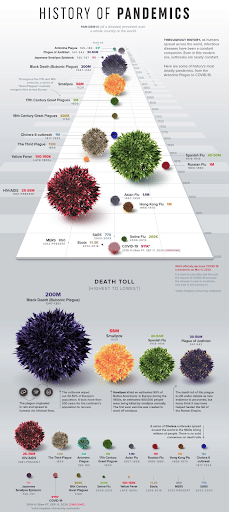
Pandemic means the outbreak of infectious disease that occurs over a wide geographical area and that is of high prevalence, generally affecting a significant proportion of the world’s population, usually over the course of several months.
Causes
- Almost all the pandemics so far have been zoonoses (diseases caused by germs that spread between animals and people).
- More than 70% of emerging diseases, such as Ebola, Zika and Nipah, are caused by microbes found in animals which spread due to contact among wildlife, livestock and people.
WHO has organised a pandemic preparedness plan that consists of six phases of pandemic alert, outlined as follows:
- Phase 1: the lowest level of pandemic alert; indicates that an influenza virus, either newly emerged or previously existing, is circulating among animals. The risk of transmission to humans is low.
- Phase 2: isolated incidences of animal-to-human transmission of the virus are observed, indicating that the virus has pandemic potential.
- Phase 3: characterised by small outbreaks of disease, generally resulting from multiple cases of animal-to-human transmission, though limited capacity for human-to-human transmission may be present.
- Phase 4: confirmed human-to-human viral transmission that causes sustained disease in human communities. At this stage, containment of the virus is deemed impossible but a pandemic is not necessarily inevitable. The implementation of control methods to prevent further viral spread is emphasised in affected parts of the world.
- Phase 5: marked by human-to-human disease transmission in two countries, indicating that a pandemic is imminent and that distribution of stockpiled drugs and execution of strategies to control the disease must be carried out with a sense of urgency.
- Phase 6: Characterised by widespread and sustained disease transmission among humans.
| Endemic A disease outbreak is endemic when it is consistently present but limited to a particular region. This makes the disease spread and rates predictable. The outbreak of such disease is limited to particular geographical areas only. | Epidemic Epidemic is an unexpected increase in the number of disease cases in a specific geographical area and doesn't necessarily have to be contagious.. Eg. Yellow fever, smallpox, measles, and polio. | Pandemic The World Health Organization (WHO) declares a pandemic when a disease’s growth is exponential. This means the growth rate skyrockets, and each day cases grow more than the day prior. It means a virus covers a wide area, affecting several countries and populations. |
(*Click this link to read prelims specific weekly current affairs articles)
FAQ
Question: Recently during which summit The political declaration on Pandemic has been launched?
Answer:
At UN General Assembly Summit 2023 at Headquarter, New York and Its aim is to ensure that the world is better prepared for future pandemics and to prevent catastrophic health and socio-economic impacts.
MCQ
Question: Consider the following statements:
- The endemicity is a stage where disease is always present in a certain population or a given geographical region.
- The epidemic refers to an outbreak of a disease and its spread through one or more populations.
- Chicken pox and malaria are examples of epidemics.
Which of the statements given above is/are correct?
(a) 1 and 2 only
(b) 2 only
(c) 3 only
(d) 1, 2 and 3
Answer: (a) See the Explanation
- According to the World Health Organization (WHO) India seems to be entering some stage of Covid-19 endemicity where there is low- to moderate-level transmission.
- An endemic disease is a disease that is always present in a certain population or a given geographical region.
- Hence, statement 1 is correct.
- Some examples of endemics include chicken pox and malaria, where there are a predictable number of cases every year in certain parts of the world.
- Hence, statement 3 is not correct
- Epidemic refers to an outbreak of a disease. An epidemic occurs when a disease is spreading through one or more populations. In contrast, the endemic disease is one that is constantly present in a group or geographic area.
- Hence, statement 2 is correct
- Pandemics are worldwide epidemics. A pandemic affects more people and takes more lives than an epidemic. Under certain circumstances, an epidemic can lead to a disease becoming endemic.
So the correct answer is option (a).
Download the PREPP App and attempt FREE IAS Exam Mock Tests and get complete study material!

Full Test - 04: UPSC CSE Prelims CSAT (Paper-II)
Full Test - 03: UPSC CSE Prelims CSAT (Paper-II)
UPSC CSE Prelims 2026 GS Paper 1 Question Paper (24-May-2026)
UPSC CSE Prelims 2026 CSAT Paper 2 Question Paper (24-May-2026)

17 February 2025 | The Hindu Must Read Articles | Current Affairs

16 February 2026 | The Hindu Must Read Articles | Current Affairs

13 February 2026 | The Hindu Must Read Articles | Current Affairs









Comments