Tracking India’s Growth Trajectory
Relevance: GS3 - Indian Economy; Growth and Development
(Source: The Hindu, 09/22/2023)
Click here for Daily Current Affairs
Why in the news?
- Recently, the National Statistical Office (NSO) under the Ministry of Statistics and Programme Implementation (MoSPI) released the economic growth data for the first quarter (April, May, June) of the current financial year. It showed that India’s economy grew by 7.8% in Q1.
- The figures 7.8% growth rate is a notable number but with underlying complexities and concerns.
Table of Contents
India’s Q1 GDP Growth
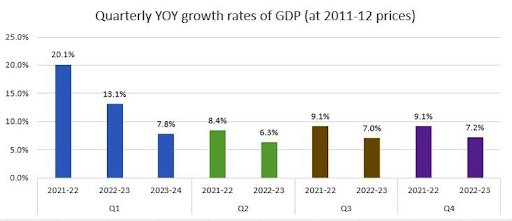
- Since Covid-19 recovery, starting 2021-22, the Q1 GDP growth rate has always been high because of the low base effect.
- This year's Q1 GDP growth rate is the lowest in the past three years.
- In the first quarter of FY24, the GDP exhibited robust performance with a nominal growth rate of 8% and a real growth rate of 7.8%.
- This impressive growth is attributed to two main factors:
- First, a significant expansion in the agriculture sector, which saw a remarkable growth rate of 3.5%; however, concerns arise regarding its sustainability due to potential disruptions caused by the El Niño phenomenon.
- Second, the services industry, particularly the financial, real estate, and professional services segment, contributed significantly with an impressive growth rate of 12.2%.
What is GDP and how is it calculated?
- Gross Domestic Product is simply the sum of the final prices of goods and services produced in an economy over a specific time period, which is a measure of the worth of a country's economic activities.
- It is calculated on a regular basis to account for changes in the production structure, relative pricing, and better documentation of economic activity.
- GDP can be calculated by adding up all of the money spent by consumers, businesses, and the government in a given period.
- It may also be calculated by adding up all of the money received by all the participants in the economy.
Method used by NSO for GDP Growth Rate
- The National Statistical Office (NSO) chose the income approach over the expenditure approach to calculate GDP. The assumption is that both methods should yield similar results.
- Income Approach: This method involves summing up all national incomes from the factors of production, such as wages, profits, rents, and interest. It also accounts for other elements like taxes, depreciation, and net foreign factor income.
- Expenditure Approach: In contrast, the expenditure approach calculates GDP by summing up all the expenditures within the economy, including consumption, investment, government spending, and net exports.
Factors Affecting India’s Growth Figures
- Discrepancy in Growth Figures: The choice of calculation method has resulted in a significant discrepancy in GDP growth figures. According to the income approach, GDP growth is reported at 7.8%, while the expenditure approach suggests a growth rate of 4.5%. This discrepancy raises questions about the accuracy and consistency of the methods used.
- Inflation Adjustment Using Price Deflator: The NSO, like many statistical agencies, adjusts GDP figures for inflation using a price deflator. This adjustment is essential to account for changes in the general price level within the economy.The price deflator is used to adjust growth figures when they are either overstated or understated by inflation.
- Base Effect resulting from the COVID-19 degrowth period: In FY20-21, India experienced a significant economic contraction due to the pandemic. The base effect occurs because growth calculations are compared to the previous year's figures.
- Exchange Rate Impact: India faces challenges related to the exchange rate, as the Indian rupee is depreciating against the US dollar. Capital outflow pressures due to the Reserve Bank of India's reluctance to raise interest rates contribute to this depreciation. A weaker rupee can lead to higher import costs, particularly for items like crude petroleum.
- Crude Oil Prices: India is a net importer of crude petroleum, and the recent rise in crude oil prices (e.g., Saudi Arabia's $100 per barrel push) can have a significant impact on India's economy. Rising oil prices can increase India's import bill, contributing to inflationary pressures.
- Diesel Consumption: Moreover, the domestic consumption of diesel, often considered a proxy for economic activity in India, fell by 3% in August. If this decline persists, it may indicate subdued economic growth in the coming quarters.
Financial trends to Revenue from Taxes
- Weakening of Direct Tax Revenue vs. Strong Indirect Tax Revenue: The government's income from direct taxes, which are typically levied on individuals and corporations based on their income or profits, has been declining. In contrast, revenue from indirect taxes, which are typically collected on goods and services, has been strong. This divergence in tax revenue patterns is indicative of a "K-shaped" pattern.
- Progressive vs. Regressive Taxation: The progressive taxation (where those with higher incomes pay a larger share of their income in taxes) is performing poorly compared to regressive taxation (where the tax burden falls more heavily on lower-income individuals). This suggests that the tax system may not be effectively redistributing wealth.
- Muted Growth of Direct Tax in a Services-Driven Economy: Despite economic growth driven by the services industry, direct tax collection has not kept pace. This is seen as a statistical discrepancy because, in a growing economy, tax revenue should ideally grow in tandem with the nominal growth rate.
Conclusion
- India's economic growth in the first quarter of the financial year shows promise but is clouded by methodological discrepancies and potential challenges such as exchange rate fluctuations, rising oil prices, and tax revenue imbalances.
- Monitoring these factors and addressing them appropriately will be crucial for sustaining and furthering India's economic recovery in the post-pandemic era.
- Additionally, policymakers may need to consider structural reforms to enhance the resilience and inclusivity of the economy.
(*Click this link to read prelims specific weekly current affairs articles)
FAQs
Question: What is Gross Domestic Product (GDP)?
Answer:
Gross Domestic Product is simply the sum of the final prices of goods and services produced in an economy over a specific time period, which is a measure of the worth of a country's economic activities.
Question: What is the National Statistical Office (NSO)?
Answer:
The National Statistical Office (NSO) is the nodal agency under the Ministry of Statistics and Programme Implementation in India. It oversees the planned development of the statistical system, sets norms and standards, and manages various departments including the Central Statistical Office (CSO), the Computer center, and the National Sample Survey Office (NSSO).
Question: What is the difference between Nominal GDP and Real GDP?
Answer:
Nominal GDP measures a nation's annual production of goods and services using actual market prices or values. Real GDP measures goods and services by adjusting for inflation.
MCQ
Question: With reference to the Indian economy, consider the following statements: (UPSC 2015)
- The rate of growth of Real Gross Domestic Product has steadily increased in the last decade.
- The Gross Domestic Product at market prices (in rupees) has steadily increased in the last decade.
Which of the statements given above is/are correct?
(a) 1 only
(b) 2 only
(d) Both 1 and 2
(d) Neither 1 nor 2
Answer: (b) See the Explanation
The Indian economy's growth rate fell from 8-9 percent to 5-6 percent during the next few years as a result of the recession in 2008. Despite the fact that the growth rate had slowed, it had never fallen below zero. So, throughout the last decade, the GDP at market prices has constantly climbed year on year.
Therefore, option (b) is the correct answer.
Download the PREPP App and attempt FREE IAS Exam Mock Tests and get complete study material!

Full Test - 04: UPSC CSE Prelims CSAT (Paper-II)
Full Test - 03: UPSC CSE Prelims CSAT (Paper-II)
UPSC CSE Prelims 2026 GS Paper 1 Question Paper (24-May-2026)
UPSC CSE Prelims 2026 CSAT Paper 2 Question Paper (24-May-2026)

17 February 2025 | The Hindu Must Read Articles | Current Affairs

16 February 2026 | The Hindu Must Read Articles | Current Affairs

13 February 2026 | The Hindu Must Read Articles | Current Affairs









Comments