Digital India – Science & Technology Notes
Digital India is the Government of India's flagship programme, with the goal of transforming India into a digitally empowered society and knowledge economy. The Indian government launched the 'Digital India' initiative in July 2015 to improve online infrastructure and increase internet access among citizens. In this article, we will discuss in detail regarding Digital India Programme which will be helpful for UPSC exam preparation.
Table of Contents
What is Digital India?
- The government launched the Digital India programme with the goal of transforming India into a digitally empowered society and knowledge-based economy by ensuring digital access, inclusion, empowerment, and bridging the digital divide.
- Digital India is a programme that encompasses several Government Ministries and Departments.
- It weaves a large number of ideas and thoughts into a single, comprehensive vision, from which each can be implemented as part of a larger goal.
- The overall goal is to ensure that digital technologies improve the lives of all citizens, that India's digital economy expands, that investment and employment opportunities are created, and that India develops digital technological capabilities.
- The Digital India Corporation (DIC) leads and guides the realisation of the Digital India program's vision, objectives, and goals.
- It provides strategic support to Centre/State Ministries/Departments in carrying out the Digital India mission through Capacity Building for e-Governance projects, promoting best practises, encouraging Public-Private Partnerships (PPP), and nurturing innovation and technology in various domains.
- The programme is focused on three key vision areas:
- Digital Infrastructure as a Utility to Every Citizen
- Governance & Services on Demand
- Digital Empowerment of Citizens
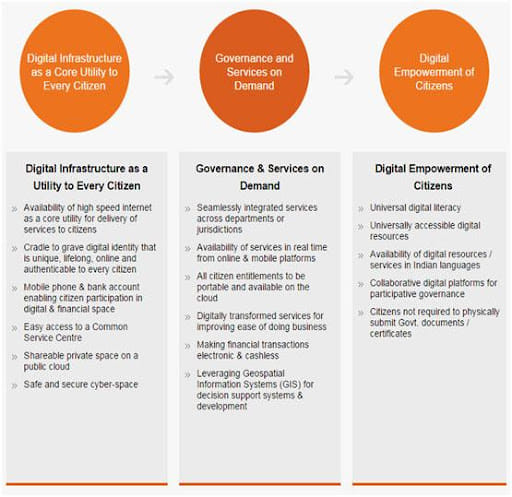
Key Vision Areas of Digital India
| Other Relevant Links | |
|---|---|
| Quantum computing | Project brainwave |
| Sagar Vani System | Locky Ransomware, Petya, WannaCry |
| Hindi word for computer i.e., “SANGANAK” | India’s first technology and innovation support centre (TISC) |
| Net neutrality | National cyber coordination centre |
| Hortnet | Digital Transaction Methodologies |
| Bitcoins | Cyber Swachhta Kendra |
| Bharat Net Project | Wi-Fi Technology |
| Digital Terrestrial Television Transmission System | Internet of Things |
Pillars of Digital India
- The nine growth pillars targeted by Digital India are:
- Broadband Highways
- Universal Mobile Access
- Public Internet Access Programme
- e-Governance: Reforming Government through Technology
- e-Kranti - Electronic Delivery of Services
- Information for All
- Electronics Manufacturing
- IT for Jobs
- Early Harvest Programmes
- Each of these areas is a complex programme in and of itself, involving multiple Ministries and Departments.
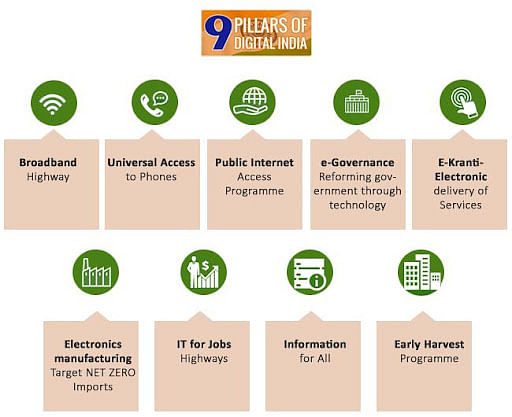
Nine Pillars of Digital India
Need for Digital India
- Despite rising adoption of digital technologies and the IT industry, India's digital divide is widening and creating economic disparities between those who can and cannot afford technology, affecting the country's overall digital growth.
- To bridge this gap, the government launched the 'Digital India' initiative, which includes e-governance, mobile e-health services, and digital finance for digital inclusion.
- The 'Digital India' initiative is enabling the country (including small towns and rural areas) to develop its internet infrastructure through schemes such as Aadhaar (a digital ID programme), BharatNet, and public Wi-Fi hotspots.
- According to a McKinsey report, Uttar Pradesh (with over 36 million internet subscribers), Madhya Pradesh, and Jharkhand were among the five fastest-growing states in terms of internet penetration between 2014 and 2018.
- Furthermore, the country's low mobile data rates have enabled a large portion of the population to access the Internet.
- The government collaborated with the following leading technology firms to implement the 'Digital India Platform':
- In 2019, the Ministry of Electronics and Information Technology (MeitY) partnered with Google to launch the 'Build for Digital India' programme, which allows engineering students to create market-ready, technology-based solutions.
- MeitY and Amazon Web Services (AWS) collaborated in January 2021 to establish a quantum computing applications lab in India to accelerate quantum computing-driven research and development and enable new scientific discoveries.
- The government collaborated with private sector companies (including Amdocs, Cognizant, Cyient, Google, Intel, Microsoft, and Zensar Technologies) to establish NDLM (National Digital Literacy Mission) centres and provide digital literacy training in India.
Significance of Digital India
- Digital India has significantly reduced the gap between the government and the citizens.
- It has also aided in the delivery of significant services directly to beneficiaries in a transparent and corruption-free manner.
- In the process, India has emerged as one of the world's preeminent nations in terms of using technology to improve the lives of its citizens.
- The Digital India initiative could boost GDP to $1 trillion by 2025.
- The education and healthcare sectors have grown, with initiatives such as the National Digital Health Mission and digital education in India.
- Advances in online infrastructure would benefit the country's economy as a whole.
- The Make in India initiative has boosted India's electronic manufacturing sector.
- Through the Digital India project, approximately 12000 rural post office branches have been electronically connected.
Benefits of Digital India
- Electronic transactions related to e-governance are increasing.
- Internet data is used as an effective tool for service delivery, and Internet penetration in urban areas has reached 64%.
- Creating digital villages through the establishment of well-equipped amenities such as LED assembly units, Wi-Fi Choupal, solar lighting, and sanitary napkin manufacturing units.
- The Bharat Net programme has connected approximately 1.15 lakh Gram Panchayats via an optical fibre network spanning 2,74,246 kilometres.
- Electronic transactions have increased, which is associated with E-Governance and the Digital India project.
- The Indian Government's National e-Governance Project has established a Common Service Centre (CSC) that provides access to ICT, or information and communication technology.
- CSCs use computers and the Internet to provide multimedia services related to digital education, entertainment, health, e-governance, and private and government services.
Challenges of Digital India
- The limited capability of entry-level smartphones for easy internet access.
- Users need to learn more about digitalization.
- A significant challenge in Digital India is a lack of trained workforce in the digital technology domain.
- In comparison to other developed countries, the internet speed per day, including Wi-Fi hotspots, is slow.
- MSME continue to struggle to adapt to modern digital technology.
- This group of people, many of whom have never used a computer, would be difficult to introduce to Digital India programmes.
- The preceding problem is exacerbated by the fact that nearly all online content, apps, and software are written in English.
- In a country as diverse as India, it would be difficult to provide all e-facilities in the 22 major Indian languages spoken. To accomplish this, the English content is typically translated. However, this translation is frequently done in a very shoddy mechanical manner, making it dull and difficult to understand for the general public.
- There is very little digital literacy, particularly in rural areas. Even if the government has declared a "Digital Literacy Mission" to address this issue, it will still be difficult.
- With increased digitalization and e-services, the threat of fraud and cybercrime will grow. Cyber risks must be made public, as well as the precautions that can be taken.
- Despite all of the attention paid to digital processes and e-services, India still lacks a binding legal framework for e-governance.
- The government cannot implement Digital India successfully on its own. The private sector's assistance and cooperation will be required at every stage. As a result, clear concepts and norms are required for public-private partnerships in this sector.
- The IT sector, states, union territories, and the Union Government are all working together to make Digital India a reality. The coordination of so many different government agencies and corporate players would be crucial to the success of this project.
Key Initiatives under Digital India
| Key Initiative | Description |
|---|---|
| Aadhaar |
|
| Common Services Centres |
|
| DigiLocker |
|
| Unified Mobile Application for New-age Governance (UMANG) |
|
| e-Sign |
|
| MyGov |
|
| MeriPehchaan |
|
| Digital Village |
|
| National Rollout of eDistrict MMP |
|
| Open Government Data Platform |
|
| eHospital/ Online Registration System (ORS) |
|
| CO-WIN |
|
| Jeevan Pramaan |
|
| NCOG-GIS Applications |
|
| National Knowledge Network |
|
| Pradhan Mantri Gramin Digital Saksharta Abhiyan (PMGDISHA) |
|
| Unified Payment Interface (UPI) |
|
| FutureSkills PRIME |
|
| Cyber Security |
|
Future of Digital India
- The increasing use of unified payment interfaces (UPIs) indicates that an increasing number of people in India are adopting a digital lifestyle.
- With the emergence of technologies such as artificial intelligence, the Internet of things (IoT), cloud computing, blockchains, and robotics, the government can take advantage of these new opportunities to accelerate India's digital and technological growth.
- According to a McKinsey report, a digital economy will create 60-65 million jobs by 2025.
- With the 'Digital India' mission, the government is well-positioned to capitalise on this opportunity and generate an economic value of US$ 1 trillion from the digital economy by 2025.
Conclusion
The digital India initiative has had a significant impact on the development of our country. India's goal of achieving the digital revolution will benefit all sectors and jurisdictions of the economy. The country will become the fastest growing digital economy due to advancements in governance, reforms, start-ups, and demographic advantage.
| Other Relevant Links | |
|---|---|
| Science & Technology Policy in India | Scientific Policy Resolution 1958 |
| Science & Technology Policy of 1983 | Science & Technology Policy of 2003 |
| Science, Technology and Innovation Policy 2013 | New Initiatives Aligned with the National Agenda |
| India and World collaboration in science projects | Technology Vision Document 2035 |
FAQs
Question: What is the Digital India initiative?
Answer: Digital India is a flagship program launched by the Government of India in 2015 with the aim of transforming India into a digitally empowered society and knowledge economy. It focuses on enhancing online infrastructure, increasing internet connectivity, and improving digital literacy among citizens to ensure inclusive growth and access to various services.
Question: When was the Digital India program launched?
Answer: The Digital India program was launched by Prime Minister Narendra Modi on 1st July 2015. The initiative aims to provide government services electronically, create digital infrastructure, and empower citizens to access information and services digitally.
Question: What are the key objectives of the Digital India program?
Answer: The key objectives of Digital India include improving digital literacy, providing high-speed internet in rural areas, enhancing online government services, creating digital infrastructure, and making India a digitally inclusive society by enabling citizens to access information and services remotely.
Question: What are the main pillars of the Digital India program?
Answer: The Digital India program is built on three main pillars: (1) Digital Infrastructure as a Utility to Every Citizen, (2) Governance & Services on Demand, and (3) Digital Empowerment of Citizens. These pillars focus on creating a robust digital ecosystem, providing accessible online services, and ensuring the inclusion of all citizens in the digital transformation.
Question: How does Digital India contribute to financial inclusion?
Answer: Digital India promotes financial inclusion by providing access to digital banking services, mobile wallets, and UPI. It enables individuals, especially in rural areas, to avail of government services, make payments, and perform financial transactions online, thereby integrating them into the formal economy.
MCQs
1. What is the primary goal of the Digital India initiative?
A) To create digital literacy among youth
B) To make India a digitally empowered society
C) To improve physical infrastructure
D) To promote foreign investment in the technology sector
Answer: (B) See the Explanation
The primary goal of the Digital India initiative is to transform India into a digitally empowered society, enhancing digital infrastructure, connectivity, and services to benefit all citizens and promote inclusive growth across the country.
2. Which of the following is not a component of the Digital India program?
A) Digital Infrastructure
B) Governance & Services on Demand
C) Digital Education
D) Digital Empowerment of Citizens
Answer: (C) See the Explanation
While Digital Education is important, it is not a formal component of the Digital India program. The main pillars of Digital India are Digital Infrastructure, Governance & Services on Demand, and Digital Empowerment of Citizens.
3. Who launched the Digital India initiative?
A) President of India
B) Prime Minister of India
C) Minister of Electronics and Information Technology
D) Minister of Finance
Answer: (B) See the Explanation
The Digital India initiative was launched by the Prime Minister of India, Narendra Modi, on 1st July 2015, with the objective of transforming India into a digitally empowered society and knowledge economy.
4. Which of the following is a major pillar of the Digital India program?
A) Digital Access to All
B) Universal Health Coverage
C) Digital Infrastructure as a Utility to Every Citizen
D) Financial Assistance to Small Businesses
Answer: (C) See the Explanation
One of the key pillars of the Digital India program is "Digital Infrastructure as a Utility to Every Citizen," which focuses on creating a robust digital infrastructure to provide universal access to digital services.
5. How does the Digital India program promote digital empowerment?
A) By providing subsidies for smartphones
B) By ensuring access to online government services
C) By providing free internet services
D) By mandating digital literacy tests
Answer: (B) See the Explanation
The Digital India program promotes digital empowerment by ensuring that all citizens have access to online government services. This enables individuals to access information, make payments, and perform transactions digitally, thus empowering them to participate in the digital economy.
GS Mains Questions and Model Answers
Q1: Analyze the impact of the Digital India program on rural areas in India.
Answer: The Digital India program has had a significant impact on rural areas by providing better access to digital infrastructure, government services, and financial inclusion. Initiatives such as Pradhan Mantri Gramin Digital Saksharta Abhiyan (PMGDISHA) and mobile banking have empowered rural citizens, particularly women and marginalized groups, to access banking services, health care, education, and government subsidies online. The program has also helped bridge the digital divide by enhancing internet connectivity in remote regions, which has boosted local economies through digital entrepreneurship and e-commerce.
Q2: Discuss the challenges in the implementation of Digital India and suggest measures to overcome them.
Answer: The Digital India program faces several challenges, including inadequate digital infrastructure in rural areas, low internet penetration, and limited digital literacy. To overcome these challenges, the government must invest in strengthening the internet backbone, particularly in remote areas, and increase awareness campaigns to promote digital literacy. Furthermore, providing affordable devices and ensuring cyber security measures can help in building trust in digital platforms. Public-private partnerships can play a pivotal role in enhancing digital infrastructure and reducing the cost of access.
Q3: How does the Digital India initiative contribute to the economic growth of the country?
Answer: The Digital India initiative contributes to the country's economic growth by fostering a digital ecosystem that drives innovation, entrepreneurship, and efficiency. It has enabled the growth of the digital economy, providing opportunities for new startups, e-commerce, and fintech companies. The widespread adoption of digital platforms has reduced transaction costs, enhanced transparency in government schemes, and increased the efficiency of public service delivery. Additionally, it has empowered people with the skills to participate in the global digital economy, contributing to overall economic development.
Previous Year Questions on Digital India
1. UPSC CSE Prelims 2021 (Date: 10th October 2021):
Question: Which of the following is the primary objective of the Digital India program?
A) To reduce physical infrastructure in urban areas
B) To enhance digital literacy and improve online governance
C) To develop digital education centers
D) To encourage the use of cryptocurrencies
Answer: B) To enhance digital literacy and improve online governance
Explanation: The primary objective of the Digital India program is to enhance digital literacy across India and improve the delivery of government services online, thereby fostering a digitally inclusive society.
2. UPSC CSE Mains 2020 (Date: 9th October 2020):
Question: Discuss the role of Digital India in fostering financial inclusion in India.
Answer: Digital India has played a pivotal role in fostering financial inclusion by facilitating access to digital banking, mobile wallets, and online payment systems. Initiatives such as Jan Dhan Yojana and UPI have made financial services more accessible to rural and unbanked populations. Through digital platforms, people in remote areas can now avail banking services, receive government benefits, and make financial transactions without the need for physical infrastructure. This has reduced financial exclusion, promoted cashless transactions, and ensured equitable access to economic opportunities.
Download the PREPP App and attempt FREE IAS Exam Mock Tests and get complete study material!

Full Test - 04: UPSC CSE Prelims CSAT (Paper-II)
Full Test - 03: UPSC CSE Prelims CSAT (Paper-II)
UPSC CSE Prelims 2026 GS Paper 1 Question Paper (24-May-2026)
UPSC CSE Prelims 2026 CSAT Paper 2 Question Paper (24-May-2026)

17 February 2025 | The Hindu Must Read Articles | Current Affairs

16 February 2026 | The Hindu Must Read Articles | Current Affairs

13 February 2026 | The Hindu Must Read Articles | Current Affairs









Comments