39 MNCs Come Together For Circular Economy Coalition
Relevance: GS2 - Bilateral, regional and global groupings and agreements involving India and/or affecting India’s interests GS3 - Environmental pollution and degradation, environmental impact assessment.
(Source: The Hindu, 07/28/2023)
Click here for Daily Current Affairs
Why in the news?
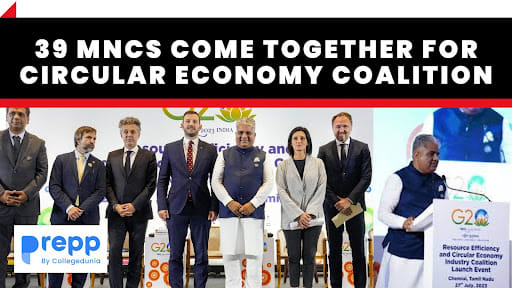
- Recently the Resource Efficiency Circular Economy Industry Coalition was launched at the 4th G-20 Environment and Climate Sustainability Working Group (ECSWG) and Environment and Climate Ministers’ meeting in Chennai.
- The Coalition is a reflection of India’s message to adopt a circular economy that will help address environmental challenges through sustainability and regeneration.
Table of Contents
What is the Resource Efficiency Circular Economy Industry Coalition?
- The Resource Efficiency Circular Economy Industry Coalition is a grouping of 39 MNCs from sectors such as steel, electronics, and FMCG including Maruti Suzuki, Coca-Cola, Unilever, Nestle, Aditya Birla Group, Tata Power, and Mahindra & Mahindra.
- They pledged to adopt the principles of resource efficiency and circular economy to address environmental challenges related to waste from plastics, microplastics, e-waste, chemical waste, etc.
- The RECEIC was conceptualized by India’s G20 Presidency and is industry-driven and self-sustaining with the government only playing a supporting role.
- Businesses are ideal for the on-ground implementation of resource efficiency and circular economy principles.
- The three pillars of the Coalition are
- Partnerships for impact
- Cooperation in technology
- Finance for scale
- The RECEIC will work towards achieving global commitments such as the Sustainable Development Goals, and Paris Climate Targets and other goals established by global organizations such as the G-20.
- Objective:
- Facilitate and encourage company-company interactions
- Develop advanced capabilities across sectors and value chains
- Learn from the practices and diverse experiences of coalition members
- Enable private sector initiatives to enhance resource efficiency and quicken the transition to circular economies.
- Impact of the RECEIC
- Promote alliances among members
- Encourage technological cooperation and knowledge sharing
- Foster innovation
- Enhance access to finance for environmental initiatives through the sharing of insights.
Circular Economy
|
EPR
|
Conclusion
- These are important steps for reducing pollution caused due to littered plastic waste in the country.
- Accumulation of plastic waste is detrimental to the environment and when this waste finds its way into the sea, there can be major harm to aquatic ecosystems, too.
(*Click this link to read prelims specific weekly current affairs articles)
FAQs
Question: What are the focus areas of the ECSWG?
Answer:
The focus areas of the 4th G-20 Environment and Climate Sustainability Working Group (ECSWG) and Environment and Climate Ministers’ meeting are Arresting land degradation, Accelerating ecosystem restoration and biodiversity enrichment, Promoting a sustainable and climate-resilient blue economy, and Ensuring resource efficiency and circular economy.
Question: What is the Polluter pays principle?
Answer:
The Polluter Pays Principle aims to penalize those who pollute the environment in order to compensate for the damage caused and return the environment to its original state regardless of the intent behind the actions.
MCQs
Question: Consider the following statements:
- The Extended producer responsibility was introduced in India for the first time under the Plastic Waste Management (Amendment) Rules, 2022.
- It establishes a centralized online portal under the Ministry of Forests, Environment, and Climate Change.
Which of the above statements is/are correct?
(a) Only 1
(b) Only 2
(c) 1 and 2
(d) None
Answer: (d) See the Explanation
- The Extended producer responsibility was introduced in India for the first time under the e-Waste(Management and Handling) Rules, 2016. Hence statement 1 is correct.
- Under the Plastic Waste (Management) Rules, 2022, a centralized portal under the CPCB has been established for the registration and filing of annual returns by producers, importers, brand owners, and plastic waste processors of plastic packaging. Hence statement 2 is incorrect.
Therefore, option (d) is the correct answer.
Download the PREPP App and attempt FREE IAS Exam Mock Tests and get complete study material!

Full Test - 04: UPSC CSE Prelims CSAT (Paper-II)
Full Test - 03: UPSC CSE Prelims CSAT (Paper-II)
UPSC CSE Prelims 2026 GS Paper 1 Question Paper (24-May-2026)
UPSC CSE Prelims 2026 CSAT Paper 2 Question Paper (24-May-2026)

17 February 2025 | The Hindu Must Read Articles | Current Affairs

16 February 2026 | The Hindu Must Read Articles | Current Affairs

13 February 2026 | The Hindu Must Read Articles | Current Affairs









Comments