Rajya Sabha Passes Cinematograph Amendment Bill, 2023 Aimed At Curbing Film Piracy
Relevance: GS 2 - Government policies and interventions for development in various sectors and issues arising out of their design and implementation; GS3 - Issues relating to intellectual property rights.
(Source: The Hindu, 07/28/23)
Click here for Daily Current Affairs
Why in the news?
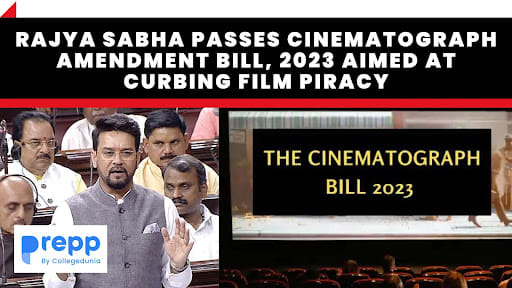
- Recently, the Rajya Sabha passed the Cinematograph (Amendment) Bill, 2023, which aims to tackle film piracy, overhaul age-based certification provided by the Central Board of Film Certification (CBFC), and provide consistency in categorizing films and material across platforms.
- The Bill seeks to amend the Cinematography Act 1952.
Table of Contents
Need for the amendment of the Cinematography Amendment Bill
- The Cinematograph Act, of 1952 needed to be amended due to several reasons:
- to harmonize the law with various executive orders,
- Supreme Court judgments, and other legislations;
- to improve the procedure for licensing films for public exhibition by the CBFC;
- and to expand the scope of categorizations for certification.
- to address the issue of unauthorized recording and exhibition of films and curb the menace of piracy, which is causing them huge losses.
What are the provisions of the bill?
- Tackling Piracy: The Bill prohibits carrying out or abetting the unauthorised recording and unauthorized exhibition of films. Attempting an unauthorised recording will also be an offence.
- Unauthorised recording: It means making or transmitting an infringing copy of a film at a licensed place for a film exhibition without the owner’s authorization.
- Unauthorised exhibition: It means the public exhibition of an infringing copy of the film for profit at a location not licensed to exhibit films or in a manner that infringes upon the copyright law.
- Certifications: It introduces three certifications under the ‘UA’ category, UA 7+, UA 13+ and UA 16+, which means that children younger than the given age limits can access such movies with parental guidance.
- Board of Film Certification: The Act constitutes the Board of Film Certification for certifying films for exhibition. Such certifications may be subject to modifications/deletions. The Board may also refuse the exhibition of films.
- Separate certificate for television/other media: Films with an ‘A’ or ‘S’ certificate will require a separate certificate for exhibition on television, or any other media prescribed by the central government. The Board may direct the applicant to carry appropriate deletions or modifications for the separate certificate.
- Validity of certification: Under the Act, the certificate issued by the Board is valid for 10 years. The Bill provides that the certificates will be perpetually valid.
- Revisional powers of the central government: The Act empowers the central government to examine and make orders in relation to films that have been certified or are pending certification. The Board is required to dispose of matters in conformance with the order. The Bill removes this power of the central government.
(*Click this link to read prelims specific weekly current affairs articles)
FAQs
Question: What is Central Board of Film Certification (CBFC)?
Answer:
The Central Board of Film Certification (CBFC) is a statutory film-certification organisation under India's Ministry of Information and Broadcasting. Its mission is to "regulate the public showing of films in accordance with the Cinematograph Act 1952." Films that have been aired in theatres and on television may only be publicly presented in India after being certified and edited by the board.
Question: What is Freedom of Speech and Expression?
Answer:
Freedom of speech and expression means the right to freely express one's views and opinions. Article 19(1)(a) of the Indian constitution deals with the . freedom of speech and expression. All Citizens in India have the right to freedom of speech and expression with some reasonable restrictions.
Question: What is Copyright?
Answer:
Copyright is a type of intellectual property that protects original works of authorship as soon as an author fixes the work in a tangible form of expression. In copyright law, there are a lot of different types of works, including paintings, photographs, illustrations, musical compositions, sound recordings, computer programs, books, poems, blog posts, movies, architectural works, plays, and so on.
Download the PREPP App and attempt FREE IAS Exam Mock Tests and get complete study material!

Full Test - 04: UPSC CSE Prelims CSAT (Paper-II)
Full Test - 03: UPSC CSE Prelims CSAT (Paper-II)
UPSC CSE Prelims 2026 GS Paper 1 Question Paper (24-May-2026)
UPSC CSE Prelims 2026 CSAT Paper 2 Question Paper (24-May-2026)

17 February 2025 | The Hindu Must Read Articles | Current Affairs

16 February 2026 | The Hindu Must Read Articles | Current Affairs

13 February 2026 | The Hindu Must Read Articles | Current Affairs









Comments