Our Semicon Report Card
Relevance: GS2 - Government policies and interventions for development in various sectors and issues arising out of their design and implementation.
(Source: Indian Express, 07/28/2023)
Click here for Daily Current Affairs
Why in the news?
- The author, Rajeev Chandrasekhar, the Minister of State for Electronics and Information Technology, has discussed India’s performance in the semiconductor industry over the years.
- India’s tech capabilities have grown significantly in recent years with India now partnering with the U.S.A. in critical technologies such as semiconductors, 5G, 6G, and quantum computing.
Table of Contents
India’s semiconductor journey
Missed Opportunities and Lack of Vision
- In its early stages, the Indian semiconductor industry faced challenges due to missed opportunities and a lack of political and strategic vision.
Rejected Proposal from Fairchild Semiconductors
- In the 1960s, India declined a proposal from Fairchild Semiconductors (now Intel) to establish a semiconductor fabrication unit in the country.
Inadequate Technology Competitiveness
- Bharat Electronics Ltd (BEL) and other institutions lacked state-of-the-art technology, hindering their ability to compete with international players.
India's Booming Electronic Ecosystem
- Presently, India's electronic ecosystem is among the world's fastest-growing, with aspirations of achieving a $1 trillion digital economy, contributing 20% of the nation's GDP.
Focus on Startup Support and Talent Development
- India aims to increase the number of supported startups to 200 and position itself as a hub for upskilling and talent development.
Emerging as a Trusted Global Partner
- India has gained trust as a partner in addressing various global challenges, including sustainability, security, vaccines, electronics, and semiconductors.
Indian initiatives in the semiconductor sector
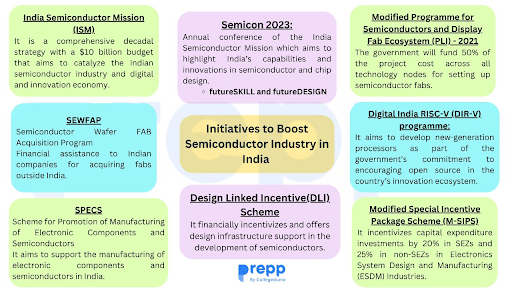
- India Semiconductor Mission (ISM): It is a comprehensive decadal strategy with a $10 billion budget that aims to energize the growth of the Indian semiconductor industry.
- It has helped expand India’s digital and innovation economy, supported the growth of Indian startups, and encouraged partnerships with global partners.
- Semicon 2023: It is the annual conference of the India Semiconductor Mission which is scheduled to be held at Gandhinagar.
- It aims to highlight India’s capabilities and innovations in the semiconductor and chip design industries.
- futureSKILL: A comprehensive VLSI curriculum for engineers has been developed for implementation across 300 institutes.
- futureDESIGN: Over 30 startups have been established, of which 5 have been granted financial support while the remaining are being assessed.
- Scheme for Promotion of Manufacturing of Electronic Components and Semiconductors (SPECS): It aims to support the manufacturing of electronic components and semiconductors in India.
- Digital India RISC-V (DIR-V) programme: It aims to develop new-generation processors as part of the government’s commitment to encouraging open source in the country’s innovation ecosystem.
- This will allow Indian enterprises to become talent hubs for RISC-V technology, and supply RISC-V SoCs globally.
- Design Linked Incentive(DLI) Scheme: It financially incentivizes and offers design infrastructure support in the development of semiconductors.
- Partnership with Micron: Global semiconductor major, Micron, has announced investment worth $2.75 billion in Gujarat to develop supply chains and fabrication units.
- Modernization of facilities: The government has set up a budget of ₹10,000 crores to upgrade the existing fab at the SCL Mohali and develop a new global India Semiconductor Research Center.
Significance of India’s domestic semiconductor industry
- A robust domestic semiconductor ecosystem is vital to bolster economic growth and safeguard the domestic industry from global disruptions, thus ensuring national security.
- It is directly and indirectly involved in the growth of multiple industries and can massively influence employment generation.
- An efficient indigenous semiconductor ecosystem is necessary to ensure the country’s digital sovereignty which will help achieve the country’s national security objectives in a digitally connected world.
Conclusion
- India has made tremendous progress with numerous opportunities opening up in emerging areas such as space, electronics, AI, and semiconductors.
- India can achieve in the Techade what took other countries more than three decades and $200 billion to achieve
- The government has provided impetus across the value chain to ensure long-term growth by nurturing the domestic ecosystem to ensure self-sufficiency.
(*Click this link to read prelims specific weekly current affairs articles)
FAQs
Question: What is the digital economy?
Answer:
The digital economy is the worldwide network of economic activities that are powered by information and communications technologies. It enables increased productivity, competitiveness, quality of products, and reduced costs.
Question: What is digital sovereignty?
Answer:
Digital sovereignty relates to the regulation and control exercised by a state over the technology and services used there. It aims to ensure the security of sensitive data secure and grants organizations and individuals greater autonomy over their digital assets and data.
MCQs
Question: Consider the following statements:
- India is self-sufficient in semiconductor production and is the leading exporter of semiconductor devices.
- The India Semiconductor Mission is a decadal strategy to develop the Indian semiconductor industry.
Which of the above statements is/are correct?
(a) Only 1
(b) Only 2
(c) 1 and 2
(d) None
Answer: (b) See the Explanation
- India is at present not self-sufficient in semiconductor production and is reliant on countries like Japan, Taiwan, and China for its semiconductors. Hence statement 1 is incorrect.
- The India Semiconductor Mission is a decadal strategy to encourage semiconductor and screen manufacturing unit production in the country. Hence statement 2 is correct.
Therefore, option (b) is the correct answer.
Download the PREPP App and attempt FREE IAS Exam Mock Tests and get complete study material!

Full Test - 04: UPSC CSE Prelims CSAT (Paper-II)
Full Test - 03: UPSC CSE Prelims CSAT (Paper-II)
UPSC CSE Prelims 2026 GS Paper 1 Question Paper (24-May-2026)
UPSC CSE Prelims 2026 CSAT Paper 2 Question Paper (24-May-2026)

17 February 2025 | The Hindu Must Read Articles | Current Affairs

16 February 2026 | The Hindu Must Read Articles | Current Affairs

13 February 2026 | The Hindu Must Read Articles | Current Affairs









Comments