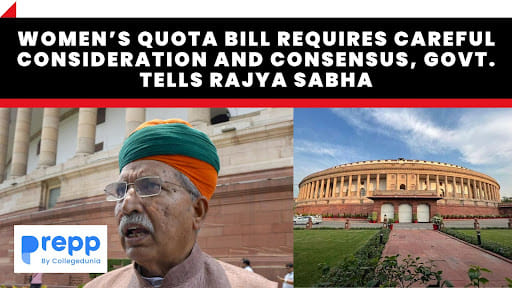
Women’s Quota Bill Requires Careful Consideration And Consensus, Govt. Tells Rajya Sabha
Relevance: GS 2 - Government policies and interventions for development in various sectors and issues arising out of their design and implementation; GS 1 - Role of women and womens organizations
(Source: The Hindu, 07/28/23)
Click here for Daily Current Affairs
Why in the news?
- Recently, the government said in Rajya Sabha that the women's reservation bill requires "careful consideration" on the basis of consensus among all political parties before it is brought to Parliament.
- Currently, there are only 15% women MPs in the 17th Lok Sabha and 12.2% women MPs in the Rajya Sabha. This is lower than the global average of 25.5%. Only 8% of the total MLAs are women across all States in India.
Table of Contents
What has been the history of political reservation for women?
- Indian national movement: During the Indian national movement, women leaders Begum Shah Nawaz and Sarojini Naidu, along with other women's organizations, advocated for the absolute equality of political status for Indian women, rejecting preferential treatment.
- Declining Representation: In 1971, the Committee on the Status of Women in India, observed a decline in women's political representation and discussions about women's reservation began to gain momentum.
- National Perspective Plan for Women: The National Perspective Plan for Women recommended reservation for women from the panchayat to Parliament.
- Representation in Local bodies: The historic 73rd and 74th amendments to the Constitution were enacted, mandating one-third of seats and offices of chairpersons in Panchayati Raj Institutions and urban local bodies to be reserved for women.
- States like Maharashtra, Andhra Pradesh, Bihar, Chhattisgarh, Jharkhand, and Kerala implemented legal provisions to ensure 50% reservation for women in local bodies.
Histroy of Women’s reservation bill
The Women’s Reservation Bill proposes to reserve 33% of seats in the Lok Sabha and State Legislative Assemblies for women:
- 1966: The Bill was first introduced as the 81st Amendment Bill in 1996 by the Deve Gowda-led United Front government. However, it failed to gain approval and lapsed with the dissolution of the Lok Sabha.
- 1988-2003: The Bill was reintroduced several times in different Lok Sabhas, but it faced strong opposition and failed to secure the majority votes needed for passage.
- 2008: The Bill was successfully passed in the Rajya Sabha (upper house of Parliament) with 186-1 votes on March 9, 2010. However, it was never taken up for consideration in the Lok Sabha and lapsed again with the dissolution of the 15th Lok Sabha.
- 2014 and 2019: The BJP included the promise of 33% reservation for women in its election manifestos for both the 2014 and 2019 general elections. However, despite these promises, no significant progress has been made on this front by the government.
What are the Arguments for and Against the Bill?
Arguments for
- Gender Equality: Proponents argue that affirmative action, through reservations, is necessary to address the inherently patriarchal nature of political parties and improve the condition of women in politics.
- Addressing Under-Representation: Reservations can help create a strong women's lobby in Parliament, advocating for issues often overlooked.
- Local Governance: Evidence from women's leadership in panchayats shows that they have shattered social myths, been more accessible than men, and prioritized public goods and women-centric issues.
- The latest report from the Inter-Parliamentary Union (IPU) titled "Women in Parliament 2022," highlighted that in the 2022 elections, chambers (parliaments or legislative bodies) that had legislated quotas, either on their own or in combination with voluntary party quotas, showed a significantly higher proportion of women representatives compared to those chambers without such quotas.
Arguments Against
- Against equality: Reservation for women runs counter to the principle of equality enshrined in the Constitution.
- Unlike caste groups, women are not a homogenous community, making it challenging to apply the same arguments used for caste-based reservations to women.
- Interconnected Interests: Women's interests cannot be isolated from other social, economic, and political factors, making a singular reservation solution less effective.
Conclusion
India has a high percentage of crimes against women, low participation of women in the workforce, low nutrition levels and a skewed sex ratio. Inorder to address all these challenges, it is argued, we need more women in decision-making.
(*Click this link to read prelims specific weekly current affairs articles)
FAQs
Question: What is meant by legislated quotas?
Answer:
Legislated quotas enshrined in the constitution and/or electoral laws require that a minimum number of candidates are women (or of the under-represented sex).
Question: What is the Global Gender Gap report?
Answer:
Global Gender Gap Report provides scores on Global Gender Gap Index (GGGI) which examines the gap between men and women in four dimensions, namely, Economic Participation and Opportunity, Educational Attainment, Health and Survival and Political Empowerment. Global Gender Gap Report is published by the World Economic Forum.
Question: What is Gender Inequality Index?
Answer:
The Gender Inequality Index is a composite measure reflecting inequality in achievements between The GII is a composite measure, reflecting inequality in achievements between women and men in three dimensions: reproductive health, empowerment and the labour market.
Download the PREPP App and attempt FREE IAS Exam Mock Tests and get complete study material!

Full Test - 04: UPSC CSE Prelims CSAT (Paper-II)
Full Test - 03: UPSC CSE Prelims CSAT (Paper-II)
UPSC CSE Prelims 2026 GS Paper 1 Question Paper (24-May-2026)
UPSC CSE Prelims 2026 CSAT Paper 2 Question Paper (24-May-2026)

17 February 2025 | The Hindu Must Read Articles | Current Affairs

16 February 2026 | The Hindu Must Read Articles | Current Affairs

13 February 2026 | The Hindu Must Read Articles | Current Affairs









Comments