Israel In Crisis: Protesters Believe The Netanyahu Government Has Broken The Social Contract
Relevance: GS2 - Bilateral, regional and global groupings and agreements involving India and/or affecting India’s interests
(Source: Indian Express, 07/28/2023)
Click here for Daily Current Affairs
Why in the news?
- Recently, the government of Israel passed a law that limited the oversight powers of the Supreme Court over the Parliament.
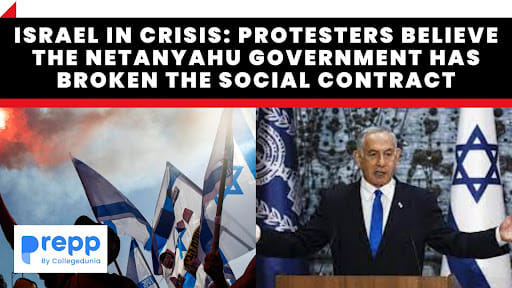
- Thousands of Israelis have been protesting against the reforms, which they say break the social contract between the people and the government, and could lead to autocracy.
Table of Contents
What are the reforms proposed by the Israeli Government?
- The controversial judicial reforms are focused on four major changes to the Israeli legal system.
- Enable the Knesset (Israel Parliament) to overturn any Supreme Court judgment through a simple majority of 61 out of 120 votes, unless the ruling is unanimous.
- Do away with the test of reasonability which has been used by the Court to strike down executive practices.
- Enable a legislative majority in the committee consisting of professionals, justices, and lawmakers which selects judges to the Supreme Court.
- Allow ministers to select their own legal advisors instead of using professionals.
- Of these, only the reform related to the test of reasonableness has been implemented.
What is the intent behind the reforms?
- According to the coalition government, the people had lost faith in the legal system.
- Therefore, judicial reforms were necessary to restore powers to elected representatives and foster democracy.
- Israel is governed by a far-right coalition that has alleged that its legislative agenda has been hindered by a judiciary that it calls left-leaning.
Impact of the changes
- It will allow the government to overturn court judgments that have expanded social reforms to support the LGBTQ community and barred previous governments from constructing Israeli outposts on private Palestinian land.
- The Opposition has claimed that the proposed reform could be used by the ruling coalition to influence Prime Minister Netanyahu’s corruption trial
- Although the changes will not have a direct and immediate impact on the corruption trial, the government could later alter the laws to exonerate Netanyahu.
- The reforms could undermine social cohesion in the country and also impact its ties with the U.S.A.
- As Israel does not have a Constitution, the reforms could give the government unchecked powers to the government to enact discriminative laws.
- In the absence of the judiciary’s powers of oversight, Israelis will have to obey rigorous Jewish religious norms.
How has the Israeli public responded?
Israeli Political Reforms: Public Support and Opposition
- According to a New York Times survey, 44% of Israelis support the proposed reforms, while 41% oppose them.
- Legislators warn of potential violence and law and order deterioration as thousands protest on the streets.
- Defense Minister Yoav Gallant initially opposed the reforms and was removed, but later reappointed with support from military and intelligence services.
Reservists Protest and Suspending Duty
- Reservists of the Israeli Defence Force, including pilots, intelligence officers, and cyber security personnel, suspend their volunteer reserve duty.
- They reject the reforms, seeing them as an arbitrary exercise of executive power, and claim it violates the democratic principles they uphold in their contracts.
Warnings from Key Institutions
- The Institute for National Security Studies (INSS), an Israeli think tank, recommends halting the reforms.
- The Israel Business Forum warns of a national economic shutdown, with technology leaders, academicians, senior doctors, and trade union leaders threatening to strike.
Legal Challenges
- The Movement for Quality Government, an Israeli rights watchdog, approaches the Supreme Court seeking to strike down the new legislation.
- The reforms have sparked divisions and concerns across various sectors of Israeli society.
Conclusion
- Although the civil movement had successfully prevented the major judicial overhaul in March, there has not been a successful people’s movement in Israel for decades with even the Arab Spring which led to civil uprisings in West Asia withering away.
- The Israel Defence Force, also known as the People’s Army, has a significant influence on the government, which can be used to prevent the government from changing the fundamentals of Israeli polity.
Social Contract
|
(*Click this link to read prelims specific weekly current affairs articles)
FAQs
Question: What is the principle of reasonableness?
Answer:
It is “a legal standard used by many judicial systems, including Australia, Britain, and Canada. A decision is deemed unreasonable if a court rules that it was made without considering all relevant factors or without giving relevant weight to each factor, or by giving irrelevant factors too much weight.”
Question: What is the Arab Spring?
Answer:
The Arab Spring was a series of pro-democracy uprisings that enveloped several largely Muslim countries, including Tunisia, Morocco, Syria, Libya, Egypt, and Bahrain. The events in these nations generally began in the spring of 2011, which led to the name.
MCQs
Question: Consider the following statements:
- Israel is a constitutional democracy.
- It has a unicameral legislature called the Duma.
Which of the above statements is/are correct?
(a) Only 1
(b) Only 2
(c) Both 1 and 2
(d) None
Answer: (d) See the Explanation
- Israel is a parliamentary democracy with the Prime Minister as the head of the government. It does not have a constitution, with Israel’s Basic Laws acting in place of the constitution. Hence statement 1 is incorrect.
- The Israeli parliament is a unicameral legislature called the Knesset which is sovereign although subject to checks by the judiciary, which have now been removed by the government. Hence statement 2 is incorrect.
- The Duma is the lower chamber of the Russian parliament.
Therefore, option (d) is the correct answer.
Download the PREPP App and attempt FREE IAS Exam Mock Tests and get complete study material!

Full Test - 04: UPSC CSE Prelims CSAT (Paper-II)
Full Test - 03: UPSC CSE Prelims CSAT (Paper-II)
UPSC CSE Prelims 2026 GS Paper 1 Question Paper (24-May-2026)
UPSC CSE Prelims 2026 CSAT Paper 2 Question Paper (24-May-2026)

17 February 2025 | The Hindu Must Read Articles | Current Affairs

16 February 2026 | The Hindu Must Read Articles | Current Affairs

13 February 2026 | The Hindu Must Read Articles | Current Affairs









Comments