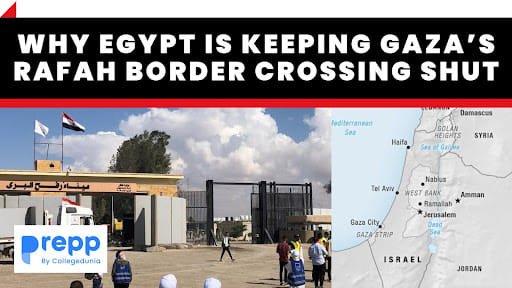
Why Egypt Is Keeping Gaza’s Rafah Border Crossing Shut
Relevance: GS2 - Effect of Policies & Politics of Countries; Prelims
(Source: The Hindu, 10/19/2023)
Click here for Daily Current Affairs
Why in the news?
- In response to a devastating cross-border infiltration by Hamas fighters on October 7 that killed over 1,300 Israelis, Israel has imposed a “total blockade” of Gaza, cutting off electricity to the territory and stopping all supplies of food and fuel.
- Hence, the only likely route for humanitarian aid to enter Gaza is via Rafah from Egypt’s Sinai region, which is also the only exit point for Gaza residents seeking to flee.
- The Rafah crossing was shuttered due to repeated Israeli airstrikes targeting the area, after the commencement of the conflict.
Table of Contents
About Israel-Palestine Conflict
- Recently, Hamas, a Palestinian militant group launched an attack on Israel which has led to the outbreak of war between Israel and Palestine.
- It is a conflict between two self-determination movements: the Jewish nationalist project and the Palestinian nationalist project, in the same territory.
- The land to which Jews and Palestinians lay claim was under the Ottoman Empire and then the British Empire in the early 20th century.
- The present conflict has its roots in the 20th century, since then, there has been a gradual expansion of territory occupied by Israel and today Palestinians are confined to only two regions: West Bank and Gaza Strip.
What is Rafah Border Crossing?
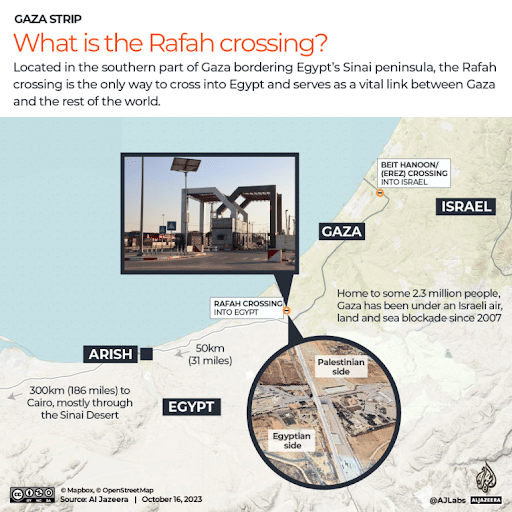
- It is crossing between the Gaza Strip and Egypt and is the sole route for aid to enter Gaza directly outside Israel which is controlled by Egypt
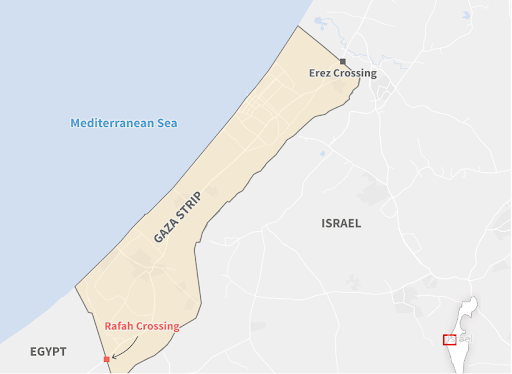
- The crossing is at the south of the Gaza Strip and wedged between Israel, Egypt and the Mediterranean Sea.
The Rafah Crossing in the Israeli-Palestinian Conflict
- Humanitarian Aid and Supplies: The Rafah Crossing serves as a critical entry point for humanitarian aid and essential supplies into the Gaza Strip. When other routes are blocked or limited, Rafah becomes the primary lifeline for delivering food, fuel, medical supplies, and other necessities to the people of Gaza.
- Escape Route for Gaza Residents: Rafah is also the main exit point for residents of Gaza who wish to leave the territory. This is especially crucial during times of conflict when the safety and well-being of civilians are at risk. People seek refuge or leave the area through Rafah.
- Diplomatic Efforts: The status and operation of the Rafah Crossing are often subject to negotiations and agreements between Israel, the Palestinian authorities, and Egypt. The crossing is a focal point for diplomatic efforts to ease tensions and facilitate movement in the region.
- Impact on Gaza's Population: The restrictions on Rafah Crossing can significantly affect the daily lives of Gaza's population. When the crossing is closed or access is limited, it can lead to dire humanitarian conditions, making it a focal point of concern for the international community.
Why is Egypt keeping Gaza’s Rafah Border crossing shut?
- Security Concerns: Egypt restricts access across Rafah due to security concerns in northeastern Sinai. The region faced an Islamist insurgency, which peaked after 2013 and has since been largely suppressed.
- Blockade of Gaza: Since Hamas took control of Gaza in 2007, Egypt has helped enforce a blockade on the enclave. This blockade heavily restricts the flow of people and goods in and out of Gaza.
- Historical Context: In 2008, tens of thousands of Palestinians crossed into Sinai after Hamas blasted holes in border fortifications, prompting Egypt to build a stone and cement wall.
- Egypt's Role as a Mediator: Egypt has acted as a mediator between Israel and Palestinian factions during past conflicts and periods of unrest. In such situations, Egypt has locked down the border, allowing aid to enter and medical evacuees to leave but preventing large-scale movement of people.
- Humanitarian Implications: The continued restrictions at Rafah have significant humanitarian implications for the people in Gaza, making it difficult for them to access essential goods and services.
Egypt’s Sinai Peninsula and Gaza
|
What efforts are underway to address the humanitarian crisis in Gaza?
- United Nations' Urgent Appeal: The United Nations has called on Israel to prevent a potential humanitarian catastrophe, emphasizing the critical shortages of food, fuel, and drinking water in the region.
- Hospitals in Gaza are facing challenges in treating the injured as their backup generators are running out of fuel.
- Egyptian Aid Efforts: Egyptian aid trucks have moved closer to the crossing, though it remains uncertain when or if they will be able to enter Gaza.
- U.S. and Israeli Cooperation: Additionally, the United States and Israel have agreed to work on a plan to deliver humanitarian aid to Gaza's civilians while ensuring that it doesn't benefit Hamas.
(*Click this link to read prelims specific weekly current affairs articles)
FAQs
Question: What is the Rafah Border Crossing
Answer:
It is crossing between the Gaza Strip and Egypt and is the sole route for aid to enter Gaza directly outside Israel. The crossing is at the south of the Gaza Strip and wedged between Israel, Egypt and the Mediterranean Sea.
Question: What is the Sinai Peninsula?
Answer:
The Sinai peninsula, which also borders Israel, is located between the Mediterranean Sea to the north and the Red Sea to the south. As the only part of Egypt to be located in Asia, it acts as a land bridge between Asia and Africa.
Question: What is the Gaza Strip?
Answer:
The Gaza Strip is a Palestinian enclave on the eastern coast of the Mediterranean Sea. It borders Egypt on the southwest, and Israel on the east and north.
It has been claimed by the de jure sovereign State of Palestine along with the West Bank. It has been controlled by Hamas since the Battle of Gaza in 2006 which led to an international political and economic boycott of the region.
MCQs
Question: Which one of the following countries of South-West Asia does not open out to the Mediterranean Sea? (UPSC 2015)
(a) Syria
(b) Jordan
(c) Lebanon
(d) Israel
Answer: (b) See the Explanation
Jordan does not open out to the Mediterranean sea, as it is bounded by Syria and Israel towards the side of the Mediterranean sea.
Therefore, option (b) is the correct answer.
Question: The area known as Golan Heights’ sometimes appear in the news, in the context of events related to? (UPSC 2015)
(a) Central Asia
(b) Middle East
(c) South-East Asia
(d) Central Africa
Answer: (b) See the Explanation
The Golan Heights is a hilly, 1,200 sq-km rocky plateau in south-western Syria in the Middle East region overlooking Lebanon, Syria, and the Jordan Valley. The Golan was Syrian territory until 1967 when Israel occupied it in the closing stages of the Six-Day War.
Therefore, option (b) is the correct answer.
Question: The term “two-state solution” is sometimes mentioned in the news in the context of the affairs of (UPSC 2018)
(a) China
(b) Israel
(c) Iraq
(d) Yemen
Answer: (b) See the Explanation
“Two-State Solution” is related to Israel-Palestine conflict. It aims at the resolution of this conflict via creation of two independent states: Israel and Palestine. It gained traction post Oslo Accord 1993, and is seen by many as the only viable solution to this impending crisis.
Therefore, option (b) is the correct answer.
Download the PREPP App and attempt FREE IAS Exam Mock Tests and get complete study material!

Full Test - 04: UPSC CSE Prelims CSAT (Paper-II)
Full Test - 03: UPSC CSE Prelims CSAT (Paper-II)
UPSC CSE Prelims 2026 GS Paper 1 Question Paper (24-May-2026)
UPSC CSE Prelims 2026 CSAT Paper 2 Question Paper (24-May-2026)

17 February 2025 | The Hindu Must Read Articles | Current Affairs

16 February 2026 | The Hindu Must Read Articles | Current Affairs

13 February 2026 | The Hindu Must Read Articles | Current Affairs









Comments