Biodiversity Technical Body Reviews Kunming-Montreal Biodiversity Framework in Nairobi
Primary Source: Down to Earth
(*Click this link to read prelims specific weekly current affairs articles)
Prepp Prelims Booster: Biodiversity, Kunming-Montreal Global Biodiversity Framework
Prepp Mains Booster: Biodiversity and its importance, International cooperation on biodiversity conservation, Challenges in implementation
Why in the news?
- The Kunming-Montreal Global Biodiversity Framework, which was adopted last December at the 15th Conference of Parties (COP15) to the Convention on Biological Diversity (CBD), is being guided for implementation in Nairobi, Kenya, where governments and biodiversity experts have been gathered.
- The Subsidiary Body on Scientific, Technical and Technological Advice (SBSTTA-25) is being held from October 15 to October 19, 2023.
- This meeting, the first since the Framework's adoption in December 2022, is being attended by approximately 670 participants from 135 countries in Nairobi.
Table of Contents
Key Takeaways of the Meet
- On the SBSTTA-25's opening day, progress updates were presented, introducing the idea of categorical indicators for more detailed progress reporting.
- Jonas Geldmann (University of Copenhagen) pointed out the omission of an indicator for changes in biodiversity abundance.
- Jenna Sullivan-Stack (Oregon State University) emphasized monitoring both quantitative and qualitative elements of area-based ocean conservation.
- Intergovernmental Science-Policy Platform's assessment report on invasive alien species was discussed by experts.
- Examining the connection between biodiversity and climate change based on recent reports from the Intergovernmental Panel on Climate Change.
Subsidiary Body on Scientific, Technical and Technological Advice (SBSTTA)
|
What is Kunming-Montreal Biodiversity Framework?
- The Kunming-Montreal Global Biodiversity Framework (GBF) is a critical and ambitious initiative adopted with the aim to tackle biodiversity loss and promote a harmonious co-existence between humanity and nature.
- The GBF was endorsed during the 15th Conference of Parties (COP 15) to the Convention on Biological Diversity (CBD) in December 2022, following a four-year consultation and negotiation process.
- This framework builds upon the Convention's previous Strategic Plans and supports the realization of the Sustainable Development Goals (SDGs).
- The overarching vision of the GBF is to attain a world living in harmony with nature by the year 2050.
- It sets forth four goals for 2050 and 23 targets for 2030, which collectively lay down an ambitious route towards this vision.
- The primary aim is to halt and reverse biodiversity loss by 2030.
- The implementation of the GBF will be guided and supported through a comprehensive package of decisions, also adopted at COP 15.
- This package includes a monitoring framework for the GBF, an enhanced mechanism for planning, monitoring, reporting, and reviewing implementation, necessary financial resources for implementation, strategic frameworks for capacity development, technical and scientific cooperation, and an agreement on digital sequence information on genetic resources.
- The GBF garnered recognition and adoption at a global platform, marking a significant step towards global biodiversity conservation and sustainable development.
Conference of Parties (COP15)
|
Kunming-Montreal Biodiversity Framework – Main Goals
- Goal A: Centred on safeguarding ecosystem integrity, species health, and genetic diversity.
- Goal B: Focus on the sustainable use and management of biodiversity and nature’s contributions to people.
- Goal C: T aim at the fair and equitable sharing of benefits arising from the utilization of genetic resources.
- Goal D: Focus on securing adequate means of implementation for the Kunming-Montreal global biodiversity framework.
Kunming-Montreal Biodiversity Framework – Key Targets
- Conservation and Management
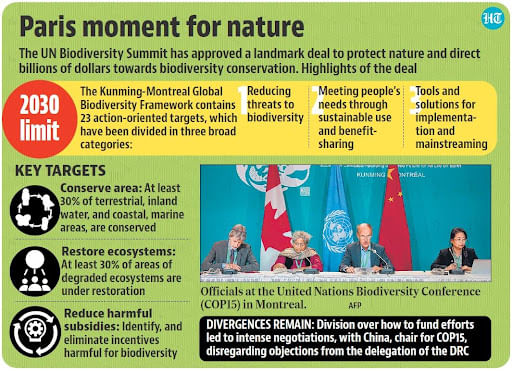
- At least 30% of the world's lands, inland waters, coastal areas, and oceans should be effectively conserved and managed, with particular emphasis on areas of significant importance for biodiversity and ecosystem functioning and services.
- Restoration
- Restoration should be completed or underway on at least 30% of degraded terrestrial, inland waters, and coastal and marine ecosystems.
- Reduction of Biodiversity Loss
- Reduce to near zero the loss of areas of high biodiversity importance, including ecosystems of high ecological integrity.
- Food Waste and Overconsumption
- Halve global food waste and significantly reduce overconsumption and waste generation.
- Chemical and Nutrient Pollution
- Reduce by half both excess nutrients and the overall risk posed by pesticides and highly hazardous chemicals.
- Financial Reforms and Mobilization
- Phase out or reform by 2030 subsidies that harm biodiversity by at least $500 billion per year, while scaling up positive incentives for biodiversity conservation and sustainable use.
- Mobilize at least $200 billion per year by 2030 in domestic and international biodiversity-related funding from all sources – public and private.
- Raise international financial flows from developed to developing countries to at least US$ 20 billion per year by 2025, and to at least US$ 30 billion per year by 2030.
- Invasive Alien Species
- Prevent the introduction of priority invasive alien species, reduce by at least half the introduction and establishment of other known or potential invasive alien species, and eradicate or control invasive alien species on islands and other priority sites.
- Corporate Responsibility
- Require large and transnational companies and financial institutions to monitor, assess, and transparently disclose their risks, dependencies, and impacts on biodiversity through their operations, supply, and value chains, and portfolios.
- Others
- Other targets also focus on aspects like reducing harmful government subsidies, cutting food waste in half, and enhancing financial support for biodiversity conservation.
India’s Stand at COP15
- India urged the creation of a new and dedicated fund to assist developing nations in successfully implementing a post-2020 global framework to prevent and reverse biodiversity loss.
- So far, the only source of money for biodiversity conservation has been the Global Environment Facility, which caters to several treaties such as the UNFCCC and the UN Convention to Combat Desertification.
- India has stated that biodiversity conservation must be based on 'Common but Differentiated Responsibilities and Respective Capabilities' (CBDR), as climate change has an influence on nature.
- According to India, developing countries bear the majority of the burden of fulfilling biodiversity conservation targets, necessitating significant financing and technological transfer.
What is the Convention on Biological Diversity (CBD)?
- The Convention on Biological Diversity (CBD) is a multilateral treaty aimed at promoting the conservation of biodiversity, the sustainable use of its components, and the equitable sharing of benefits arising from the use of genetic resources.
- It represents a commitment by the world's nations to address biodiversity loss and is one of the key international instruments dedicated to ensuring the sustainable future of Earth's diverse ecosystems and species.
- The CBD was opened for signature at the Earth Summit in Rio de Janeiro, Brazil, in 1992 and entered into force on 29 December 1993.
- The three main objectives of CBD are:
- Conservation of Biodiversity: To protect biological diversity at all levels – ecosystems, species, and genetic levels.
- Sustainable Use: To promote the use of ecosystem components in a manner and at a rate that does not lead to their long-term decline, ensuring their potential to meet the needs of present and future generations.
- Fair and Equitable Sharing: To ensure the equitable sharing of benefits arising from the utilization of genetic resources, often through the establishment of Access and Benefit-Sharing (ABS) agreements.
- Important Protocols:
- The Cartagena Protocol on Biosafety (2000): This addresses the safe handling, transport, and use of living modified organisms (LMOs) resulting from modern biotechnology.
- The Nagoya Protocol on Access to Genetic Resources and the Fair and Equitable Sharing of Benefits Arising from their Utilization (2010): This provides a framework for the equitable sharing of benefits arising from the utilization of genetic resources and traditional knowledge.
- The primary governing body of the CBD is the Conference of the Parties (COP), which meets periodically to evaluate progress, establish strategic goals, and address emerging issues.
- The CBD adopted the Strategic Plan for Biodiversity 2011-2020, which included the Aichi Biodiversity Targets, a set of 20 ambitious goals aimed at halting biodiversity loss and ensuring the resilient functioning of ecosystems.
- The CBD has near-universal participation, with most of the world's countries being parties to the Convention. This makes it one of the most widely ratified international environmental agreements.
Conclusion
The Kunming-Montreal Global Biodiversity Framework serves as a roadmap to address the pressing issue of biodiversity loss and to promote sustainable development on a global scale. Recommendations from SBSTTA-25 in Nairobi will proceed for consideration at COP16 in 2024.
(*Click this link to read prelims specific weekly current affairs articles)
FAQs
Question: What is the Kunming-Montreal Global Biodiversity Framework?
Answer:
It's a framework adopted at the 15th Conference of Parties (COP15) to the Convention on Biological Diversity (CBD) aimed at guiding international efforts in biodiversity conservation.
Question: What is Convention on Biological Diversity (CBD)?
Answer:
The Convention on Biological Diversity (CBD) is a multilateral treaty aimed at promoting the conservation of biodiversity, the sustainable use of its components, and the equitable sharing of benefits arising from the use of genetic resources. It represents a commitment by the world's nations to address biodiversity loss and is one of the key international instruments dedicated to ensuring the sustainable future of Earth's diverse ecosystems and species.
Question: Wha are the main goals of Kunming-Montreal Biodiversity Framework?
Answer:
The main goals of Kunming-Montreal Biodiversity Framework are:
- Centred on safeguarding ecosystem integrity, species health, and genetic diversity.
- Focus on the sustainable use and management of biodiversity and nature’s contributions to people.
- To aim at the fair and equitable sharing of benefits arising from the utilization of genetic resources.
- Focus on securing adequate means of implementation for the Kunming-Montreal global biodiversity framework.
MCQs
Question: Consider the following statements: (UPSC 2023)
- In India, the Biodiversity Management Committees are key to the realization of the objectives of the Nagoya Protocol.
- The Biodiversity Management Committees have important functions in determining access and benefit sharing, including the power to levy collection fees on the access of biological resources within its jurisdiction.
Which of the statements given above is/are correct?
(a) 1 only
(b) 2 only
(c) Both 1 and
(d) Neither 1 nor 2
Answer: (c) See the Explanation
BMCs are local-level committees constituted under the Biological Diversity Act, 2002, with the goal of conserving India's biodiversity and ensuring fair sharing of the benefits derived from its utilization.
BMCs are responsible for a variety of critical responsibilities, including biodiversity recording, the creation of People's Biodiversity Registers (PBRs), conservation planning, encouraging sustainable resource use, and implementing biodiversity awareness and education initiatives.
BMCs play an important role in facilitating access and benefit sharing in accordance with the principles of the Nagoya Protocol, an international agreement on biodiversity conservation and sustainable use. They establish fair and equitable benefit sharing agreements for biological resources and associated traditional knowledge. Hence, statement 1 is correct.
BMCs have the power to charge collection fees for the use and access to biological resources under their jurisdiction. These fees are used to assist biodiversity conservation, sustainable livelihoods, and community development. Hence, statement 2 is correct.
Therefore, option (c) is the correct answer.
Question: Invasive Species Specialist Group' (that develops Global Invasive Species Database) belongs to which one of the following organizations? (UPSC 2023)
(a) The International Union for Conservation of Nature
(b) The United Nations Environment Programme
(c) The United Nations World Commission for Environment and Development
(d) The World Wide Fund for Nature
Answer: (a) See the Explanation
The Global Invasive Species Database is a free, searchable online database of information about foreign and invasive species that threaten biodiversity.
By distributing specialists' expertise and experience to a global audience, the GISD strives to raise public awareness of invasive species and facilitate successful prevention and management operations.
It focuses on invasive alien species that endanger native biodiversity and natural environments, and it includes taxonomic groups ranging from microorganisms to animals and plants.
The Invasive Species Specialist Group (ISSG) of the IUCN Species Survival Commission manages the Global Invasive Species Database (GISD).
Therefore, option (a) is the correct answer.
Question: “Momentum for Change: Climate Neutral Now” is an initiative launched by: (UPSC 2018)
(a) The Intergovernmental Panel on Climate Change
(b) The UNEP Secretariat
(c) The UNFCCC Secretariat
(d) The World Meteorological Organisation
Answer: (c) See the Explanation
The UNFCCC secretariat launched the "Momentum for Change: Climate Neutral Now" program in 2015. The program is part of the Momentum for Change effort, which aims to achieve climate neutrality.
Therefore, option (c) is the correct answer.
Download the PREPP App and attempt FREE IAS Exam Mock Tests and get complete study material!

Full Test - 04: UPSC CSE Prelims CSAT (Paper-II)
Full Test - 03: UPSC CSE Prelims CSAT (Paper-II)
UPSC CSE Prelims 2026 GS Paper 1 Question Paper (24-May-2026)
UPSC CSE Prelims 2026 CSAT Paper 2 Question Paper (24-May-2026)

17 February 2025 | The Hindu Must Read Articles | Current Affairs

16 February 2026 | The Hindu Must Read Articles | Current Affairs

13 February 2026 | The Hindu Must Read Articles | Current Affairs









Comments