India Likely To Sign Deal With U.S. For 31 MQ-9B Drones By February 2024
Relevance: GS3 - Defense Technology, GS2 - Bilateral, regional and global groupings and agreements involving India and/or affecting India’s interests.
(Source: The Hindu, 10/19/2023)
Click here for Daily Current Affairs
Why in the news?
- This article discusses the deal between India and the U.S.A. for 31 MQ-9B Unmanned Aerial Vehicles which is expected to be concluded by February 2024.
- India had approached the U.S.A. to purchase the SkyGuardian and the SeaGuardian variants of the MQ-9B UAV developed by General Atomics.
Table of Contents
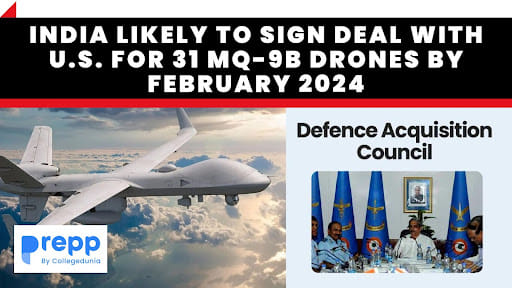
India-U.S. deal for MQ-9B Drones
- India has expressed interest in acquiring 31 MQ-9B High Altitude Long Endurance (HALE) drones from the U.S. manufacturer General Atomics.
- This would include 15 Sea Guardians for the Indian Navy and Eight Sky Guardians each for the Indian Army and the Indian Air Force.
- According to the Ministry of Defense, the deal is estimated to cost around $3,072 million.
Present status
- The agreement is expected to be concluded by February 2024.
- The Union Ministry of Defense issued the Letter of Request (LoR) to the U.S. in September 2023.
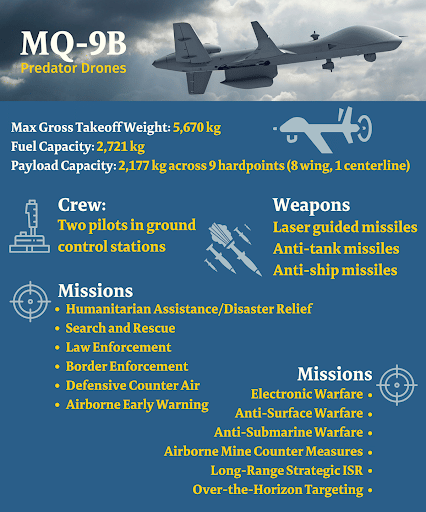
MQ-9B
|
What is the process to acquire MQ-9B’s from the U.S.A?
- The agreement to purchase MQ-9B UAVs will be executed through the Foreign Military Sales (FMS) route of the U.S. government.
- Acceptance of Necessity: The first step in the acquisition process is the Acceptance of Necessity (AoN) which was accorded to the agreement by the Defence Acquisition Council (DAC).
- Letter of Request (LOR): The next step is sending a Letter of Request to the U.S. government.
- This would include the tri-services requirements, the details of equipment, and the terms of the procurement.
- Letter of Offer and Acceptance: On the basis of the LOR, the U.S. government and the Ministry of Defense will finalize the Letter of Offer and Acceptance (LOA).
- It will include details of equipment and the terms of the procurement, which will be negotiated and finalized based on the norms of the FMS program and the terms of the sale offered to other countries.
- Cabinet approval: Once the terms are finalized, the U.S. Government is required to notify the U.S. Congress of the sale.
- Similarly, the deal must also be approved by the Cabinet Committee on Security of the Indian government after which the contract will be concluded.
Defense Acquisition Council
|
Significance of the Agreement
- All weather capabilities: MQ-9Bs, depending on the configuration, can fly over the horizon via satellite for up to 40 hours in all weather conditions.
- Round-the-clock surveillance: The MQ-9Bs can be used for surveillance in border and beyond regions which will allow the armed forces to be better prepared for any hostile activity by unfriendly neighbors.
- Counterterrorism: It can be used to support counter-terrorism and counter-insurgency operations in Kashmir and other regions affected by militancy.
- Maritime security: The SeaGuardian variant includes a 360° surface-search maritime radar, automatic identification system, sonobuoy monitoring system, and sonobuoy dispensers which can be employed in anti-surface and anti-submarine warfare missions.
- This will help improve monitoring and response to any security threats in the maritime theater.
- Integrability: The UAVs can be successfully integrated with other U.S.-origin platforms used by the Indian armed forces such as the P-8Is, AH-64 Apache attack helicopters, and MH-60R multi-role helicopters.
- It can also be safely integrated into civil airspace which will enable coordinated efforts between military and civilian authorities for real-time situational awareness.
- Cost-effectiveness: The MQ-9B system can provide 80% of the capability of a large human-flown maritime patrol aircraft at 20% of its cost.
- This means larger volumes of air or sea can be covered by the armed forces while lowering the time, cost, and wear and tear involved.
- It significantly reduces the wear and tear of manned aircraft including the Indian Navy’s fleet of 12 P-8I long-range maritime patrol aircraft.
- Lowered fatigue: It also results in lowered crew fatigue among the personnel of the armed forces.
Advantages of the acquisition
- India’s acquisition of the drones will give it a strategic advantage over its adversaries.
- The MQ-9B UAVs will enable India to conduct long-range surveillance and precision strikes without risking its manned aircraft or personnel.
- It will also boost India's defense cooperation with the U.S.A and strengthen the strategic partnership which is key for both countries in the Indo-Pacific region.
- The agreement is likely to lead to new opportunities for India's defense industry through technology transfer and joint production under the Make in India initiative.
Other deals between India and General Atomics
- General Atomics is in talks with several Indian companies for the domestic manufacture of components for the MQ-9B which could expand to potentially include the manufacture of electronics, sensors, and avionics.
- In February 2023, HAL and General Atomics announced that they are looking to develop a comprehensive engine maintenance, repair, and overhaul (MRO) program for the HALE Remotely Piloted Aircraft project.
- The engines for the MQ-9B will be supported by the engine division of HAL for the foreign market.
(*Click this link to read prelims specific weekly current affairs articles)
FAQs
Question: What is a HALE drone?
Answer:
High-altitude long-endurance (HALE) unmanned aerial vehicles are UAVs flying at an altitude of 15–20 km with a low speed in order to complete long-distance flights in environments with thin air and low temperature.
Question: What is the Foreign Military Sales Route?
Answer:
It is a program of the U.S. Ministry of Defense that facilitates the sale of the US. arms, equipment, defense services, and military training to foreign governments. The US Ministry of Defense acts as an intermediary between the purchaser and the defense contractor.
MCQs
Question: Consider the following activities:
- Spraying pesticides on a crop field
- Inspecting the craters of active volcanoes
- Collecting breath samples from spouting whales for DNA analysis
At the present level of technology, which of the above activities can be successfully carried out by using drones? (UPSC CSE 2020)
(a) 1 and 2 only
(b) 2 and 4 only
(c) 1 and 3 only
(d) 1, 2 and 3
Answer: (d) See the Explanation
- Drones equipped with spraying mechanisms can be used to spray pesticides on crop fields which reduces the risk of human workers being exposed to harmful chemicals and ensures precise and efficient spraying. Hence statement 1 is correct.
- Drones can be used to inspect the craters of active volcanoes without risking human lives as they can capture high-resolution images and videos of the volcano's activity as well as material from the plume, thereby improving research. Hence statement 2 is correct.
- Drones can be used to collect breath samples from spouting whales for DNA analysis as it is less invasive than traditional methods and reduces the risk of harming the whale or the researchers. Hence statement 3 is correct.
Therefore, option (d) is the correct answer.
Question: What is "Terminal High Altitude Area Defense (THAAD)", sometimes seen in the news? (UPSC 2018)
(a) An Israeli radar system
(b) India's indigenous anti-missile Programme
(c) An American anti-missile system
(d) A defense collaboration between Japan and South Korea
Answer: (c) See the Explanation
- The Terminal High Altitude Area Defense (THAAD) is a transportable, ground-based anti-ballistic missile defense system developed by U.S. company Lockheed Martin.
- The THAAD system is designed to intercept and destroy short and medium-range ballistic missiles during their final phase of flight.
Therefore, option (c) is the correct answer.
Download the PREPP App and attempt FREE IAS Exam Mock Tests and get complete study material!

Full Test - 04: UPSC CSE Prelims CSAT (Paper-II)
Full Test - 03: UPSC CSE Prelims CSAT (Paper-II)
UPSC CSE Prelims 2026 GS Paper 1 Question Paper (24-May-2026)
UPSC CSE Prelims 2026 CSAT Paper 2 Question Paper (24-May-2026)

17 February 2025 | The Hindu Must Read Articles | Current Affairs

16 February 2026 | The Hindu Must Read Articles | Current Affairs

13 February 2026 | The Hindu Must Read Articles | Current Affairs









Comments