PM Modi ‘Directs’ ISRO To Land Man On Moon By 2040
Relevance: GS3 - Science and Technology, Space Technology
(Source: The Hindu, 10/18/2023)
Click here for Daily Current Affairs
Why in the news?
- Recently, PM Narendra Modi chaired a meeting to assess the progress of the Gaganyaan mission and outline the future of Indian space exploration.
- The Prime Minister has instructed ISRO to develop an Indian-crafted indigenous space station by 2035 and land an Indian on the moon by 2040, following a review of preparations for the Gaganyaan mission, India's first manned space mission set for 2025.
Table of Contents

Gaganyaan Mission Review and Envision for Future Space Exploration
- Roadmap: The Department of Space (DoS), under which ISRO functions, presented the state of preparedness and technologies developed for Gaganyaan Mission. The plans include a roadmap for moon exploration, which involves a series of Chandrayaan missions and the development of new launch vehicles.
- This roadmap also includes constructing a new launch pad and establishing human-centric laboratories and associated technologies.
- Vision for Interplanetary Missions: Prime Minister Modi also called upon scientists to work towards interplanetary missions, including a space vehicle to orbit Venus and one that will land on Mars. These ambitious goals will require substantial investments and private sector involvement.
Escalating Costs and Challenges in Future Space Missions
- The International Space Station (ISS), jointly developed and maintained by several countries, is slated for decommissioning by 2030 due to increasing expenses and financial disputes among partner nations.
- Hence, China's Tiangong is the only operational space station, albeit smaller than the ISS.
- India, part of the Artemis Accords with the United States, has plans to send an astronaut to the ISS in 2024, but experts warn that future space missions, including moon landings and space stations, will demand substantial investments and private sector involvement.
- Unlike past missions, which were born from military space races, modern space endeavors will require rigorous testing and incur high costs, making it necessary to evaluate feasibility as budgets become available.
What is the International Space Station?
- A space station is essentially a large spacecraft that remains in low-earth orbit (LEO) for extended periods of time. It is like a large laboratory in space.
- The International Space Station Program unites global flight crews, diverse launch vehicles, distributed operations, training, engineering, and research facilities, communication networks, and the international scientific community.
- ISS has been known for the exemplary cooperation between the five participating space agencies that have been running it. These countries are:
- NASA (United States), Roscosmos (Russia), JAXA (Japan), ESA (Europe), and CSA (Canada).
- The ISS has been in operation since 1998 and is expected to decommission by 2030.
Significance of Space Station
- Facilitating Meaningful Scientific Data: Space stations serve as vital platforms for conducting experiments that provide valuable insights into various scientific fields, with a particular focus on biological research. These controlled environments allow scientists to gather data that is often unattainable elsewhere.
- Extended Study Opportunities: Space stations offer the capability to conduct a greater number of experiments and longer-duration studies compared to other space vehicles. Researchers can explore complex questions and phenomena that require extended periods to observe and analyze.
- Prolonged Crew Missions: While crew members typically spend weeks to several months on a space station, their stays rarely exceed a year. This extended presence enables the collection of data over more extended time frames, allowing for comprehensive investigations.
- Human Spaceflight Impact Studies: Space stations are instrumental in investigating the effects of extended spaceflight on the human body. These platforms serve as laboratories for understanding the physiological and psychological challenges that astronauts face during long-term missions, contributing to the development of strategies to mitigate these challenges.
About Gaganyaan Mission
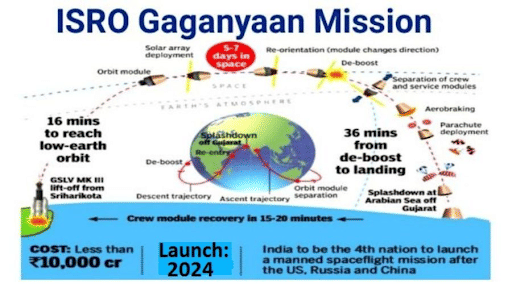
- Gaganyaan is India's first Human space flight mission aiming for safe transportation of astronauts to space and back.
- It envisages demonstration of human spaceflight capability by launching a crew of 3 members to an orbit of 400 km for a three-day mission and bring them back safely to earth, by landing in Indian sea waters (either the Bay of Bengal or the Arabian Sea).
- It necessitates the development of critical technologies, including a human-rated launch vehicle for crew transportation, a Life Support System to create Earth-like conditions for the crew in space, emergency escape provisions for the crew, and the ongoing refinement of crew management aspects encompassing training, recovery, and rehabilitation.
- The LVM3 rocket, the heavy lift launcher of Isro, has been identified as the launch vehicle for the Gaganyaan mission. It consists of the solid stage, liquid stage and cryogenic stage.
- Various precursor missions are planned for demonstrating the Technology Preparedness Levels before carrying out the actual Human Space Flight mission. These demonstrator missions include:
- Integrated Air Drop Test (IADT),
- Pad Abort Test (PAT) and
- Test Vehicle (TV) flights.
What is the importance of Gaganyaan mission to India?
- Economic Opportunities: The Gaganyaan mission presents a significant economic opportunity for India's industries. Approximately 60% of the mission's equipment will be sourced from the Indian private sector, boosting local businesses and fostering innovation.
- Job Creation: The mission's execution will require an additional workforce and new employment opportunities. It will also contribute to the development of human resources skilled in advanced technologies, furthering economic growth.
- Technological Advancement: Human spaceflight is at the forefront of science and technology. Gaganyaan will serve as a platform for conducting experiments and testing future technologies, driving innovation and progress in various fields.
- Academic Collaboration: The Gaganyaan program is a national endeavor that will involve collaboration between ISRO, academia, industry, national agencies, and scientific organizations. This collaboration will establish a robust framework for advancing research and development.
- Research Opportunities: The mission will facilitate valuable research and technology development, enabling extensive studies in areas like materials processing, astro-biology, resource mining, planetary chemistry, and orbital calculations.
- Inspiration: Human spaceflight will serve as a powerful source of inspiration for the youth and the nation as a whole. It will encourage a new generation of students to pursue careers in science and technology, promoting national development.
- National Prestige: India's successful Gaganyaan mission will not only enhance the country's prestige on the global stage but also solidify its role as a significant player in the space industry, becoming the fourth country to launch a human space mission.
(*Click this link to read prelims specific weekly current affairs articles)
FAQs
Question: What is a Space Station?
Answer:
A space station is essentially a large spacecraft that remains in low-earth orbit (LEO) for extended periods of time. It is like a large laboratory in space.
Question: What is the International Space Station (ISS)?
Answer:
The International Space Station (ISS), jointly developed and maintained by the United States, Russia, Canada, Japan, and European agencies, is the largest space station but is expected to be decommissioned by 2030.
Question: What is Gaganyaan Mission?
Answer:
It is India's first Human space flight mission aiming for safe transportation of astronauts to space and back. It envisages demonstration of human spaceflight capability by launching a crew of 3 members to an orbit of 400 km for a three-day mission and bring them back safely to earth, by landing in Indian sea waters
UPSC Mains Practice Question:
|
MCQ
Question: The experiment will employ a trio of spacecraft flying in formation in the shape of an equilateral triangle that has sides one million kilometres long, with lasers shining between the craft.” The experiment in question refers to: (UPSC 2020)
(a) Voyager-2
(b) New Horizons
(c) LISA Pathfinder
(d) Evolved LISA
Answer: (d) See the Explanation
- The evolved Laser Interferometer Space Antenna (eLISA) is a spectacular plan of setting into space three spacecrafts, a mother and two daughter spacecrafts, which will fly in a triangular formation, trailing the earth in its orbit around the sun at a distance of over.
- 50 million km. Each arm of the imaginary triangle, from the mother to each daughter spacecraft, will measure about a million km.
- eLISA seeks to measure gravitational waves in the frequency range from 0.1 mHz to about 100 mHz. To achieve this, it is necessary for the interferometers to have an arm length of a million kilometres and that is impossible to achieve with an earth based setup.
Therefore, option (d) is the correct answer.
Download the PREPP App and attempt FREE IAS Exam Mock Tests and get complete study material!

Full Test - 04: UPSC CSE Prelims CSAT (Paper-II)
Full Test - 03: UPSC CSE Prelims CSAT (Paper-II)
UPSC CSE Prelims 2026 GS Paper 1 Question Paper (24-May-2026)
UPSC CSE Prelims 2026 CSAT Paper 2 Question Paper (24-May-2026)

17 February 2025 | The Hindu Must Read Articles | Current Affairs

16 February 2026 | The Hindu Must Read Articles | Current Affairs

13 February 2026 | The Hindu Must Read Articles | Current Affairs









Comments