Lao PDR Becomes Second Country In 2023 After Bangladesh To Eliminate Lymphatic Filariasis
Relevance: GS2 - Issues relating to development and management of Social Sector/Services relating to Health, Prelims - Current Events of International Importance
(Source: Down To Earth, 10/18/2023)
Click here for Daily Current Affairs
Why in the news?
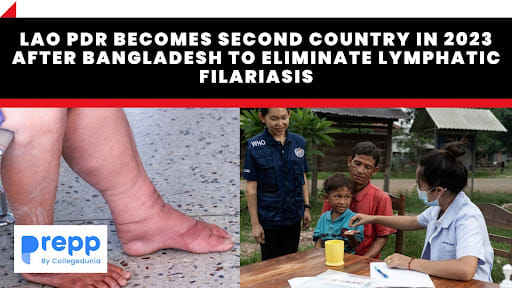
- Recently, the WHO announced that the Lao People’s Democratic Republic had officially eliminated lymphatic filariasis.
- This was the second neglected tropical disease (NTD) eliminated by the country following the elimination of trachoma as a public health hazard in 2017.
Table of Contents
WHO progress report on Lymphatic Filariasis
- The recent WHO progress report on Lymphatic Filariasis (LF) revealed that Lao PDR became the second country to eliminate LF in 2023 after Bangladesh.
- At present, 19 countries have successfully eliminated LF of which 11 belong to the WHO Western Pacific Region, including Lao PDR.
- Four countries in the WHO South-East Asia region - Bangladesh, the Maldives, Sri Lanka, and Thailand - have eliminated LF.
- Two countries in the WHO Africa Region - Malawi and Togo - and one in the WHO Eastern Mediterranean Region - Yemen - have also eliminated the disease.
- The Global Programme to Eliminate Lymphatic Filariasis (GPELF) launched in 2000 has helped reduce the global population requiring LF interventions has decreased by 53% in the last fifteen years.
- According to the WHO report, 10 countries have stopped the National Mass Drug Administration (MDA).
- This is an indicator that Benin, Cameroon, Eritrea, Mali, Sao Tome and Principe, Uganda, Brazil, Dominican Republic, Timor-Leste, and Brunei Darussalam are on the right track but have not yet met the criteria for validation.
- Kenya has also made progress and the country’s MDA strategy can be stopped soon.
Lymphatic Filariasis
|
Mass Drug Administration
- Mass drug administration is the most effective method for halting the transmission of the disease by treating residents of LF-endemic areas.
- The WHO has recommended multiple rounds of MDA, covering around 65% of the population.
- The WHO has recommended a combination of ivermectin, diethylcarbamazine, and albendazole (IDA).
- MDA has enabled more than 935.5 million individuals in 72 LF-endemic countries to receive more than 9.3 billion cumulative treatments since 2000.
- Global disease burden: 794 million people, required MDA for the treatment of LF globally in 2022.
- Only 326 million people or 41% of the 794 million people who needed MDA in 2022, were treated globally.
- Disease burden in India: More than half of the people requiring MDA for the treatment of LF in 2022 were from India.
- However, only 152.2 million people, or 34% received treatment in the country, according to a WHO report.
Elimination of NTDs
- Neglected Tropical Diseases (NTDs) is a term used to describe a group of infections that are most common among marginalized communities in the developing regions of Africa, Asia, and the Americas.
- They are considered “neglected” because they generally receive less funding for research and treatment when compared to tuberculosis, HIV-AIDS, and malaria.
- The elimination of NTDs by 2030 is one of the primary objectives of SDG 3 i.e. health for all.
- Although they are preventable and treatable, they have health, social, and economic consequences on account of their interrelationships with poverty and ecological systems.
- Cause: Pathogens like viruses, bacteria, protozoa, and parasitic worms.
- Affected areas: NTDs are common in tropical areas with inadequate access to clean water or safe human waste disposal systems.
- Examples: snakebite envenomation, scabies, yaws, trachoma, Leishmaniasis, Chagas disease, etc.
- Global NTD scenario: Nearly 1.7 billion people across the world are affected by around 20 NTDs that impact over 1.7 billion people worldwide.
- India also has a large burden of NTDs like kala-azar and lymphatic filariasis and eliminated NTDs like guinea worm, trachoma, and yaws.
- Indian initiatives:
- APELF: The Accelerated Plan for Elimination of Lymphatic Filariasis was launched in 2018 to accelerate efforts towards the elimination of NTDs.
- WHO-supported regional alliance: India, Bangladesh, and Nepal established a regional alliance in 2005 with support from the WHO to fast-track early diagnosis and treatment of vulnerable populations and improve disease surveillance.
WHO Roadmap for NTDs 2021-2030
|
(*Click this link to read prelims specific weekly current affairs articles)
FAQs
Question: What is Mass Drug Administration?
Answer:
Mass drug administration (MDA) is the administration of antimalarial treatment to every member living in a defined geographical area regardless of their disease status at approximately the same time and at repeated intervals.
Question: What is the GPELF?
Answer:
The WHO's Global Programme to Eliminate Lymphatic Filariasis (GPELF), launched in 2000, focuses on stopping infection spread, providing care to affected individuals, and reducing the population needing MDA to zero.
UPSC Mains Practice Question:
|
MCQs
Question: Consider the following statements:
- Tapeworm is a hermaphrodite.
- Round-worm has separate sexes.
- Filaria is caused by a nematode.
- Guinea-worm is an annelid.
Which of these is/are correct? (UPSC CSE 2001)
(a) 1 and 2
(b) 1, 2 and 3
(c) 3 and 4
(d) 2, 3 and 4
Answer: (b) See the Explanation
- Tape worms are hermaphrodites (both male and female reproductive organs are present). Hence statement 1 is correct
- Round worms are unisexual (separate sex). Hence statement 2 is correct.
- Filaria is caused by Wuchereria bancrofti which is a parasitic nematode. Hence statement 3 is correct.
- Guinea worm is a long and very thin nematode, not an annelid. Hence statement 4 is incorrect.
Therefore, option (b) is the correct answer.
Question: Match List-I with List-II and select the correct answer by using the codes given below: (UPSC CSE 1997)
List- I List-II
- Malaria 1. Bone marrow
- Filaria 2. Brain
- Encephalitis 3. Muscle
- Leukaemia 4. Lymph node
- Blood cells
(a) A – 5; B – 3; C – 2; D – 1
(b) A – 5; B – 4; C – 2; D – 1
(c) A – 4; B – 3; C – 5; D – 1
(d) A – 5; B – 4; C – 1; D – 2
Answer: (b) See the Explanation
- Malaria is a parasitic disease that spreads through the sucking of blood through mosquitoes and the invasion of blood cells by parasites.
- The encephalitis virus is most active in the brain.
- The Filaria parasite is found in blood lymph nodes.
- Leukaemia is a cancer that is observed as abnormal cell growth in bone marrow.
Therefore, option (b) is the correct answer.
Question: Consider the following diseases :
- Diphtheria
- Chickenpox
- Smallpox
Which of the above diseases has/have been eradicated in India? (UPSC CSE 2014)
(a) 1 and 2 only
(b) 3 only
(c) 1, 2, and 3
(d) None
Answer: (b) See the Explanation
India has successfully eradicated polio, leprosy, smallpox, yaws, maternal and neonatal tetanus, and rinderpest. Hence statement 3 is correct.
Therefore, option (b) is the correct answer.
Download the PREPP App and attempt FREE IAS Exam Mock Tests and get complete study material!

Full Test - 04: UPSC CSE Prelims CSAT (Paper-II)
Full Test - 03: UPSC CSE Prelims CSAT (Paper-II)
UPSC CSE Prelims 2026 GS Paper 1 Question Paper (24-May-2026)
UPSC CSE Prelims 2026 CSAT Paper 2 Question Paper (24-May-2026)

17 February 2025 | The Hindu Must Read Articles | Current Affairs

16 February 2026 | The Hindu Must Read Articles | Current Affairs

13 February 2026 | The Hindu Must Read Articles | Current Affairs









Comments